Ottoman pillow cover
yastık
late 16th/ early 17th century | Österreichisches Handelsmuseum, Wien
Ottoman pillow cover Cartouches with alternating inverted Persian lettering: mobarak bad (good luck), sa‘adat bad (prosperity). Wealthy Ottomans have a particular liking for pillow covers (yastık) of silk velour (çatma). Bursa, located to the south of Istanbul, is the centre of silk velvet weaving from the 15th until the 17th century. Locally produced silk velvet textiles stitched with gold and silver threads are also popular in Europe. When the Austrian Commercial Museum mounts the first international exhibition of oriental carpets in 1891, historic silk velvet brocades from Bursa are amongst the most important objects displayed.
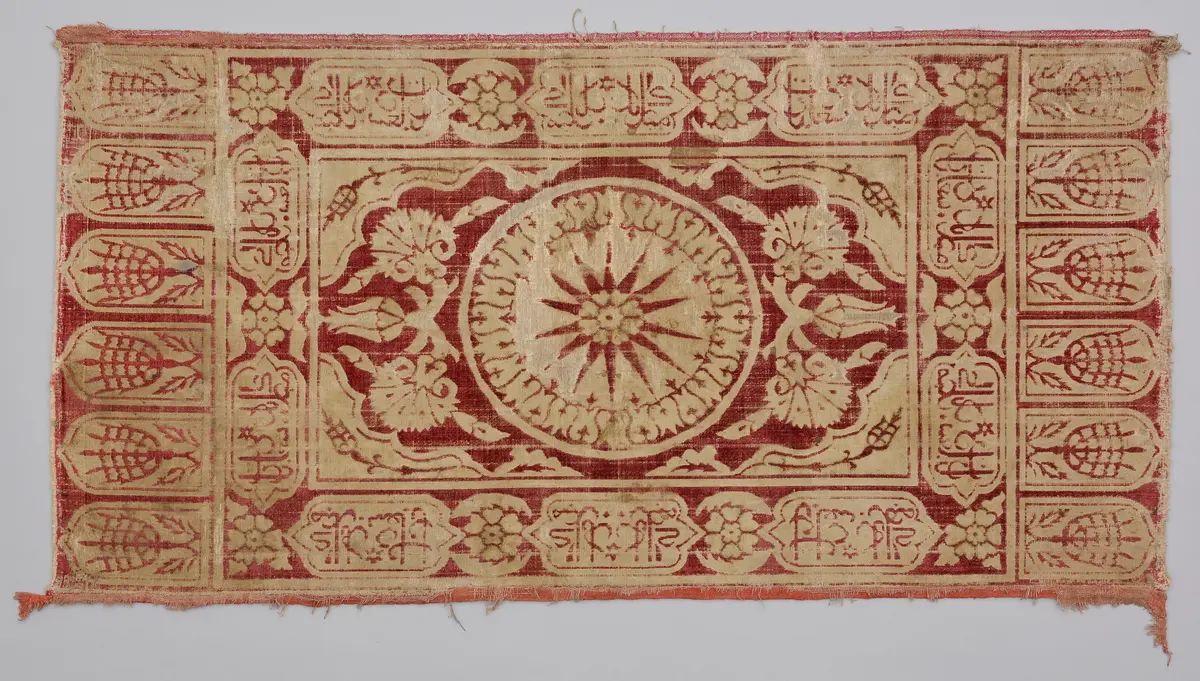
Ottoman pillow cover Cartouches with alternating inverted Persian lettering: mobarak bad (good luck), sa‘adat bad (prosperity). Wealthy Ottomans have a particular liking for pillow covers (yastık) of silk velour (çatma). Bursa, located to the south of Istanbul, is the centre of silk velvet weaving from the 15th until the 17th century. Locally produced silk velvet textiles stitched with gold and silver threads are also popular in Europe. When the Austrian Commercial Museum mounts the first international exhibition of oriental carpets in 1891, historic silk velvet brocades from Bursa are amongst the most important objects displayed.
Collection:
Österreichisches Handelsmuseum, Wien
Collector:
Johann von und zu Liechtenstein
Reference/Institution:
Wiener Weltausstellung (1873) DNB
Time:
late 16th/ early 17th century
Entry Date:
1925
Object Name
Ottoman pillow cover
Culture
Turkey, prob. Bursa
Material/technology:
Silk, cotton, silver threads
Dimensions:
B 61,5 cm × H. 122,5 cm
Copyright
Weltmuseum Wien
Collection area
North Africa, Middle East, Central Asia and Siberia
Invs.
120183