Violin, bow
Gesokesong
Note: The following text is taken from a 19th-century collection catalog and, in its language and perspective, partially reflects colonial thought patterns. We present the text in its original version to make the collection's history transparent and promote a critical examination of the colonial legacy. Certain terms and formulations may be perceived as problematic today. A 2009 research project concluded that most descriptions are factually correct and still usable; only a few details were found to be inaccurate or incorrect. The results of this project were published in the following collection catalog: khm-wmw-tm-library.on.worldcat.org/oclc/1457155265"451 - 452. Violins - "Gesokesong"Two peculiarly built violins which are also used all over the Indian Archipelago. They are called "rebab" in Java. The body is formed from a piece of hollowed out wood, it has a convex form on the underside like a mandolin, the upper side is completely open. A drum skin is stretched across this open part on which rests the little bridge, over which run two thin metal strings, like European violins. The bow is a piece of wood with a bow shape and the hairs, also horsehair, are not tight but hang loose. They are tightened by the hand of the player in such a way that four fingers of his right, playing hand are gripped between the hairs and the bow and by making a fist he holds the hairs away from the bow and also tightens them. One of the present violins is simple and roughly worked, the other, however, is painted red and green and richly decorated with gold painting. Violin playing is an art that only a few of the natives have been able to master to perfection. All night long the naive children of nature can listen quietly to the dreadful scratching of these brown musicians without tiring and if they are asked how they are enjoying the music they will respond in euphoric expressions of their enjoyment. They all consider themselves - at least this is the way they explain it - to be in paradise. It is not necessary to mention that these popular artists are well paid, since violin playing is a gift of God which is not something every mortal possesses. The musicians are admired and stared at as if they were extraordinary beings. It is not possible, not even for the best musicians, to find any regularity in this scratching, not to mention a melody."Translation of: Czurda, F. A. J. (1883). Catalog mit Erklärungen der Etnografischen Privatsammlung des Dr. F. A. J. Czurda in Postelberg (Böhmen). (p. 106-107). Wien, Wilhelm Braumüller
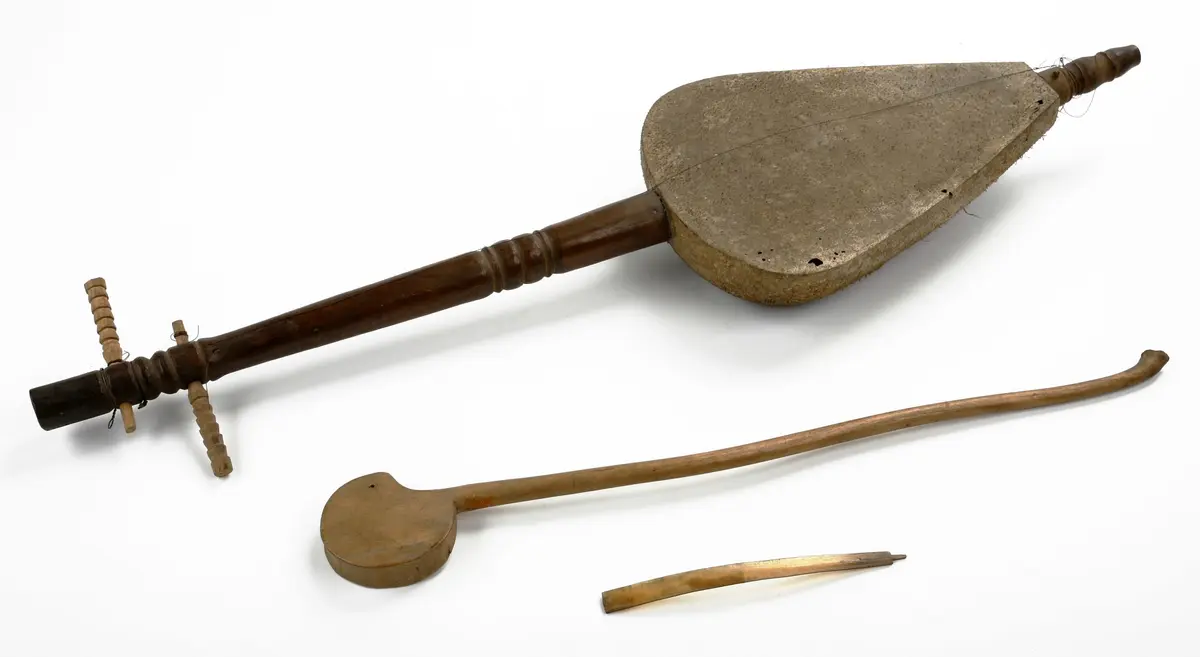
Note: The following text is taken from a 19th-century collection catalog and, in its language and perspective, partially reflects colonial thought patterns. We present the text in its original version to make the collection's history transparent and promote a critical examination of the colonial legacy. Certain terms and formulations may be perceived as problematic today. A 2009 research project concluded that most descriptions are factually correct and still usable; only a few details were found to be inaccurate or incorrect. The results of this project were published in the following collection catalog: khm-wmw-tm-library.on.worldcat.org/oclc/1457155265"451 - 452. Violins - "Gesokesong"Two peculiarly built violins which are also used all over the Indian Archipelago. They are called "rebab" in Java. The body is formed from a piece of hollowed out wood, it has a convex form on the underside like a mandolin, the upper side is completely open. A drum skin is stretched across this open part on which rests the little bridge, over which run two thin metal strings, like European violins. The bow is a piece of wood with a bow shape and the hairs, also horsehair, are not tight but hang loose. They are tightened by the hand of the player in such a way that four fingers of his right, playing hand are gripped between the hairs and the bow and by making a fist he holds the hairs away from the bow and also tightens them. One of the present violins is simple and roughly worked, the other, however, is painted red and green and richly decorated with gold painting. Violin playing is an art that only a few of the natives have been able to master to perfection. All night long the naive children of nature can listen quietly to the dreadful scratching of these brown musicians without tiring and if they are asked how they are enjoying the music they will respond in euphoric expressions of their enjoyment. They all consider themselves - at least this is the way they explain it - to be in paradise. It is not necessary to mention that these popular artists are well paid, since violin playing is a gift of God which is not something every mortal possesses. The musicians are admired and stared at as if they were extraordinary beings. It is not possible, not even for the best musicians, to find any regularity in this scratching, not to mention a melody."Translation of: Czurda, F. A. J. (1883). Catalog mit Erklärungen der Etnografischen Privatsammlung des Dr. F. A. J. Czurda in Postelberg (Böhmen). (p. 106-107). Wien, Wilhelm Braumüller
Collector:
František A. J. Czurda (1844 Pisek - 1886 Cirebon) DNB
Entry Date:
1883
Object Name
Violin, bow
Culture
Süd-Sulawesi, Mallasoro
Material/technology:
Wood, leather, hair
Copyright
Weltmuseum Wien
Collection area
Insular Southeast Asia
Invs.
17697