Jump to navigation Jump to content Jump to contact Jump to search Jump to search Jump to footer

Insular Southeast Asia

The Insular Southeast Asia Collection that comprises objects from the Nicobar and the Andaman Islands as well as states of Malaysia, Brunei, Singapore, Indonesia, Timor Leste, and the Philippines.

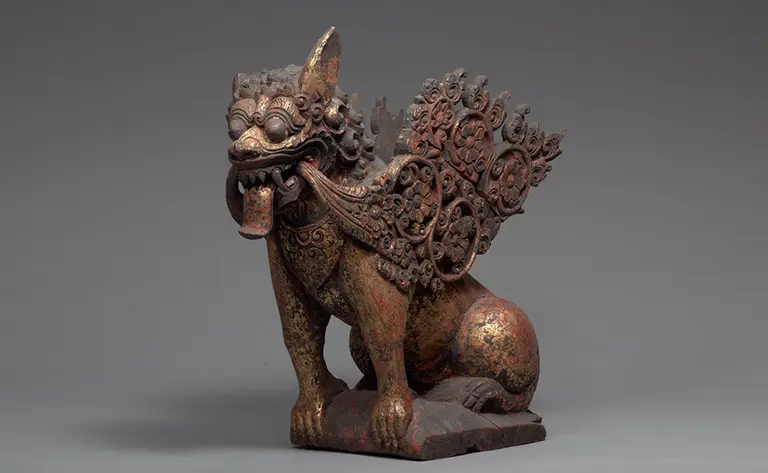
A carved statue of a mythical creature resembling a lion, featuring intricate designs and patterns on its body and wings. The figure sits upright, with a large, expressive face, detailed fur, and a prominent tongue. The statue has a rich finish, possibly made from wood or stone.

About the collection

Today Indonesia is the largest Muslim country in the world. While Malaysia and Brunei have Islam as their official religion, the majority of people in the Philippines and Timor Leste are Catholic. The Nicobar and the Andaman Islands are part of the territory of India, and only accessible to a limited extent.

Insular Southeast Asia is characterised by two exceptional, historical developments: one the one hand, the coastal regions have been shaped by “international” contacts and their repercussions for centuries, while numerous ethnic groups live in remote locations in the interior on the other hand. It is these contrasts that have resulted in a particularly diverse region that is highly appealing not only to experts.

Research projects on the collection

Publications

Danced Creation
Exhibition Catalogue 2013 Danced Creation
Danced Creation
Exhibition Catalogue 2013 Danced Creation

Contact

+43 1 534 30-5052
info@weltmuseumwien.at

History of the collection

In 2017, the Insular Southeast Asia Collection comprises a total of ca. 19,603 objects. The two oldest artefacts can be traced back to the Chamber of Art of Emperor Rudolf II (1607-1611): a wayang klitik figure (wooden puppet), and a kris (dagger). The inventory of the collection has been continuously growing since the mid-19th century until today. 

Many objects came into possession of the Museum from collectors in the military of the 19th century, e.g. army doctors or officers. Even at that time, it was deemed important to document a culture in systematic fashion, which meant assembling a “coherent” collection of objects from various areas of everyday and religious life. This goal was accomplished, for example, by Dr. Frantisek Czurda, a Bohemian army doctor in the service of the Dutch crown in Dutch East India, today’s Indonesia, between 1876 and 1886. In the course of his service, he was relocated several times and could explore a few islands of Indonesia (Sumatra, Java, Sulawesi). Out of Dr. Czurda’s Indonesia Collection of 1,100 objects, ca. 850 are today found at the Weltmuseum Wien, the remaining 250 at the Náprstek Museum Prague. Dr. Czurda described his collection in great detail in his “Catalogue of a Private Ethnographic  Collection” – one of the first ethnographic catalogues in the world – which published in 1883. It is one of the world’s most comprehensive collections on the island of Celebes (today Sulawesi).    

Another remarkable element worth mentioning is the excellent Batak Collection of Karl Maschmeyer (ca. 362 objects, 1900) who not only added the indigenous names to the objects, but also documented them in Batak script. A collection from Borneo was assembled by Felix Isidor Baczes (ca. 383 objects, 1887) who stated, “that my collection comprises almost everything related to the way of life of the Dayak both at home and outside.”

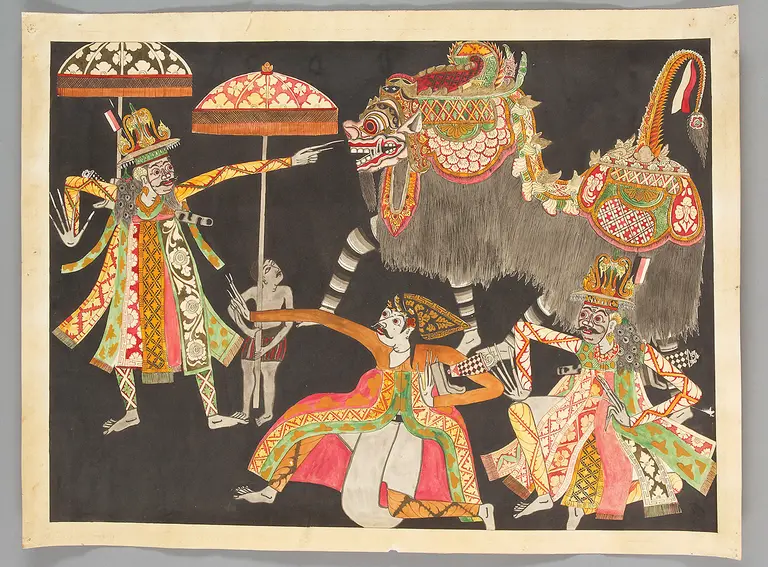
Aside from the systematic collections, the Museum received a multitude of ethnographic objects from expeditions of the Imperial and Royal Monarchy, including the expeditions of the ships “Aurora” and “Novara” as well as the ram cruiser “Kaiserin Elisabeth”, which Archduke Franz Ferdinand of Austria-Este used for his voyage around the world in 1892/1893. The successor to the throne arrived in Ambon, Maluku Islands, the Dutch resident Baron van Hoëvell (1848-1920) presented him with an outstanding collection (ca. 800 objects) as a gift. This category also includes the collections of the two Austrians, Linda Bandara-Hofland (ca. 170 objects, 1962) and Helene Potjewijd (ca. 710 objects, 1946). Both women were Indonesia enthusiasts and added carefully selected objects to the Museum. While the composer Linda Bandara-Hofland had collected numerous beautiful and old batik cloths, Helene Potjewijd assembled a wide range of Balinese artwork.

According to the current acquisition strategy, the Museum seeks to add contemporary objects on the issues of “marriage”, “China diaspora”, “batik”, and “toys” to the collection.

Further collections and departments