Sarong, Batik
Sarung
Zweite Hälfte des 19. Jh. | František A. J. Czurda
Note: The following text is taken from a 19th-century collection catalog and, in its language and perspective, partially reflects colonial thought patterns. We present the text in its original version to make the collection's history transparent and promote a critical examination of the colonial legacy. Certain terms and formulations may be perceived as problematic today. A 2009 research project concluded that most descriptions are factually correct and still usable; only a few details were found to be inaccurate or incorrect. The results of this project were published in the following collection catalog: khm-wmw-tm-library.on.worldcat.org/oclc/1457155265"614 - 622. SarongsThe same size as the previous ones, the designs are mostly multi-colored and not so finely executed; mostly coarser work both in the drawing as in the colors. The large surfaces are covered with a uniform design and the head, "kapala" is also multi-colored with horizontal zigzags. These sarongs are worn in West Java, and often worn by the European women; mostly made on Batavia."Translation of: Czurda, F. A. J. (1883). Catalog mit Erklärungen der Etnografischen Privatsammlung des Dr. F. A. J. Czurda in Postelberg (Böhmen). (p. 155). Wien, Wilhelm Braumüller
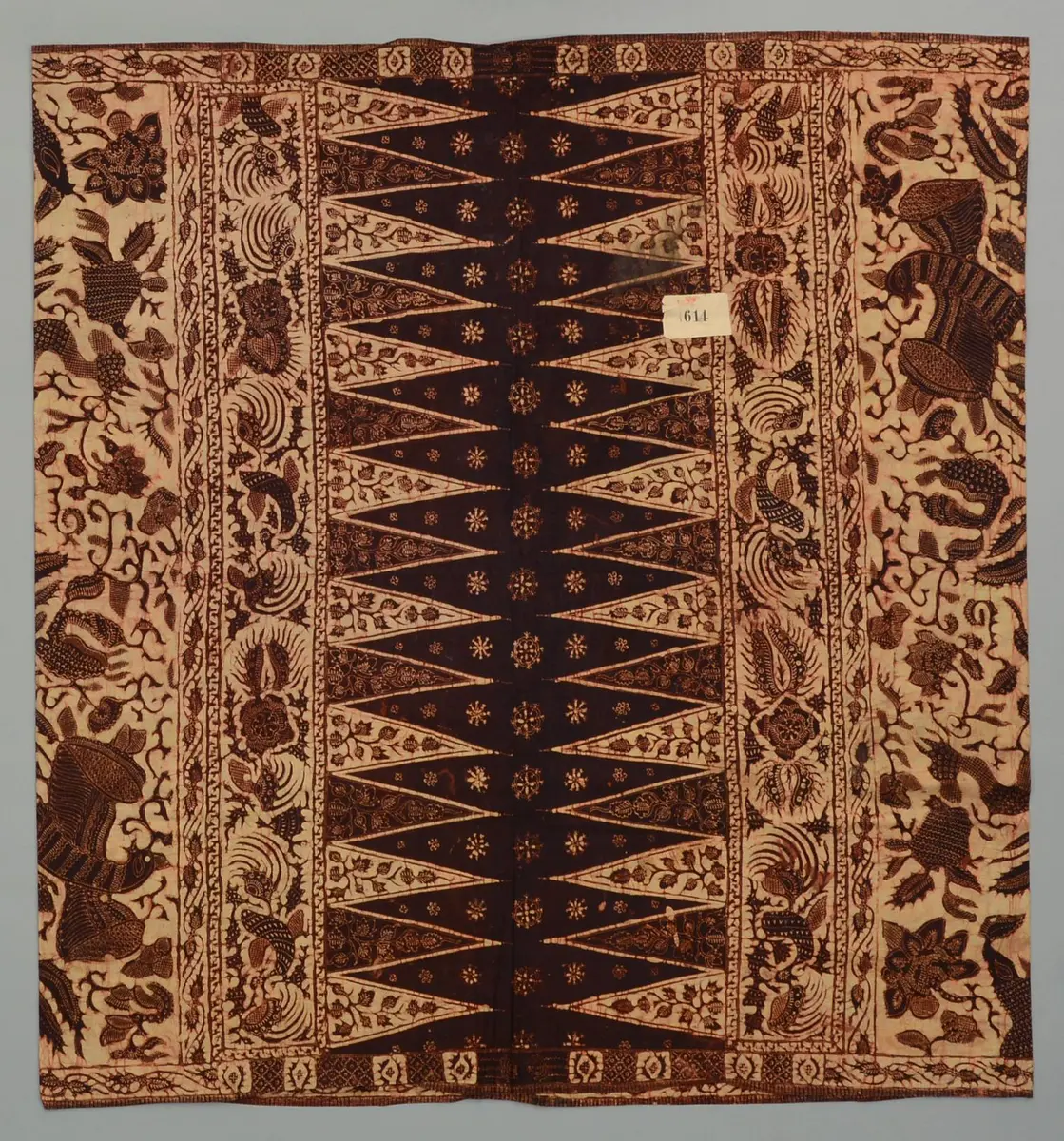
Note: The following text is taken from a 19th-century collection catalog and, in its language and perspective, partially reflects colonial thought patterns. We present the text in its original version to make the collection's history transparent and promote a critical examination of the colonial legacy. Certain terms and formulations may be perceived as problematic today. A 2009 research project concluded that most descriptions are factually correct and still usable; only a few details were found to be inaccurate or incorrect. The results of this project were published in the following collection catalog: khm-wmw-tm-library.on.worldcat.org/oclc/1457155265"614 - 622. SarongsThe same size as the previous ones, the designs are mostly multi-colored and not so finely executed; mostly coarser work both in the drawing as in the colors. The large surfaces are covered with a uniform design and the head, "kapala" is also multi-colored with horizontal zigzags. These sarongs are worn in West Java, and often worn by the European women; mostly made on Batavia."Translation of: Czurda, F. A. J. (1883). Catalog mit Erklärungen der Etnografischen Privatsammlung des Dr. F. A. J. Czurda in Postelberg (Böhmen). (p. 155). Wien, Wilhelm Braumüller
Sammler/in:
František A. J. Czurda (1844 Pisek - 1886 Cirebon) DNB
Zeit:
Zweite Hälfte des 19. Jh.
Zugangsdatum:
1883
Objektbezeichnung
Sarong, Batik
Kultur
Peranakan / West-Java
Material/Technik:
Baumwolle, Leinwandbindung, Reservedruck, Wachsbatik, Naturfarben
Bildrecht
Weltmuseum Wien
Sammlungsbereich
Insulares Südostasien
Inv. Nr.
18028