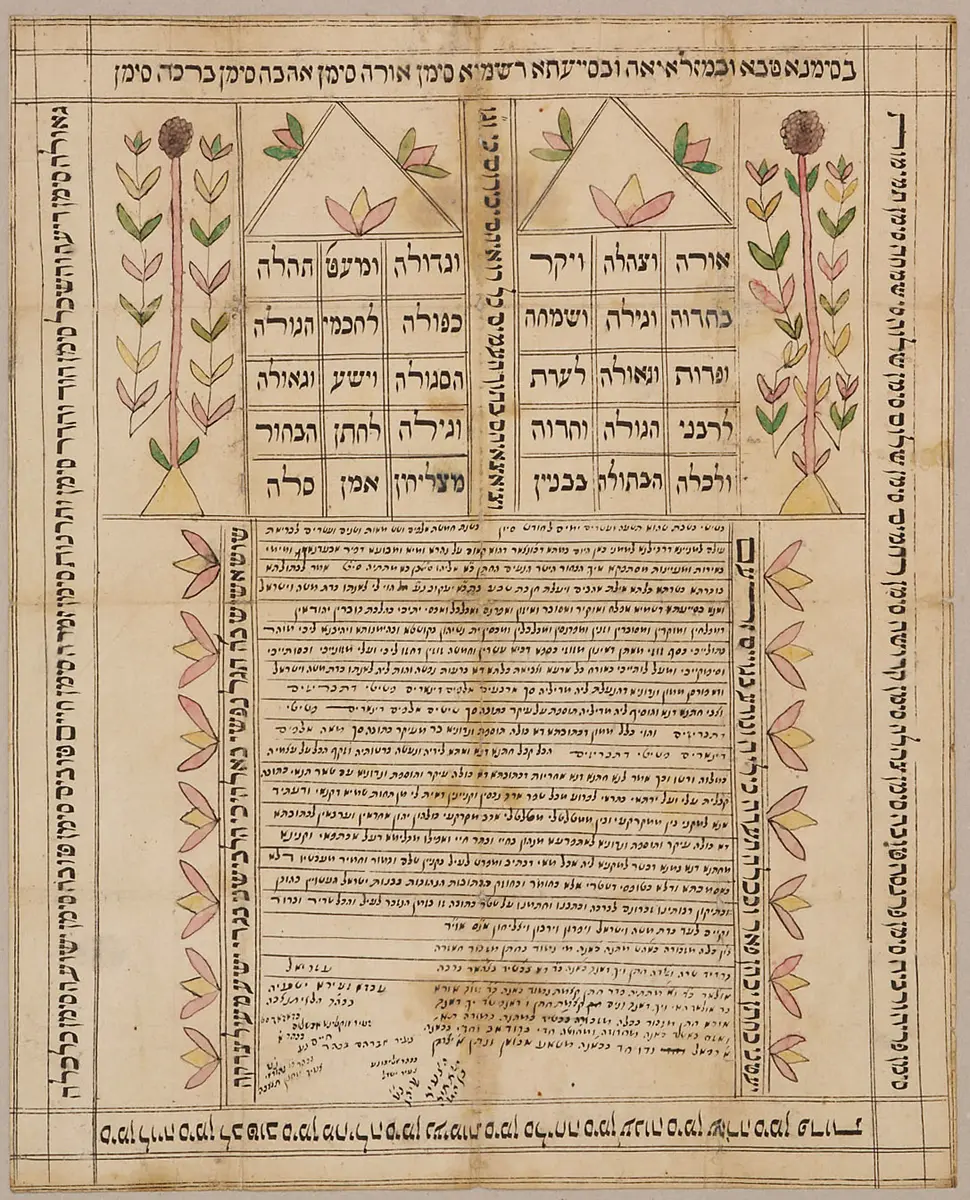
Jüdische Eheurkunde
ketubba
5622 (AD 1862) | Alfred Janata
„Ihre Nachkommen werden bei allen Nationen bekannt sein / und ihre Kinder in allen Völkern. Jeder, der sie sieht, wird erkennen: / Das sind die Nachkommen, die der Herr gesegnet hat.
Von Herzen will ich mich freuen über den Herrn. / Meine Seele soll jubeln über meinen Gott. Denn er kleidet mich in Gewänder des Heils, / er hüllt mich in den Mantel der Gerechtigkeit, wie ein Bräutigam sich festlich schmückt / und wie eine Braut ihr Geschmeide anlegt.“ (Jesaja, Kapitel 61, 9–10)
Die Ketubba (hebräisch „das Geschriebene“) ist die jüdische Eheurkunde, die die Verpflichtung des Ehemannes (lat. donatio propter nuptias) enthält, der Ehefrau im Falle einer Scheidung oder seines Todes eine bestimmte Summe auszuzahlen bzw. auszahlen zu lassen. Er wird in aramäischer Sprache verfasst und von zwei Zeugen unterschrieben. Ihr Ursprung geht wohl auf den biblischen Kaufpreis, den Mohar, zurück, den der Bräutigam anfänglich dem Vater der Braut bezahlte (Exodus 22, 16). Die Ketubba bedeutete für die Frau eine wesentliche Sicherung ihrer Ansprüche in einer Zeit, da die Ehescheidung ohne oder gegen ihren Willen vom Ehemann erzwungen werden konnte.
Im – größtenteils festgelegten – Wortlaut der abgebildeten Ketubba wurde zum Eintragen der Namen, des Datums und anderer Einzelheiten, die sich ändern, Platz ausgespart. Oberhalb und seitlich des Standardtextes wurde die Eheurkunde mit stilisierten Blüten (rosa, gelb, grün und violett) verziert. Am Kopfsteg des Blattes steht ein aramäischer Segensspruch, an den äußeren Blattkanten hebräische Bibelverse (Jes. 61, 9 und 61,10). Als Name des Bräutigams wurde Elijahu ben Matitja(hu), als Name der Braut Batscheva bat Ja’akov vermerkt. In der Urkunde wurde zudem festgehalten, dass zum Brautpreis von 40.000 (kleinen?) Dinar der Bräutigam noch zusätzliche 60.000 Dinar entrichtet habe. Am unteren Blattrand findet sich noch ein Zusatz in Judeo-Persisch zum aramäischen Standardtext.
Sammlung:
Alfred Janata (1933 Wien - 1993 Wien)
Sammlung:
Irmgard Janata
Zeit:
5622 (AD 1862)
Zugangsdatum:
1987
Objektbezeichnung
Jüdische Eheurkunde
Kultur
Iran, Khwansar; Juden
Material/Technik:
Papier, Tinte, Pigment
Maße:
H. 44 cm, B. 35,5 cm
Bildrecht
Weltmuseum Wien
Sammlungsbereich
Nordafrika, Vorder- und Zentralasien, Sibirien
Inv. Nr.
169129