Nyenchen Thanglha
19. Jahrhundert | René Nebesky-Wojkowitz
If the sacred mountains are depicted as war deities, they are equipped with bow and arrow, and wear suits of armour. At the upper edge of the canvas, we find gods and high lamas of erudite Buddhism as reference to the integration of these originally pre-Buddhist deities into the divine world of Buddhism. The lower edge shows offerings for the deity at the centre of the painting, and figures from his entourage. Nyenchen Thanglha is among the most popular sacred mountains in Tibet. He protects Mount Marpori in Lhasa, home of the Dalai Lama’s Potala Palace, and dwells in one of its many temples. Portrayed above Nyenchen Thanglha, Guru Rinpoche subdued the god and bound him under oath to protect Buddhism.
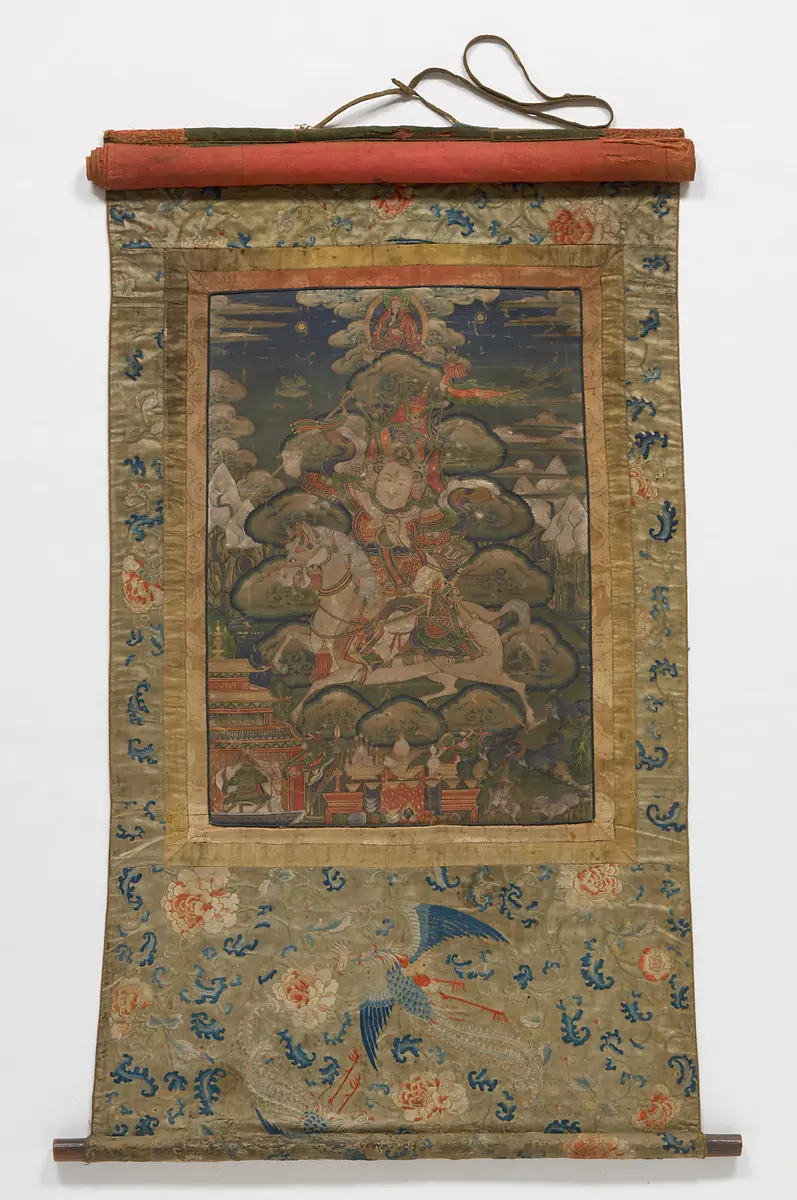
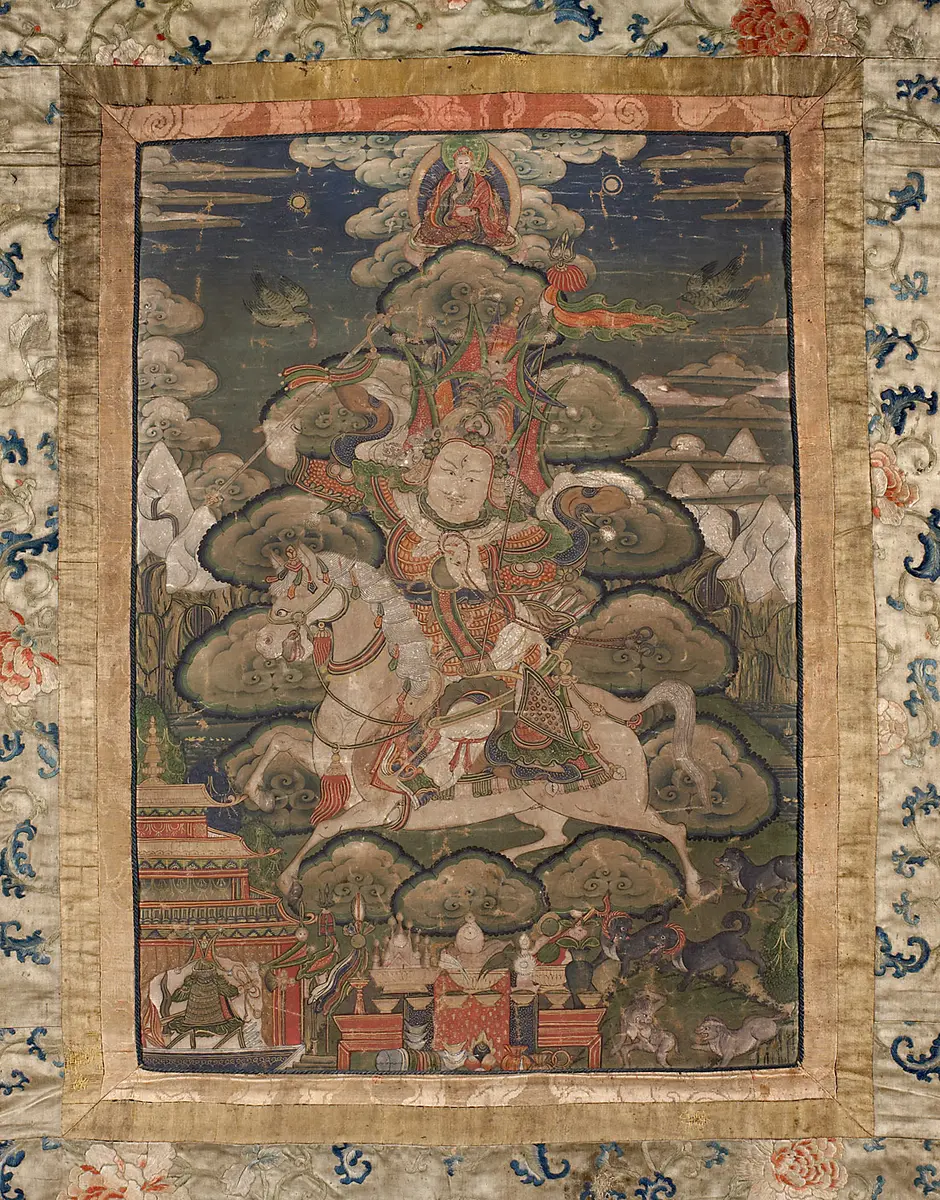
If the sacred mountains are depicted as war deities, they are equipped with bow and arrow, and wear suits of armour. At the upper edge of the canvas, we find gods and high lamas of erudite Buddhism as reference to the integration of these originally pre-Buddhist deities into the divine world of Buddhism. The lower edge shows offerings for the deity at the centre of the painting, and figures from his entourage. Nyenchen Thanglha is among the most popular sacred mountains in Tibet. He protects Mount Marpori in Lhasa, home of the Dalai Lama’s Potala Palace, and dwells in one of its many temples. Portrayed above Nyenchen Thanglha, Guru Rinpoche subdued the god and bound him under oath to protect Buddhism.
Sammlung:
René Nebesky-Wojkowitz (1923 Groß-Hoschütz - 1959 Wien) DNB
Zeit:
19. Jahrhundert
Zugangsdatum:
1953
Objektbezeichnung
Nyenchen Thanglha
Kultur
Tibet
Material/Technik:
Bildfeld: Mineralfarbe auf Leinwand
Rahmung: Seidensatin mit Nadelmalerei (Seide) bestickt und 2 Rahmenstreifchen direkt um das Bild aus gelbem Seidensatin und orangem Damast
2 Vorhänge: breitere Vorhang aus roter Wildseide, schmälerer Vorhang aus grüner Wildseide(?), beide in Leinwandbindung
Futter: Baumwolle, Leinwandbindung
2 Holzstäbe, an der Oberkante ein schmaler rechteckiger Holzstab, an der Unterkante ein runder Holzstab
Bildrecht
Weltmuseum Wien
Sammlungsbereich
Süd-, SO-Asien, Himalaya
Geographie
Südasien/Himalaya/Tibet
Inv. Nr.
134447