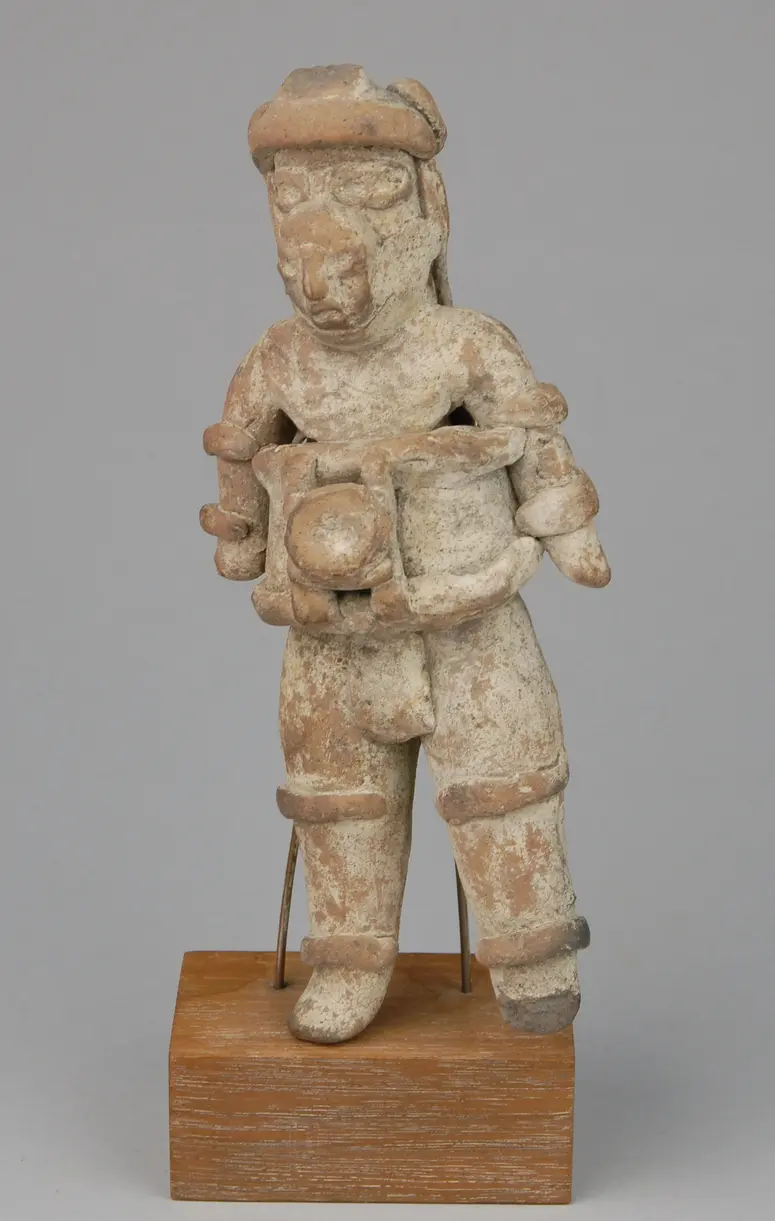
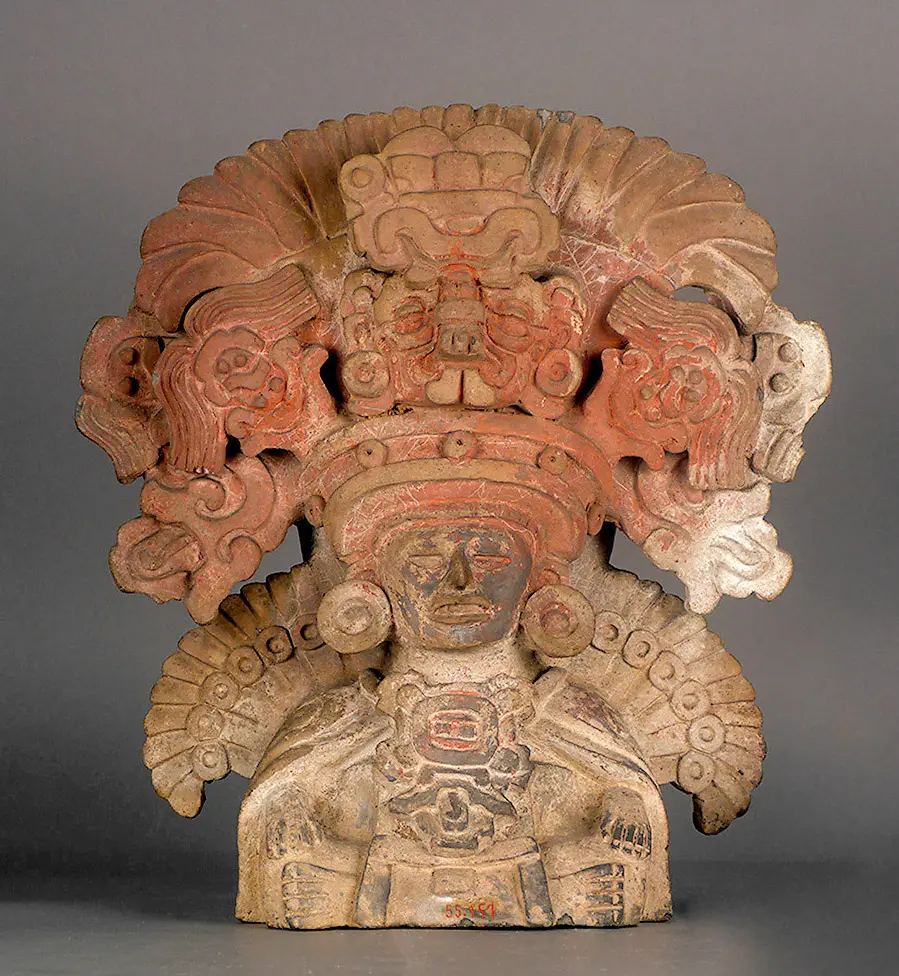
Verehrter Vorfahr, im Kopfschmuck Cocijo, Regen-Blitz-Donnergott, und Mais
350-600? | L. Guillaume
Die Figur zeigt den jungen Maisgott. Mais war das Hauptnahrungsmittel der vorspanischen Kulturen in Mesoamerika und galt daher als heilige Pflanze. Der Maisgott sitzt mit verschränkten Beinen am Boden, seine Hände ruhen auf den Knien. Auf dem Haupt trägt er einen riesigen kunstvollen Kopfschmuck. In der Mitte des Kopfschmucks können Sie die Maske des zapotekischen Regengottes Cocijo sehen. Er sorgt dafür, dass die Erde genug Wasser erhält und dass der Mais wächst. Charakteristisch für den Regengott sind die brillenartigen Ringe um die Augen. Aus seinem Mund ragt eine gespaltene Schlangenzunge. Der Regengott trägt ebenfalls einen Kopfschmuck, der von der Glyphe C gebildet wird. Als Glyphen bezeichnet man die Bild- und Silbenzeichen der Zapoteken-Schrift. Die Glyphe C, die Sie hier als Kopfschmuck des Regengottes sehen, stellt zugleich ein Wassergefäß als auch einen stilisierten Jaguarkopf dar. Links und rechts der Maske des Regengottes können Sie Maiskolben erkennen, die wiederum auf den Maisgott verweisen. Außer seinem riesigen Kopfschmuck trägt der Maisgott Ohrscheiben, einen Brustschmuck, ein Cape und einen Lendenschurz. Über seinen Schultern ragen fächerartig arrangierte Federn hervor, an denen der junge Gott zu lehnen scheint. Die einzelnen Bestandteile der Figur wurden zuerst mit Modeln hergestellt, dann zusammengefügt. Keramikfiguren wie diese sind charakteristisch für die klassische zapotekische Kultur von Monte Albán in Mexiko. Monte Albán liegt in der Nähe der heutigen Stadt Oaxaca und bildete zwei Jahrtausende lang das wichtigste religiöse und politische Zentrum im Süden Mexikos.
Sammlung:
L. Guillaume
Sammlung:
Georg Haas (1841 Schlaggenwald - 1914 Schloss Mostau, Westböhmen) DNB
Zeit:
350-600?
Zugangsdatum:
1895
Objektbezeichnung
Verehrter Vorfahr, im Kopfschmuck Cocijo, Regen-Blitz-Donnergott, und Mais
Material/Technik:
Keramik
Bildrecht
Weltmuseum Wien
Sammlungsbereich
Nord- und Mittelamerika
Inv. Nr.
55157