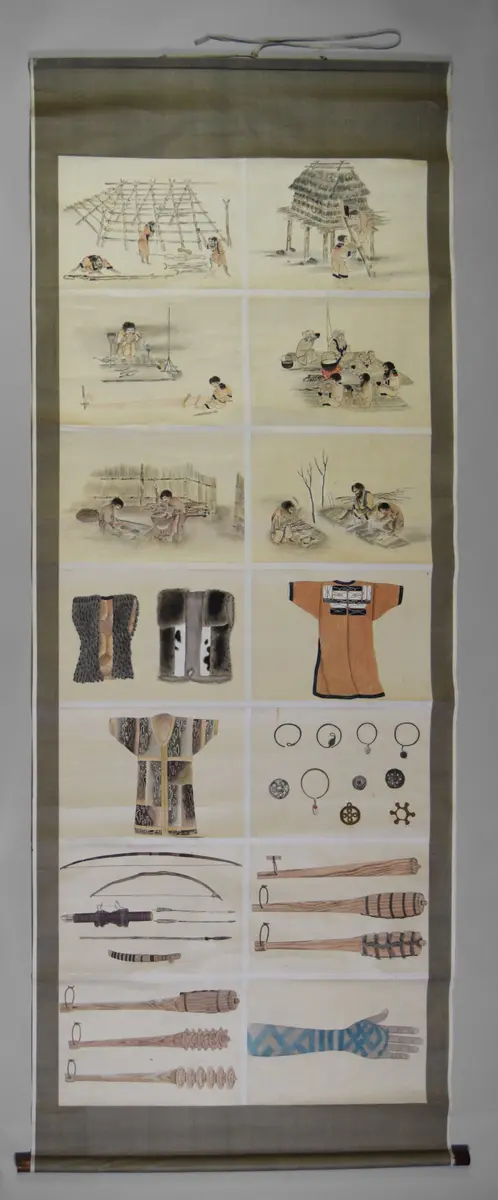
Objects and scenes of daily life of the Ainu, mounted on a long scroll kakemono
kakemono Ainu no kibutsu to setaiga 掛物: アイヌの器物と世態画
The exhibited objects of the Ainu, a population group from the Hokkaido, Kuril and Sakhalin islands, belong to the circumpolar habitat and cultural region. At the beginning of the Meiji period (1868-1912), in about 1876, a number of western researchers became increasingly interested in the way of life of these people, which was based on hunting, fishing and gathering. Their social and political position in Japan in the 21st century is comparable to that of the First Nations and Native Americans in North America.
The exhibited objects of the Ainu, a population group from the Hokkaido, Kuril and Sakhalin islands, belong to the circumpolar habitat and cultural region. At the beginning of the Meiji period (1868-1912), in about 1876, a number of western researchers became increasingly interested in the way of life of these people, which was based on hunting, fishing and gathering. Their social and political position in Japan in the 21st century is comparable to that of the First Nations and Native Americans in North America.
Time:
ca. 1878
Entry Date:
1997
Object Name
Objects and scenes of daily life of the Ainu, mounted on a long scroll kakemono
Culture
Ainu
Material/technology:
Paper, wood, ink, paint
Copyright
Weltmuseum Wien
Collection area
East Asia: China, Korea, Japan
Geography
Ostasien/Japan
Period
Meiji Period (1868-1912)
Invs.
176768
Provenance
Die beiden Rollen aus dem Besitz Heinrich von Siebold (Die Darstellungen auf den Rollen werden in seiner Publikation verwendet) kamen in die Sammlung des Handelsmuseums ( Inv. Nr. : 16431). Nach Auflösung des Handelsmuseums im Jahr 1907 gelangten Teile der Siebold Sammlung in das Museum für angewandte Kunst (MAK), das Technische Museum und die anthroplogisch-ethnographische Abteilung des k.k. Naturhistorischen Museums..
Die beiden Längsrollen kamen in die Sammlung des MAK ( Incv. Nr. : Or 3240) und im Jahr 2003 durch eine Tauschaktion in den Bestand des Museum für Völkerkunde