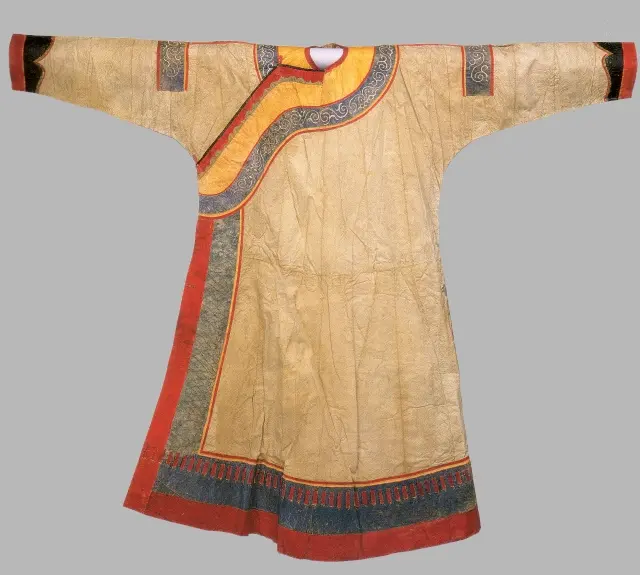
Women's festive coat
before 1899 | Adolph Traugott Dattan
Towards the end of the 19th century, the increasing pressure of competition amongst the museums of natural sciences leads to a race for superlative objects from beyond Europe. The Department of Anthropology and Ethnography at the Natural Court History Museum also desires to expand its collection inventory as quickly as possible. At the same time ethnologists lament the “Europeanisation” of the cultures they study. “Gaps in the collection” must be filled in rapidly. Since the existing funds are not sufficient for large-scale purchases for the collection, patrons should enable the expansion of the collection inventory. Members of the upper classes, thirsting for high honours, supply the museum with large amounts of funding, in order “politely and humbly” to request an aristocratic title or at least a “sovereign distinction”. At the turn of the 20th century, the German-Russian entrepreneur in Vladivostok Adolph Traugott Dattan (1854–1924) is in search of prestige. Between 1897 and 1905 he donates to the Natural Court History Museum 787 objects from the Amur River peoples in the Russian Far East. In April 1903 Dattan obtains the desired Officer's Cross of the Order of Franz Joseph I.
Towards the end of the 19th century, the increasing pressure of competition amongst the museums of natural sciences leads to a race for superlative objects from beyond Europe. The Department of Anthropology and Ethnography at the Natural Court History Museum also desires to expand its collection inventory as quickly as possible. At the same time ethnologists lament the “Europeanisation” of the cultures they study. “Gaps in the collection” must be filled in rapidly. Since the existing funds are not sufficient for large-scale purchases for the collection, patrons should enable the expansion of the collection inventory. Members of the upper classes, thirsting for high honours, supply the museum with large amounts of funding, in order “politely and humbly” to request an aristocratic title or at least a “sovereign distinction”. At the turn of the 20th century, the German-Russian entrepreneur in Vladivostok Adolph Traugott Dattan (1854–1924) is in search of prestige. Between 1897 and 1905 he donates to the Natural Court History Museum 787 objects from the Amur River peoples in the Russian Far East. In April 1903 Dattan obtains the desired Officer's Cross of the Order of Franz Joseph I.
Collection:
Adolph Traugott Dattan (1854 Rudersdorf - 1924 Naumburg)
Time:
before 1899
Entry Date:
1899
Object Name
Women's festive coat
Material/technology:
Salmon skin, pigment, fibre, plastic
Dimensions:
L. 107 cm, W. 135 cm (across arms)
Copyright
Weltmuseum Wien
Collection area
North Africa, Middle East, Central Asia and Siberia
Geography
Nordasien/Russland/Sibirien/Chabarowsk
Invs.
64225