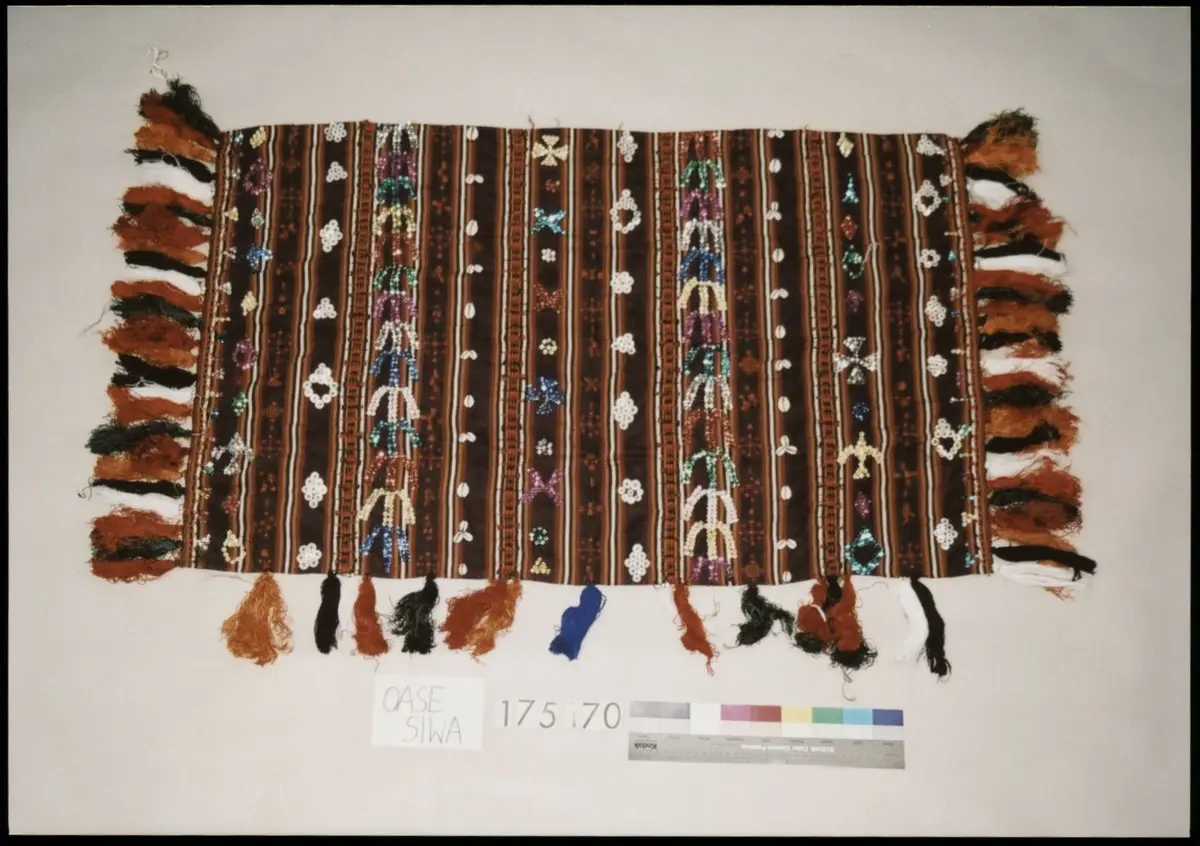
Reichhaltig mit Kunstseidengarn (schwarz, rot, grün, orange) nach herkömlicher Musterpalette bestickter, im Handel erworbener bunt gestreifter Stoff (violett, orange, weiß). Die parallel zur Schmalseite des Tuches verlaufenden Motive der fadengestickten Ornamentbänder werden in Applikationen aus Pailletten, Perlmuttknöpfe und Kaurischalen wiederholt. An der Längs- bzw. den beiden Schmalseiten bunte Quasten aus grüner, roter, dunkelroter und oranger Kunstseide bzw. schwarzer, weißer und (einmal längsseitig in der Mitte) blauer Wolle. In seinen besonders opulent gearbeiteten Varianten gilt das truq'et als Bestandteil der Braut- oder Festtagskleidung.Angaben der Sammlerin: “Truket n’akbir el harir [sic!], silk scarf striped mainly red with rich silk embroidery, sequence, mother of pearl buttons and cowry shells, worn with the black marriage dress ‘asherah nahuak on the 7th day of the marriage ceremony shemata. A square piece, letjneb, of the scarf worn by the married women on the black dress akbir nwassa. Aisha Mellem has been embroidering most of it and her neighbour Sem Sem added some of the rich decoration, which took over two years. It was interrupted by festivities and mourning of both families during this period. The scarf is now very seldom worn compared to the green silk scarf worn with the marriage dress worn until today. Aisha is still living with her son Driss at her parents house, maybe to get married to a good Siwan man with no children.”
Lit.: Monika Humer, Frauenhandwerk im Wandel. Das Beispiel von Siwa, in: Archiv für Völkerkunde 47, S. 47-66. Frank Bliss, Siwa - die Oase des Sonnengottes, Bonn: PAS, 1998, S. 189-195.
Collector:
Bettina Leopoldo
Collector:
Leonardo Leopoldo
Entry Date:
1994
Culture
Berber
Material/technology:
Kunstseidengarn, Pailletten, Perlmuttknöpfe, Kaurischalen
Dimensions:
L. 135 cm, B. 80 cm
Copyright
Weltmuseum Wien
Collection area
North Africa, Middle East, Central Asia and Siberia
Geography
Nordafrika/Nilländer/Ägypten/Oase Siwa
Invs.
175170