Bodhisattva
4. Jahrhundert n. Chr. | Kunsthistorisches Museum Wien, Wien
This figure from the late period of Gandhara art is difficult to interpret iconographically, as the figure holds the attributes of two different bodhisattvas. The lotus blossom in the right hand refers to Avalokiteshvara, the vial in the left to Maitreya. Such iconographic hybrids are usually found on steles depicting Buddhist paradises in which various bodhisattvas are grouped around a preaching Buddha.Divine manifestations of Buddhism were first depicted by craftsmen in Gandhara. Gandhara, the ancient name for an area in what is now northwest Pakistan, also denotes the style of the earliest Buddhist art. Cultural influences that spread along the trade routes between India, Iran and the Roman Orient shaped these religious works. After Alexander the Great's campaign, a state influenced by Hellenism flourished in Gandhara, whose kings founded Buddhist institutions and promoted their art. The figure is a prime example of this early globalization, as the drapery of the clothing is clearly influenced by the art of ancient Greece.
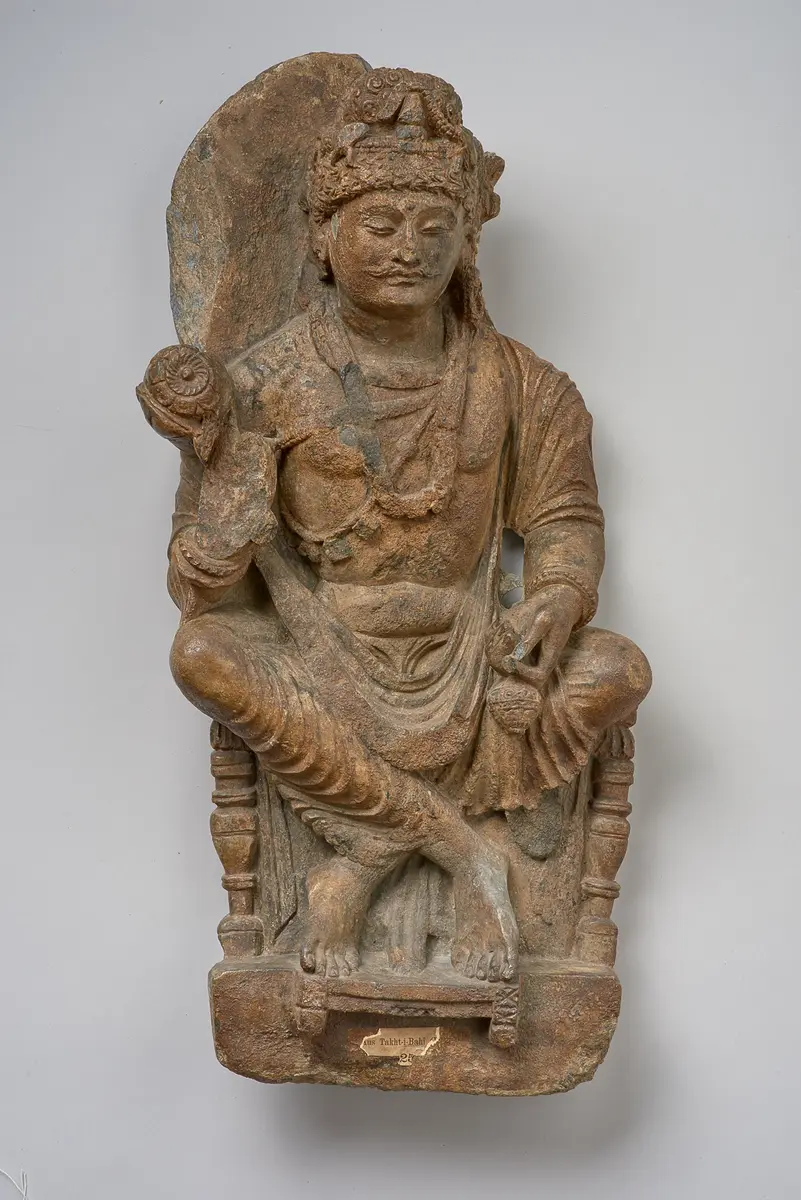
This figure from the late period of Gandhara art is difficult to interpret iconographically, as the figure holds the attributes of two different bodhisattvas. The lotus blossom in the right hand refers to Avalokiteshvara, the vial in the left to Maitreya. Such iconographic hybrids are usually found on steles depicting Buddhist paradises in which various bodhisattvas are grouped around a preaching Buddha.Divine manifestations of Buddhism were first depicted by craftsmen in Gandhara. Gandhara, the ancient name for an area in what is now northwest Pakistan, also denotes the style of the earliest Buddhist art. Cultural influences that spread along the trade routes between India, Iran and the Roman Orient shaped these religious works. After Alexander the Great's campaign, a state influenced by Hellenism flourished in Gandhara, whose kings founded Buddhist institutions and promoted their art. The figure is a prime example of this early globalization, as the drapery of the clothing is clearly influenced by the art of ancient Greece.
Collector:
Kunsthistorisches Museum Wien, Wien DNB
Time:
4. Jahrhundert n. Chr.
Object Name
Bodhisattva
Culture
Gandhara / Pakistan
Material/technology:
Schiefer
Copyright
Weltmuseum Wien
Collection area
South Asia, Southeast Asia, Himalayas
Geography
Südasien/Subkontinent/Pakistan
Invs.
126005