Buddha
15th/16th century | Carl Bock
Buddha sits on a small throne with his legs crossed, which is the most common form of depiction in Thailand. With his right hand, he invokes the earth goddess as a witness to his victory over Mara. Mara is considered the king of desire and thus the personification of death, as it is the desire for existence that binds man in the cycle of rebirths.The concept of l'art pour l'art, of art for art's sake, as an essential element of Western culture in no way corresponds to the nature of such statues; rather, they are aimed at the experience of the mystical presence of a deity. The aesthetic quality is not seen as a value in itself. The Thai word silpa, which comes closest to our understanding of art, rather means "manual skill", the "artist" is a "skilful craftsman". Statues give divine beings exactly the body that is described in detail in the sacred texts. The creator of these manifestations of the divine must follow these specifications to the letter; there is no artistic licence.
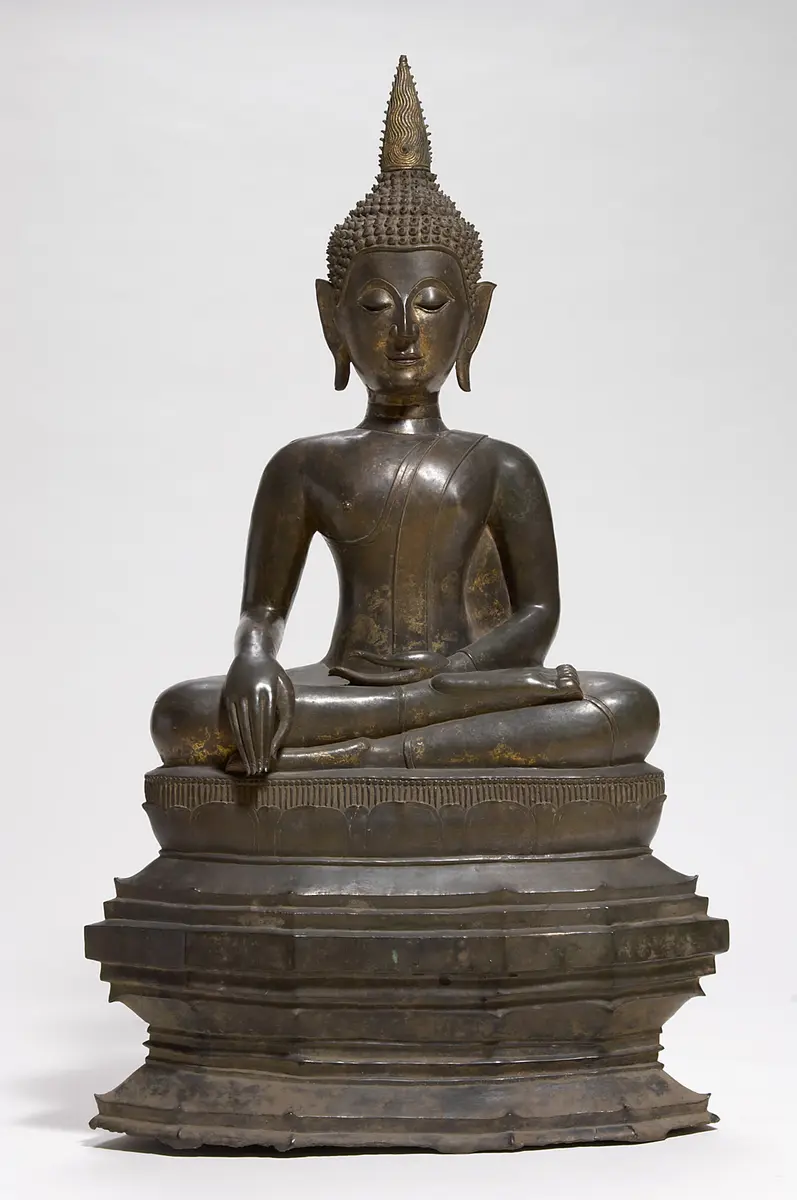
Buddha sits on a small throne with his legs crossed, which is the most common form of depiction in Thailand. With his right hand, he invokes the earth goddess as a witness to his victory over Mara. Mara is considered the king of desire and thus the personification of death, as it is the desire for existence that binds man in the cycle of rebirths.The concept of l'art pour l'art, of art for art's sake, as an essential element of Western culture in no way corresponds to the nature of such statues; rather, they are aimed at the experience of the mystical presence of a deity. The aesthetic quality is not seen as a value in itself. The Thai word silpa, which comes closest to our understanding of art, rather means "manual skill", the "artist" is a "skilful craftsman". Statues give divine beings exactly the body that is described in detail in the sacred texts. The creator of these manifestations of the divine must follow these specifications to the letter; there is no artistic licence.
Time:
15th/16th century
Entry Date:
1883
Object Name
Buddha
Culture
Thailand
Material/technology:
Bronze
Copyright
Weltmuseum Wien
Collection area
South Asia, Southeast Asia, Himalayas
Geography
Südostasien/Festland/Laos/Muang Fang
Invs.
19066