Dagger
18th/19th century | Franz Ferdinand von Österreich-Este
The wooden scabbard is covered with nickel silver plates. The parts are held together all around by silver rails worked in openwork silver. Both ends of the rails are attached to a cuff of the same design. The silver openwork shows floral vine motifs into which a long, slender dragon has been worked, emphasized by a gold lapel inlay. A number of Buddhist auspicious motifs are also incorporated. The front of the scabbard and the handle are also covered with plates of the same design and choice of motif. The slender pointed blade is sharpened on both sides. The thrusting weapon most likely originates from the Himalayan kingdom of Bhutan, which is famous for these daggers.
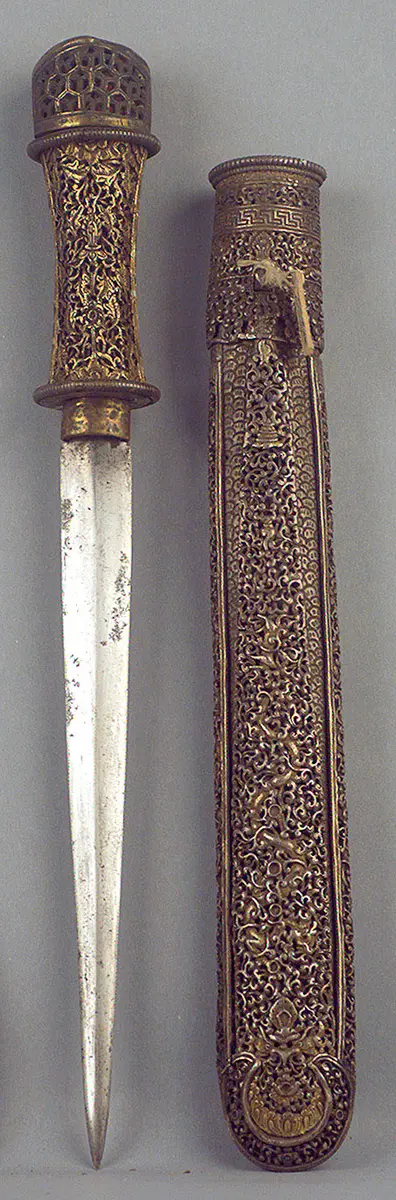
The wooden scabbard is covered with nickel silver plates. The parts are held together all around by silver rails worked in openwork silver. Both ends of the rails are attached to a cuff of the same design. The silver openwork shows floral vine motifs into which a long, slender dragon has been worked, emphasized by a gold lapel inlay. A number of Buddhist auspicious motifs are also incorporated. The front of the scabbard and the handle are also covered with plates of the same design and choice of motif. The slender pointed blade is sharpened on both sides. The thrusting weapon most likely originates from the Himalayan kingdom of Bhutan, which is famous for these daggers.
Collection:
Franz Ferdinand von Österreich-Este (1863 Graz - 1914 Sarajevo) DNB
Time:
18th/19th century
Object Name
Dagger
Culture
Bhutan
Material/technology:
Steel, nickel silver
Copyright
Weltmuseum Wien
Collection area
South Asia, Southeast Asia, Himalayas
Geography
Südasien/Himalaya/Bhutan
Invs.
103286_ab