Ivory Tusk with Relief Carving
mid-18th - mid-19th century | William Downing Webster
This Carved Altar Tusk is part of the historical collections from the Benin Kingdom, in present-day Nigeria. In 1897, the kingdom was conquered and Oba (king) Ovonramwen banned into exile. The loot from the royal palace was then sold through the art market to finance the conquest in retrospect. Many of these objects today constitute European collections. Through its provenance, this Carved Altar Tusk can be directly linked with the events of 1897.
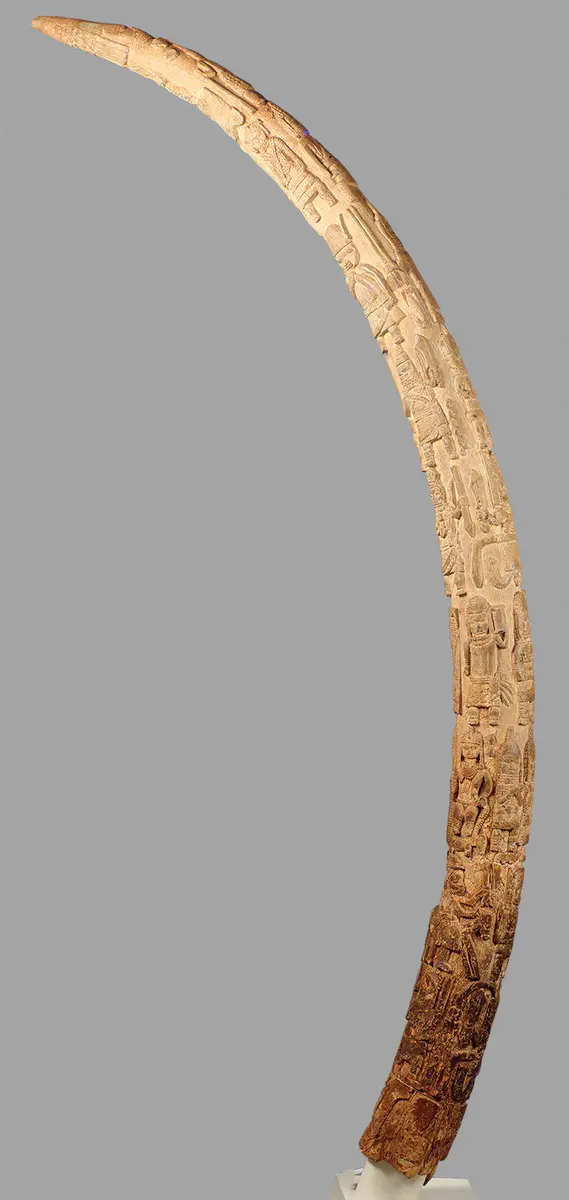
This Carved Altar Tusk is part of the historical collections from the Benin Kingdom, in present-day Nigeria. In 1897, the kingdom was conquered and Oba (king) Ovonramwen banned into exile. The loot from the royal palace was then sold through the art market to finance the conquest in retrospect. Many of these objects today constitute European collections. Through its provenance, this Carved Altar Tusk can be directly linked with the events of 1897.
Collection:
William Downing Webster (1868 - 1913) DNB
Accession via:
Georg Haas (1841 Schlaggenwald - 1914 Schloss Mostau, Westböhmen) DNB
Time:
mid-18th - mid-19th century
Entry Date:
1899
Object Name
Ivory Tusk with Relief Carving
Culture
Edo, Benin Kingdom
Material/technology:
Ivory
Copyright
Weltmuseum Wien
Collection area
Sub-Saharan Africa
Invs.
64659