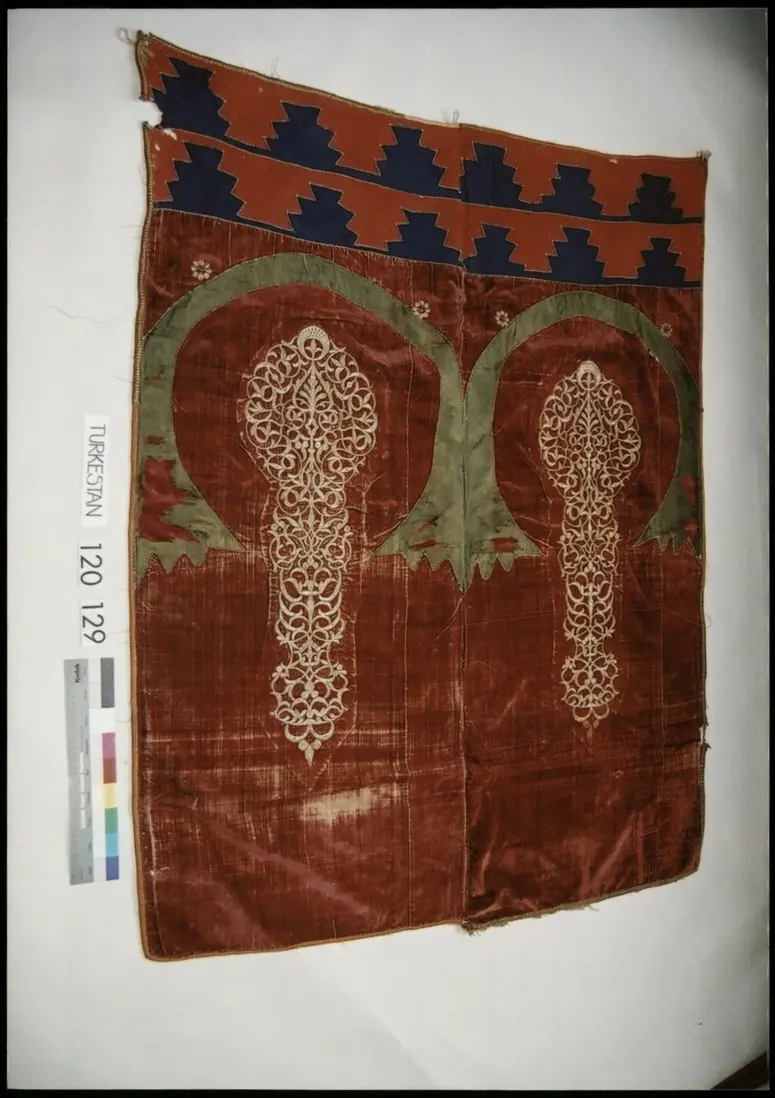
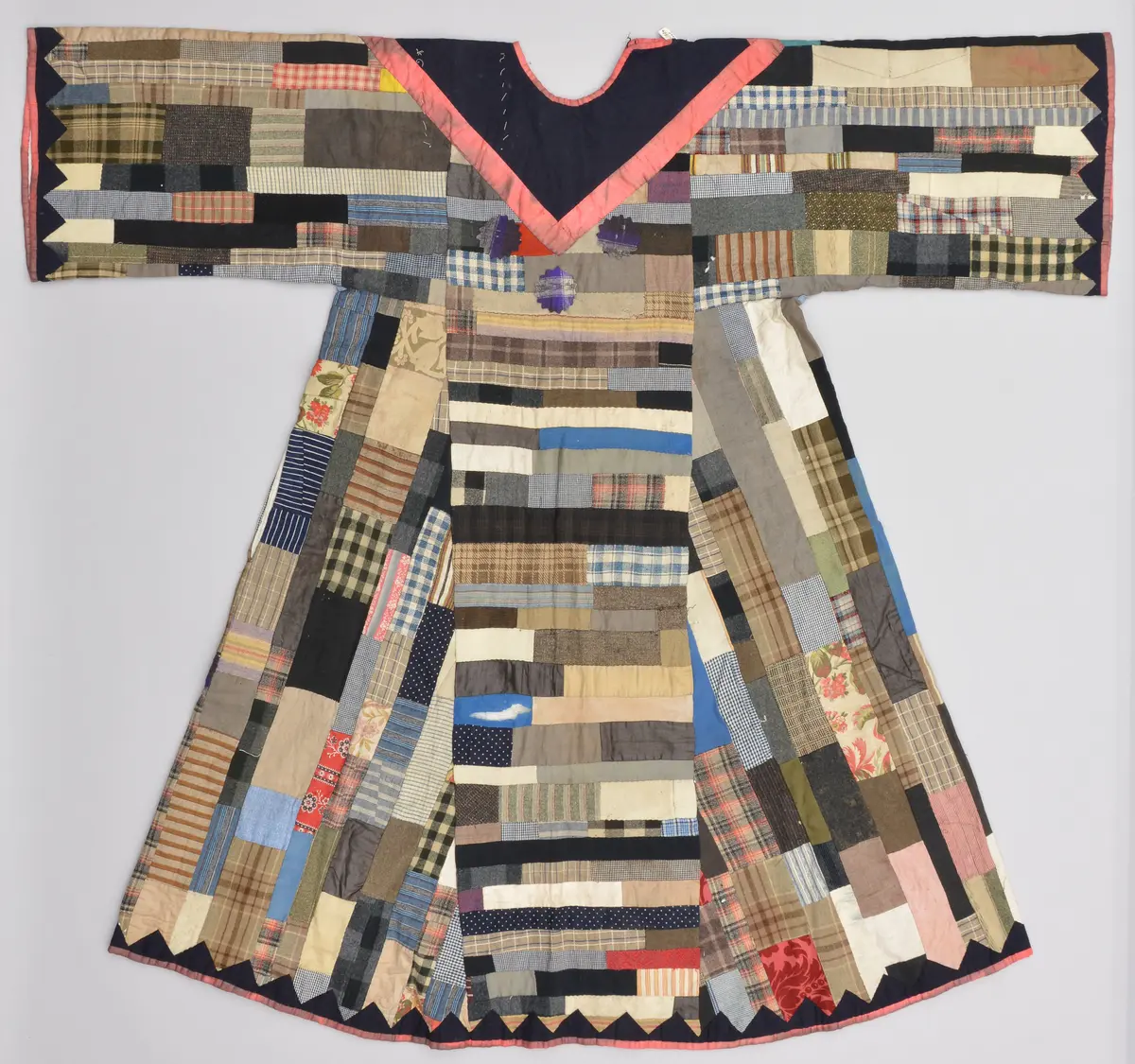
Rag costume of a dervish
hirqa
before 1925 | Österreichisches Handelsmuseum, Wien
In the twenty-first century a Sufi wears completely normal daily clothing and is, therefore, not externally distinguishable from his surroundings. Once upon a time, an individual who wanted to lead the life of a mystic and had renounced the world donned a robe of rough wool and was identified as a Sufi, derived from the Arabic word for wool, ṣūf. Admission into a brotherhood took place by means of a particular ceremony, at the end of which the novice was dressed in the clothing of a dervish, the hirqa; these are differentiated by colour and style from brotherhood to brotherhood. Often this garment was stitched together out of numerous patches. And it is also related that such patched robes were preferably sewn out of rags that the Sufis had torn out of their garments in ecstasy. The tattered clothing of the Sufis expresses poverty. Yet it is somehow also reminiscent of the colourful costume of a harlequin, with his vivid lozenge-shaped stripes. It seems as if the rambling fool of God in the Commedia dell'arte had slipped into the role of the half-clownish, half-demonic prankster, in order to expose the structures and mechanisms of society, attracting ridicule and disdain upon himself. Spirituality and humour are not mutually exclusive. Both can be understood as effective attempts to reveal the complex and paradox situations of which real life is so full.
In the twenty-first century a Sufi wears completely normal daily clothing and is, therefore, not externally distinguishable from his surroundings. Once upon a time, an individual who wanted to lead the life of a mystic and had renounced the world donned a robe of rough wool and was identified as a Sufi, derived from the Arabic word for wool, ṣūf. Admission into a brotherhood took place by means of a particular ceremony, at the end of which the novice was dressed in the clothing of a dervish, the hirqa; these are differentiated by colour and style from brotherhood to brotherhood. Often this garment was stitched together out of numerous patches. And it is also related that such patched robes were preferably sewn out of rags that the Sufis had torn out of their garments in ecstasy. The tattered clothing of the Sufis expresses poverty. Yet it is somehow also reminiscent of the colourful costume of a harlequin, with his vivid lozenge-shaped stripes. It seems as if the rambling fool of God in the Commedia dell'arte had slipped into the role of the half-clownish, half-demonic prankster, in order to expose the structures and mechanisms of society, attracting ridicule and disdain upon himself. Spirituality and humour are not mutually exclusive. Both can be understood as effective attempts to reveal the complex and paradox situations of which real life is so full.
Collector:
Österreichisches Handelsmuseum, Wien
Reference/Institution:
Wiener Weltausstellung (1873) DNB
Time:
before 1925
Entry Date:
1925
Object Name
Rag costume of a dervish
Culture
Iraq
Material/technology:
Cotton
Dimensions:
H. 127 cm, W. 140.5 cm
Copyright
Weltmuseum Wien
Collection area
North Africa, Middle East, Central Asia and Siberia
Geography
Westasien/Vorderer Orient/Irak
Invs.
120123_a