Ritual helmet
19./20. Jahrhundert | René Nebesky-Wojkowitz
The helmet is worn by Newar priests (Vajracârya) when performing religious rites. Vajracaryas are Buddhist tantric priests who perform religious rituals for the lay population.The 5 Dhyani Buddhas are depicted in 5 flaming auroras on the front, the top of the helmet is adorned with half a vajra, the symbol of true reality in Buddhism.The guru of the Vajracarya priests, Vajrasattva, symbolizes the Absolute in Buddhism.When the priest wears this headdress, he merges with the cosmic basic principle and the divine essence.Nevertheless, pre-Buddhist shamanistic elements play an important role in religious practice, especially in life cycle rituals. The use of ritual head coverings made of metal points to shamanistic roots.
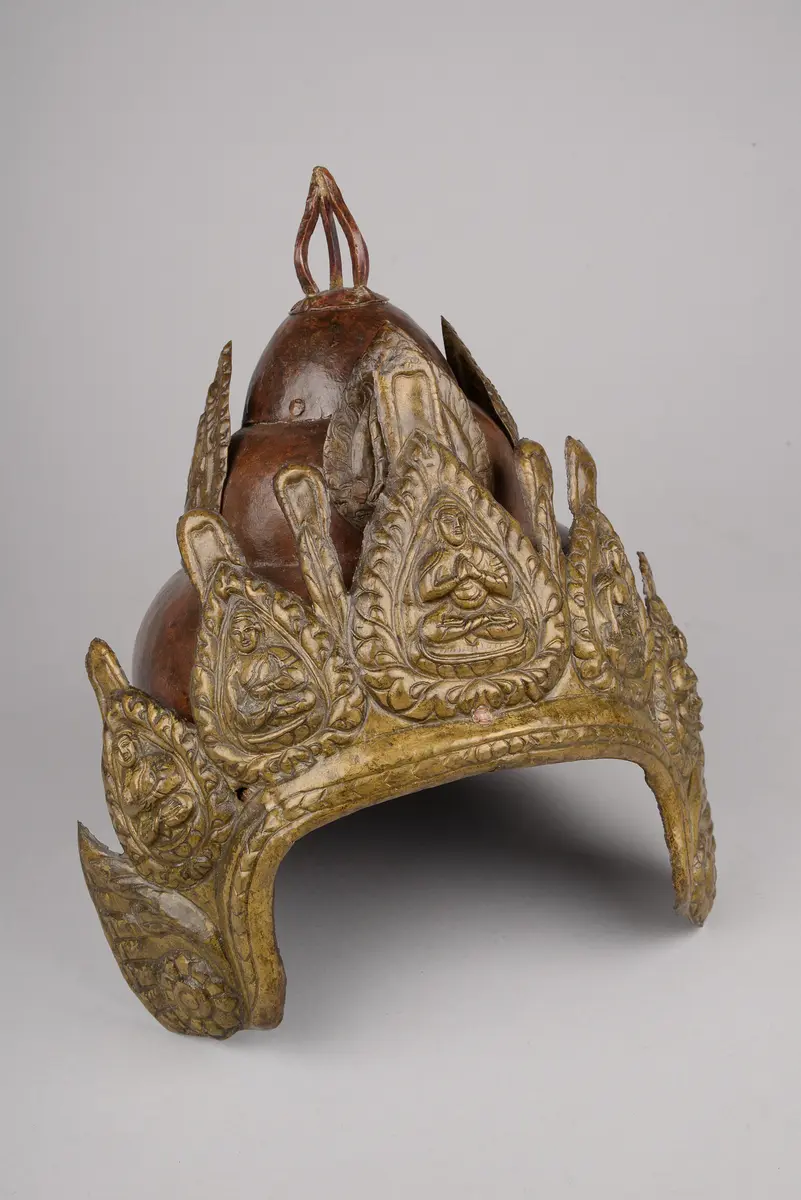
The helmet is worn by Newar priests (Vajracârya) when performing religious rites. Vajracaryas are Buddhist tantric priests who perform religious rituals for the lay population.The 5 Dhyani Buddhas are depicted in 5 flaming auroras on the front, the top of the helmet is adorned with half a vajra, the symbol of true reality in Buddhism.The guru of the Vajracarya priests, Vajrasattva, symbolizes the Absolute in Buddhism.When the priest wears this headdress, he merges with the cosmic basic principle and the divine essence.Nevertheless, pre-Buddhist shamanistic elements play an important role in religious practice, especially in life cycle rituals. The use of ritual head coverings made of metal points to shamanistic roots.
Collector:
René Nebesky-Wojkowitz (1923 Groß-Hoschütz - 1959 Wien) DNB
Time:
19./20. Jahrhundert
Object Name
Ritualhelm
Culture
Nepal, Newar
Material/technology:
Kupfer, Messingblech
Copyright
Weltmuseum Wien
Collection area
South Asia, Southeast Asia, Himalayas
Geography
Südasien/Himalaya/Nepal
Invs.
136903