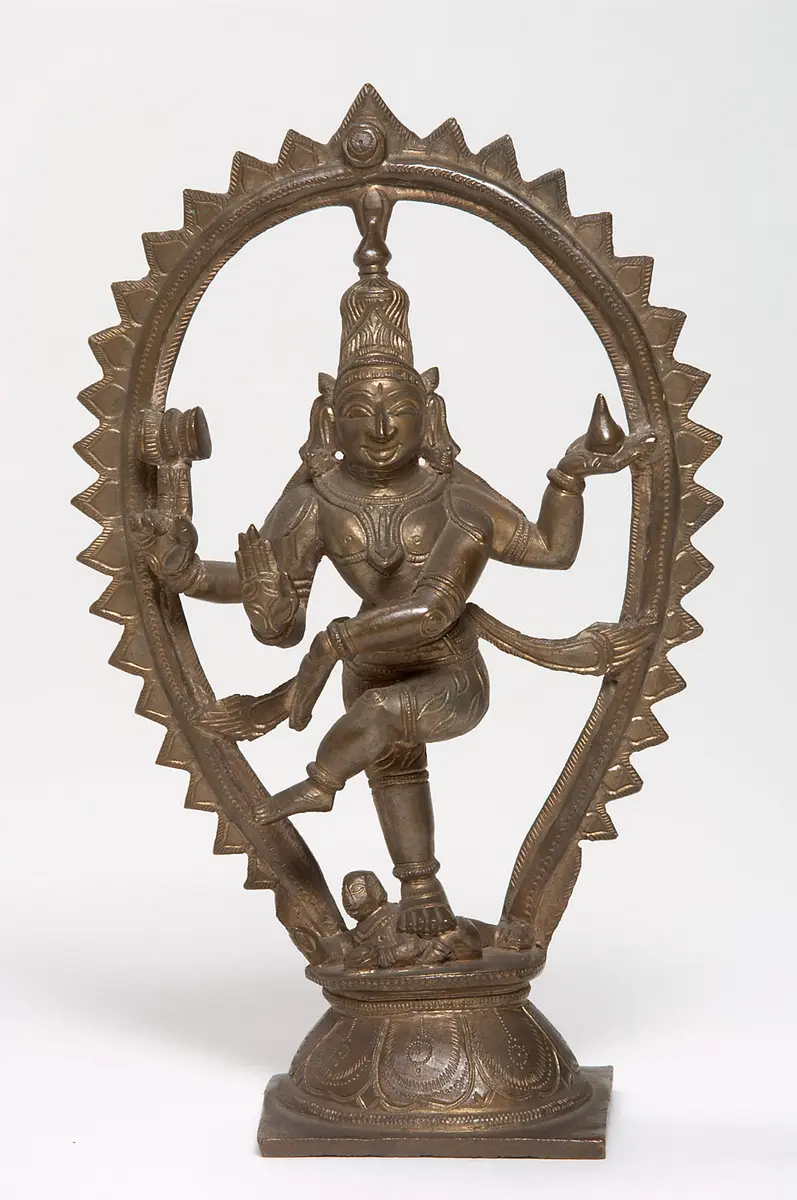
Shiva Nataraja
18. Jahrhundert | Charles Eugène Aubry-Lecomte
Vishnu is worshipped as the upholder of the established order of the world and the universe. When, in the succession of infinite ages, the earth repeatedly comes to the brink of destruction, evil in the form of mythological demons increasingly gains the upper hand. Now it is up to Vishnu, as the embodiment of good, to confront the demon ruler and reinstate the rule of the gods in order to save the earth from destruction. To this end, he is active in various incarnations around the world.
The attributes in his two upraised hands express aspects of his nature. The discus (sudarshana) in his raised right hand symbolizes both Vishnu's destructive ability as an offensive weapon of early warfare and also stands for the eternal rotation of the world and continuous change and ultimately for the cosmic/ethical order itself. Like Shiva, he also rules over time. The conch shell (panchajanyam) in his raised left hand symbolizes the act of creation. The sound of the conch shell is also considered to be the first manifestation of the Absolute in the empirical world. Many believe that whoever touches it immediately attains wisdom. As Vishnu avoids extremes in his nature, he enjoys great popularity. He is also regarded as the god of love and emotion.
Vishnu is worshipped as the upholder of the established order of the world and the universe. When, in the succession of infinite ages, the earth repeatedly comes to the brink of destruction, evil in the form of mythological demons increasingly gains the upper hand. Now it is up to Vishnu, as the embodiment of good, to confront the demon ruler and reinstate the rule of the gods in order to save the earth from destruction. To this end, he is active in various incarnations around the world.
The attributes in his two upraised hands express aspects of his nature. The discus (sudarshana) in his raised right hand symbolizes both Vishnu's destructive ability as an offensive weapon of early warfare and also stands for the eternal rotation of the world and continuous change and ultimately for the cosmic/ethical order itself. Like Shiva, he also rules over time. The conch shell (panchajanyam) in his raised left hand symbolizes the act of creation. The sound of the conch shell is also considered to be the first manifestation of the Absolute in the empirical world. Many believe that whoever touches it immediately attains wisdom. As Vishnu avoids extremes in his nature, he enjoys great popularity. He is also regarded as the god of love and emotion.
Collector:
Charles Eugène Aubry-Lecomte (1821 Paris - 1898 Paris) DNB
Time:
18. Jahrhundert
Object Name
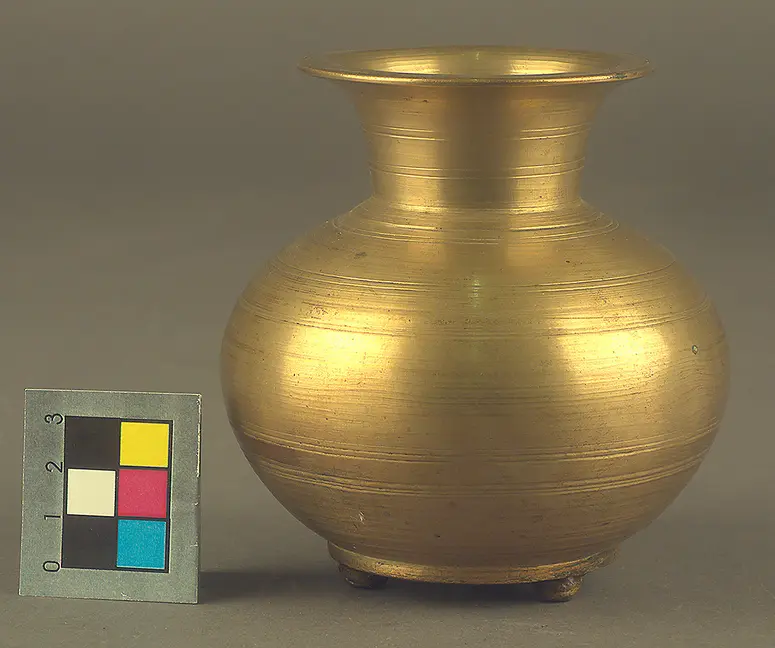
Shiva Nataraja
Culture
Indien
Material/technology:
Bronze
Copyright
Weltmuseum Wien
Collection area
South Asia, Southeast Asia, Himalayas
Geography
Südasien/Subkontinent/Indien
Invs.
8931