Skullcup (nang mchod thod pa)
In the "inner sacrifice", five liquids and five types of flesh symbolize the meditator. The meditator offers himself as a sacrifice. After a purification ritual, he performs a visualization in which he forms a skull bowl from the syllable OM, in the middle of which is a red lotus flower with eight petals and a germinal syllable on each. The triangular stand represents the sacrificial fire. It heats and purifies the liquids and flesh in the skull bowl. He stirs with a ritual dagger (phur bu) until it melts into all the ingredients and everything takes on the "pure color of the moon".
The three heads at the corners of the stand represent the three basic evils - ignorance, hatred and jealousy - which must be overcome.
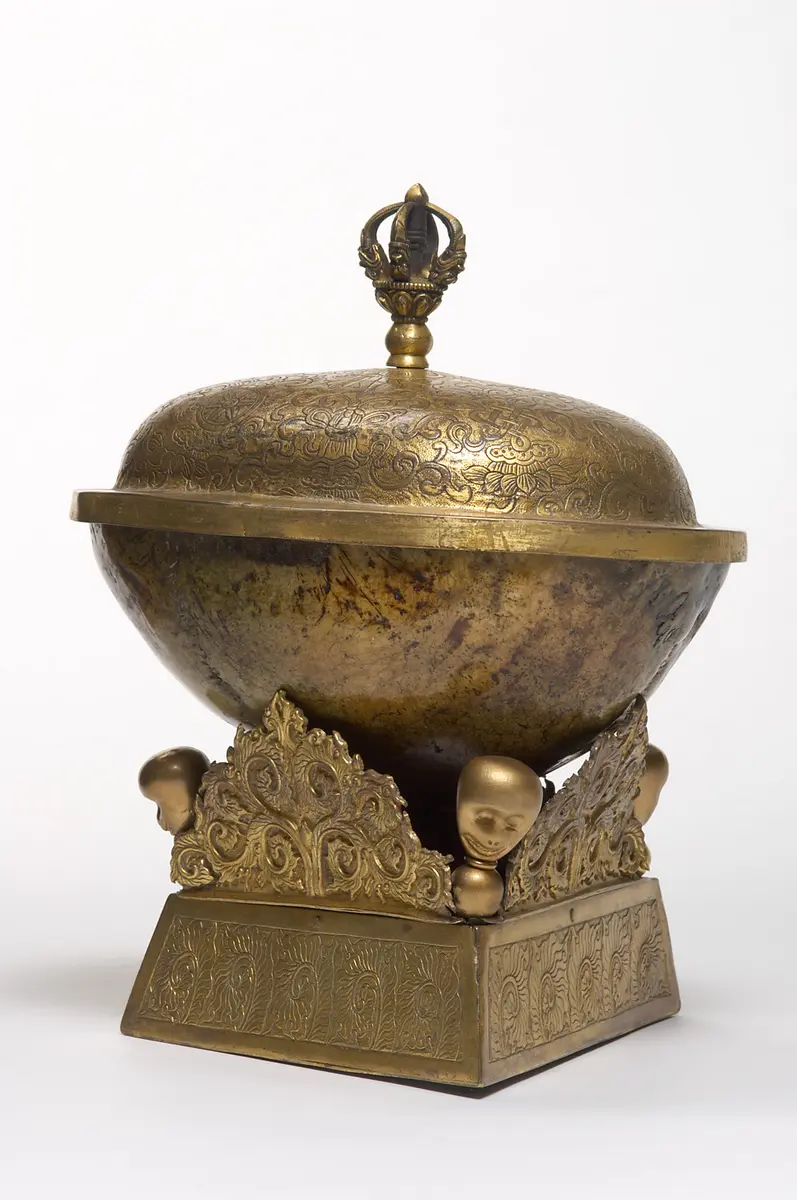
In the "inner sacrifice", five liquids and five types of flesh symbolize the meditator. The meditator offers himself as a sacrifice. After a purification ritual, he performs a visualization in which he forms a skull bowl from the syllable OM, in the middle of which is a red lotus flower with eight petals and a germinal syllable on each. The triangular stand represents the sacrificial fire. It heats and purifies the liquids and flesh in the skull bowl. He stirs with a ritual dagger (phur bu) until it melts into all the ingredients and everything takes on the "pure color of the moon".
The three heads at the corners of the stand represent the three basic evils - ignorance, hatred and jealousy - which must be overcome.
Collector:
Margarete Geyling (1882 - 1949) DNB
Object Name
Opferschale
Culture
Tibet
Material/technology:
Knochen, menschlich; Kupferlegierung, Treibtechnik; Deckel: Kupferlegierung gegossen, vergoldet, ziseliert; Ständer: Kupferlegierung, Basis ziseliert, Aufbau punziert, Köpfe aus Holz, 1 fehlender Kopf durch Replika ersetzt.
Copyright
Weltmuseum Wien
Collection area
South Asia, Southeast Asia, Himalayas
Geography
Ostasien/VR China/Tibet
Invs.
135313_a_c
Browse more Similar items you might be interested in
Amitabha Paul Möwis