Selendang Batik Jumputan
Erste Hälfte des 20. Jh. | Maria Magyar
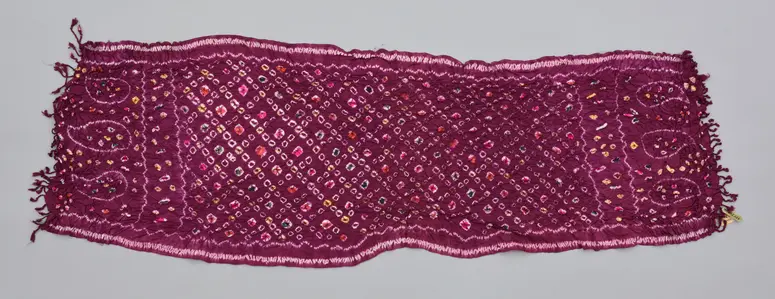
The shawl presented here features floral and geometric motifs inspired by Indian patterns. The orange background gives the shawl a special touch. Borders and fringes made of silver threads.Jumputan batik is a batik technique in which no wax is used. Instead, the fabric is tied together with a rope or sewn and folded.There are two techniques for making jumputan batik, namely the ikat technique and the sewing technique (tritik). In the ikat technique, the fabric is tied tightly before dipping so that the desired pattern is created when the ties are removed. In the sewing technique, the fabric is first given an excess pattern, which is then sewn with a running stitch along the color line with a thread. The thread is then pulled as tightly as possible until the fabric creases as tightly as possible. For Jumputan batik motifs, coins, marbles or stones are attached to several parts of the fabric using elastic bands.
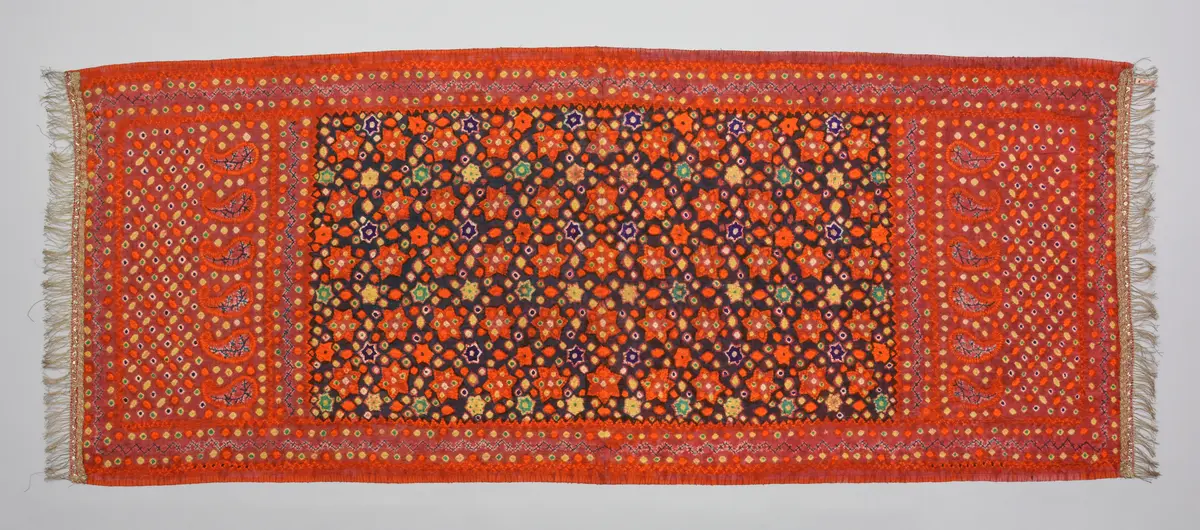
The shawl presented here features floral and geometric motifs inspired by Indian patterns. The orange background gives the shawl a special touch. Borders and fringes made of silver threads.Jumputan batik is a batik technique in which no wax is used. Instead, the fabric is tied together with a rope or sewn and folded.There are two techniques for making jumputan batik, namely the ikat technique and the sewing technique (tritik). In the ikat technique, the fabric is tied tightly before dipping so that the desired pattern is created when the ties are removed. In the sewing technique, the fabric is first given an excess pattern, which is then sewn with a running stitch along the color line with a thread. The thread is then pulled as tightly as possible until the fabric creases as tightly as possible. For Jumputan batik motifs, coins, marbles or stones are attached to several parts of the fabric using elastic bands.
Collector:
Maria Magyar
Time:
Erste Hälfte des 20. Jh.
Culture
Palembang, Süd Sumatera
Material/technology:
Seide, synthetische Farben, Jumputan
Copyright
Weltmuseum Wien
Collection area
Insular Southeast Asia
Geography
Insulares Südostasien/Indonesien/Sumatra
Invs.
134239
Browse more Similar items you might be interested in





Der Alltag auf Nikobaren: : Fischreuse, Körbchen, Zählholz, Fächer, Scheidewand Edward Horace Man 1888