Drum, drumstick
Ganrang
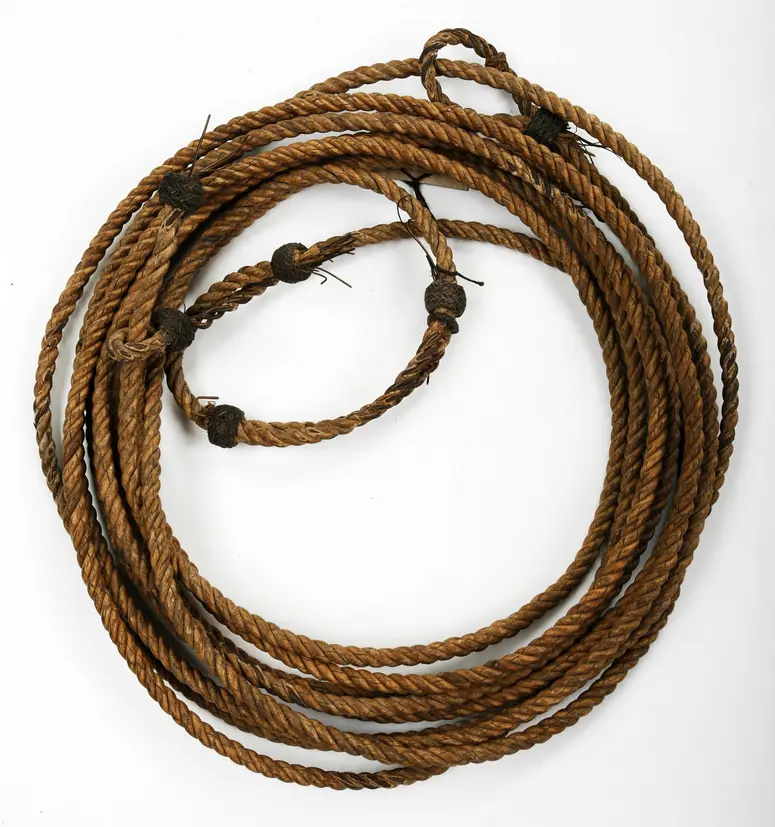
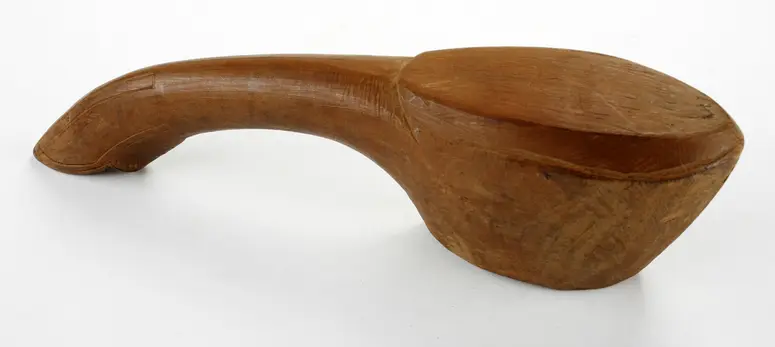
Note: The following text is taken from a 19th-century collection catalog and, in its language and perspective, partially reflects colonial thought patterns. We present the text in its original version to make the collection's history transparent and promote a critical examination of the colonial legacy. Certain terms and formulations may be perceived as problematic today. A 2009 research project concluded that most descriptions are factually correct and still usable; only a few details were found to be inaccurate or incorrect. The results of this project were published in the following collection catalog: khm-wmw-tm-library.on.worldcat.org/oclc/1457155265"448 - 449. Drums - "Ganrang"This type of drum is used everywhere in the Indian Archipelago, they are called "Ganrang" in the Malay language. They are made of tree trunks, about one meter high, which have been hollowed out, and each end of the open cylinder is covered with a skin which has been stretched over it. Rattan runs from both skins on the outside of the drum so that the skins can be tightened, similar to ours. These narrow, high, rather heavy drums are usually carried on a cord hung around the neck so that they hang horizontally and the musician can play both ends with both hands. The left hand usually hits the drum flat while the right hand holds a club-like mallet called "cabara". These drums are used at large celebrations and festivities, at funerals and processions, but also in the houses for small family parties such as birthday parties, weddings, circumcisions, teeth filing, etc.; they are hit in different ways: so, for example, for the birth of a girl one beat follows the next slowly, which is called "tatte - sore". At the birth of a boy the beats are louder and stronger and follow each other more quickly; they are called "tatte kanjdjara", etc. The Bissus, the heathen priests and priestesses on South Celebes have their own way of beating the drums, just like the ladies of the courts at princely palaces; as do the court dances, war dancers, etc. At the birth of a prince there are seven different ways to beat, at the birth of a princess there are five, for the birth of a child of lower nobility or of a chief there are three ways of beating. The beating of the drum is performed by artists who travel from village to village for various festivals and occasions and who are well paid. For the European ear it is naturally difficult to differentiate among all the different types of beats."Translation of: Czurda, F. A. J. (1883). Catalog mit Erklärungen der Etnografischen Privatsammlung des Dr. F. A. J. Czurda in Postelberg (Böhmen). (p. 104-105). Wien, Wilhelm Braumüller
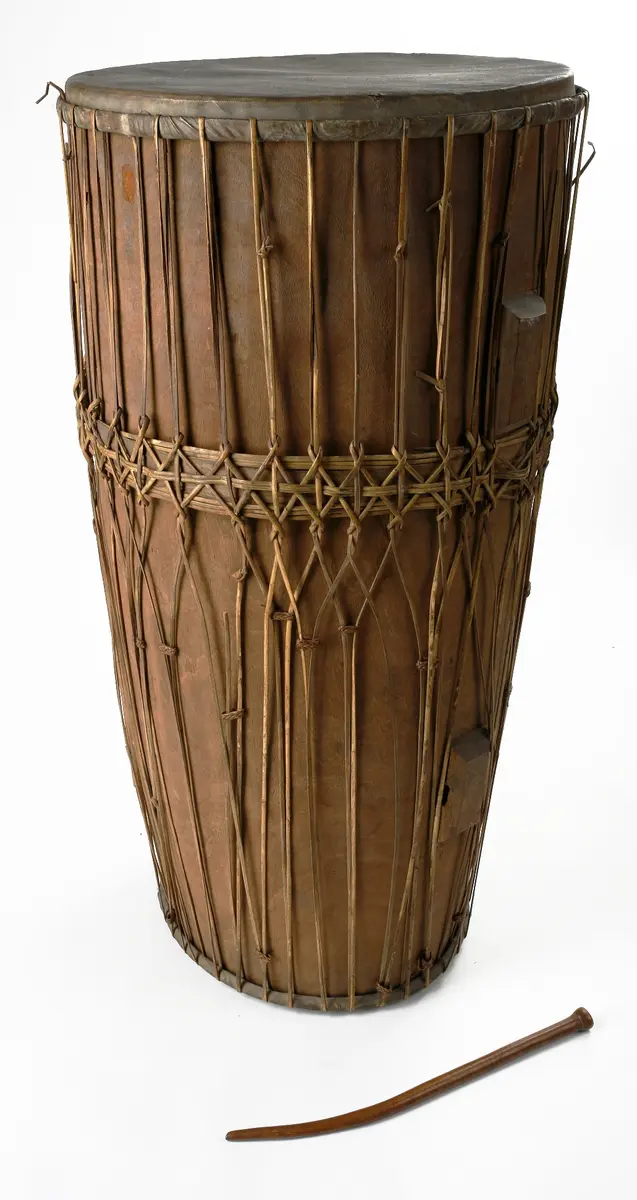
Note: The following text is taken from a 19th-century collection catalog and, in its language and perspective, partially reflects colonial thought patterns. We present the text in its original version to make the collection's history transparent and promote a critical examination of the colonial legacy. Certain terms and formulations may be perceived as problematic today. A 2009 research project concluded that most descriptions are factually correct and still usable; only a few details were found to be inaccurate or incorrect. The results of this project were published in the following collection catalog: khm-wmw-tm-library.on.worldcat.org/oclc/1457155265"448 - 449. Drums - "Ganrang"This type of drum is used everywhere in the Indian Archipelago, they are called "Ganrang" in the Malay language. They are made of tree trunks, about one meter high, which have been hollowed out, and each end of the open cylinder is covered with a skin which has been stretched over it. Rattan runs from both skins on the outside of the drum so that the skins can be tightened, similar to ours. These narrow, high, rather heavy drums are usually carried on a cord hung around the neck so that they hang horizontally and the musician can play both ends with both hands. The left hand usually hits the drum flat while the right hand holds a club-like mallet called "cabara". These drums are used at large celebrations and festivities, at funerals and processions, but also in the houses for small family parties such as birthday parties, weddings, circumcisions, teeth filing, etc.; they are hit in different ways: so, for example, for the birth of a girl one beat follows the next slowly, which is called "tatte - sore". At the birth of a boy the beats are louder and stronger and follow each other more quickly; they are called "tatte kanjdjara", etc. The Bissus, the heathen priests and priestesses on South Celebes have their own way of beating the drums, just like the ladies of the courts at princely palaces; as do the court dances, war dancers, etc. At the birth of a prince there are seven different ways to beat, at the birth of a princess there are five, for the birth of a child of lower nobility or of a chief there are three ways of beating. The beating of the drum is performed by artists who travel from village to village for various festivals and occasions and who are well paid. For the European ear it is naturally difficult to differentiate among all the different types of beats."Translation of: Czurda, F. A. J. (1883). Catalog mit Erklärungen der Etnografischen Privatsammlung des Dr. F. A. J. Czurda in Postelberg (Böhmen). (p. 104-105). Wien, Wilhelm Braumüller
Collector:
František A. J. Czurda (1844 Pisek - 1886 Cirebon) DNB
Entry Date:
1883
Object Name
Drum, drumstick
Culture
Süd-Sulawesi, Alu
Material/technology:
Wood, leather, rattan
Copyright
Weltmuseum Wien
Collection area
Insular Southeast Asia
Invs.
17693_ab