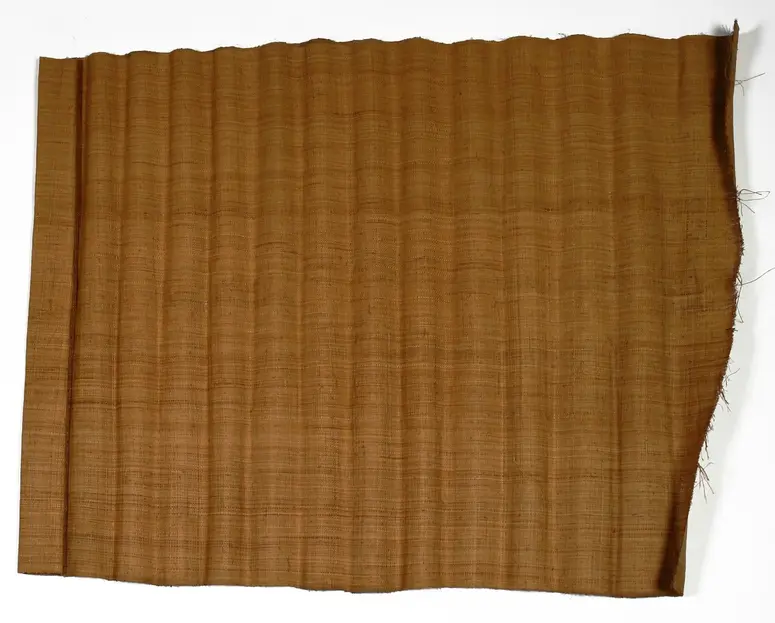
Fishing rod
Meng-ripetape
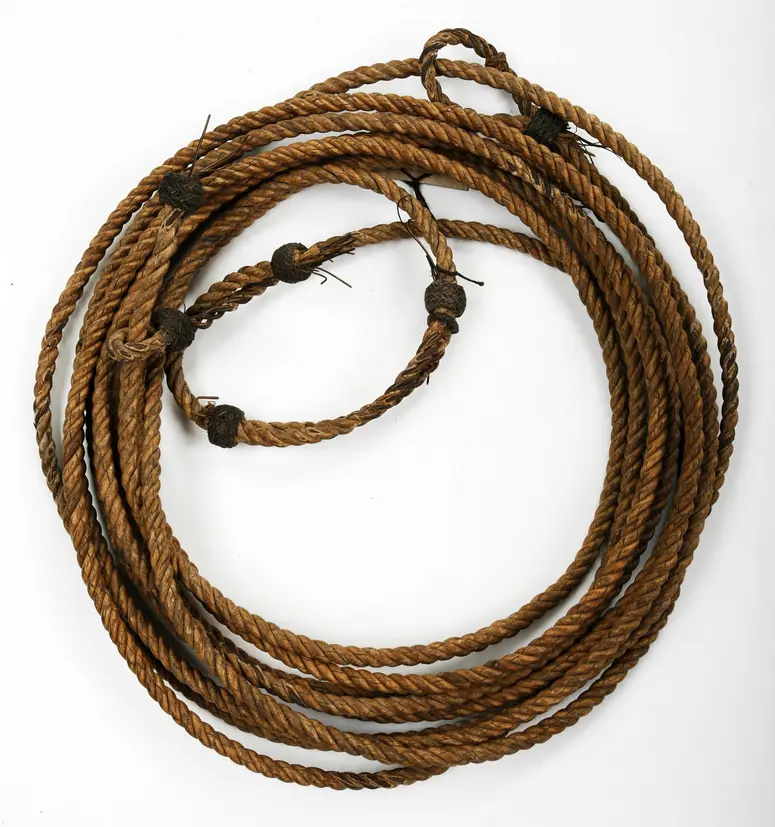
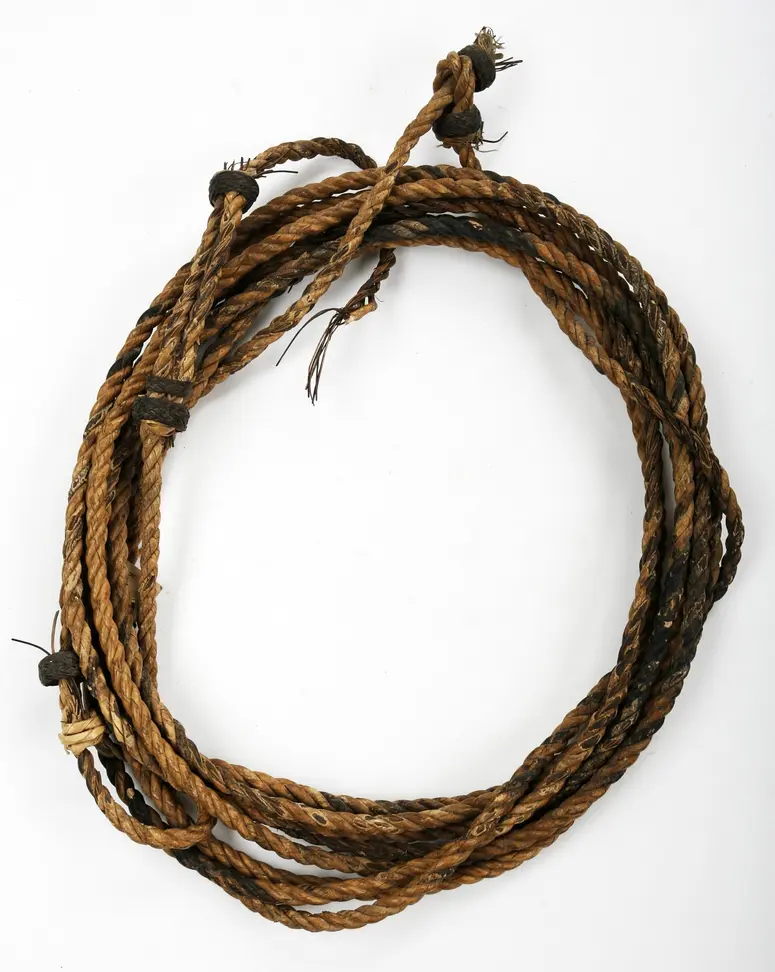
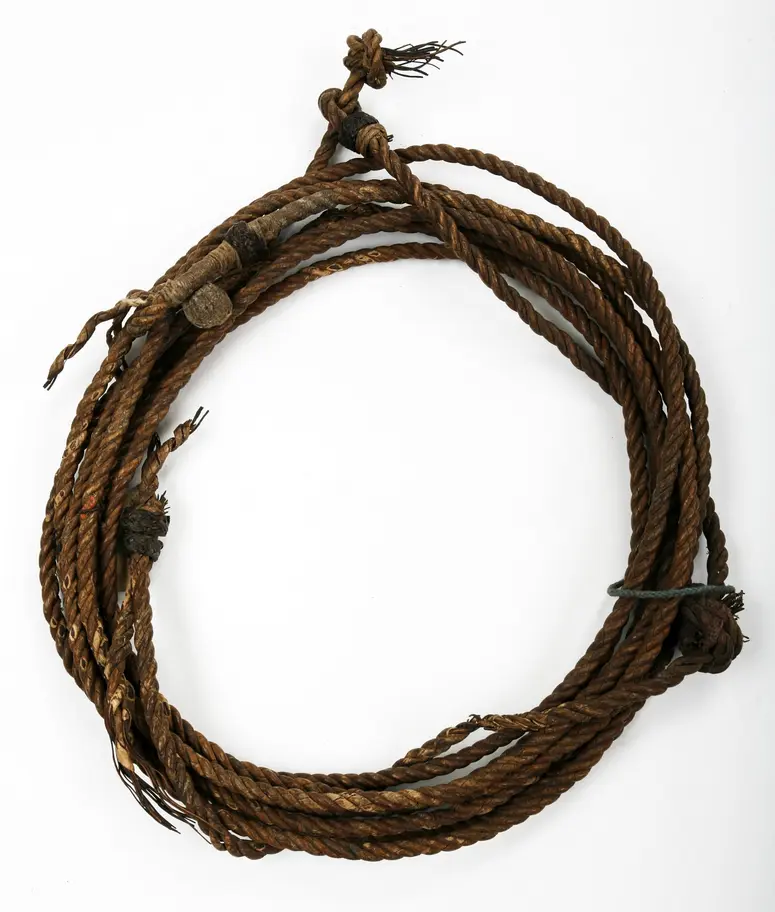
Note: The following text is taken from a 19th-century collection catalog and, in its language and perspective, partially reflects colonial thought patterns. We present the text in its original version to make the collection's history transparent and promote a critical examination of the colonial legacy. Certain terms and formulations may be perceived as problematic today. A 2009 research project concluded that most descriptions are factually correct and still usable; only a few details were found to be inaccurate or incorrect. The results of this project were published in the following collection catalog: khm-wmw-tm-library.on.worldcat.org/oclc/1457155265"426 - 427. Fishing lines - "Meng-ripetape" Long, thin cords of wool which are completely covered with a layer of resin; they have a lead sinker at the bottom and also a 20 cm long horn spring in which two brass fishing hooks are fixed with horsehair is fastened onto the strings. If the line is dropped into the water, the heavy sinker lies on the bottom while the light horn spring with the two fish hooks always moves back and forth towards the top, whereby the bait on the hooks is noticed by the fish. These lines are only used on lakes with great depths, where the native goes out with his canoe and throws the lines out. When the line is pulled lightly he can feel immediately if a fish is caught, at which time he then carefully pulls the line out of the water. The fish hooks are of various sizes and can be changed on this line whenever the fisherman wants, since he carries a great supply of these with him."Translation of: Czurda, F. A. J. (1883). Catalog mit Erklärungen der Etnografischen Privatsammlung des Dr. F. A. J. Czurda in Postelberg (Böhmen). (p. 99). Wien, Wilhelm Braumüller
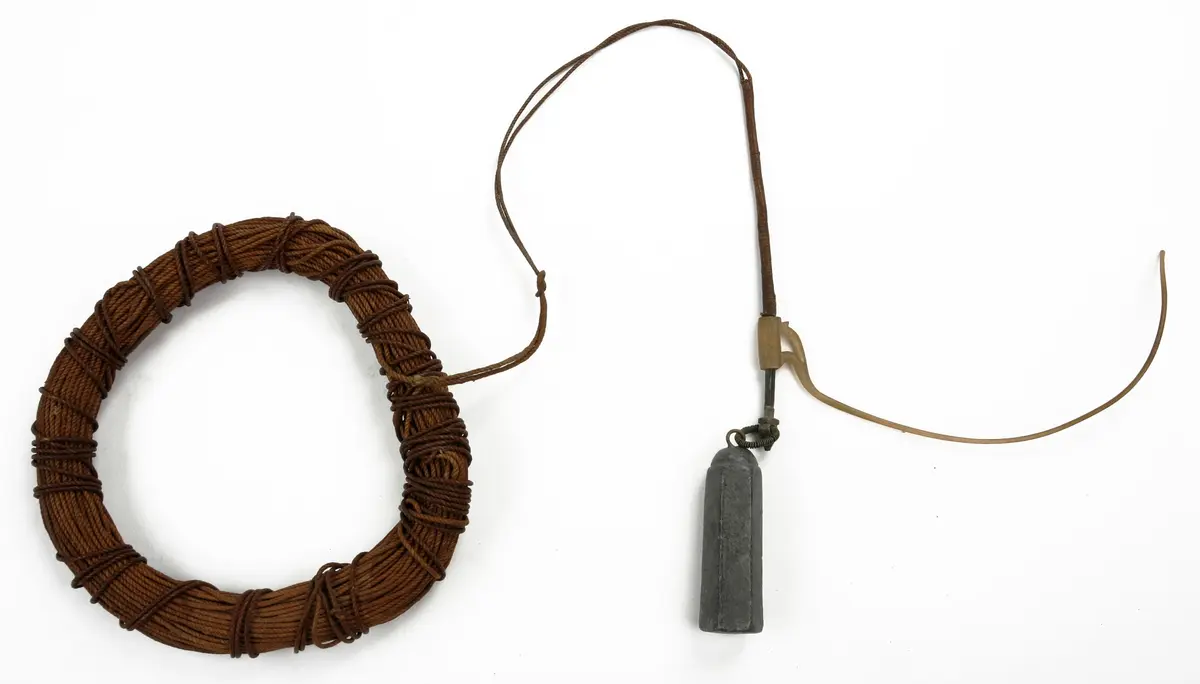
Note: The following text is taken from a 19th-century collection catalog and, in its language and perspective, partially reflects colonial thought patterns. We present the text in its original version to make the collection's history transparent and promote a critical examination of the colonial legacy. Certain terms and formulations may be perceived as problematic today. A 2009 research project concluded that most descriptions are factually correct and still usable; only a few details were found to be inaccurate or incorrect. The results of this project were published in the following collection catalog: khm-wmw-tm-library.on.worldcat.org/oclc/1457155265"426 - 427. Fishing lines - "Meng-ripetape" Long, thin cords of wool which are completely covered with a layer of resin; they have a lead sinker at the bottom and also a 20 cm long horn spring in which two brass fishing hooks are fixed with horsehair is fastened onto the strings. If the line is dropped into the water, the heavy sinker lies on the bottom while the light horn spring with the two fish hooks always moves back and forth towards the top, whereby the bait on the hooks is noticed by the fish. These lines are only used on lakes with great depths, where the native goes out with his canoe and throws the lines out. When the line is pulled lightly he can feel immediately if a fish is caught, at which time he then carefully pulls the line out of the water. The fish hooks are of various sizes and can be changed on this line whenever the fisherman wants, since he carries a great supply of these with him."Translation of: Czurda, F. A. J. (1883). Catalog mit Erklärungen der Etnografischen Privatsammlung des Dr. F. A. J. Czurda in Postelberg (Böhmen). (p. 99). Wien, Wilhelm Braumüller
Collector:
František A. J. Czurda (1844 Pisek - 1886 Cirebon) DNB
Entry Date:
1883
Object Name
Fishing rod
Culture
Süd-Sulawesi, Makassar
Material/technology:
Wool, horsehair, sinker
Copyright
Weltmuseum Wien
Collection area
Insular Southeast Asia
Invs.
17676