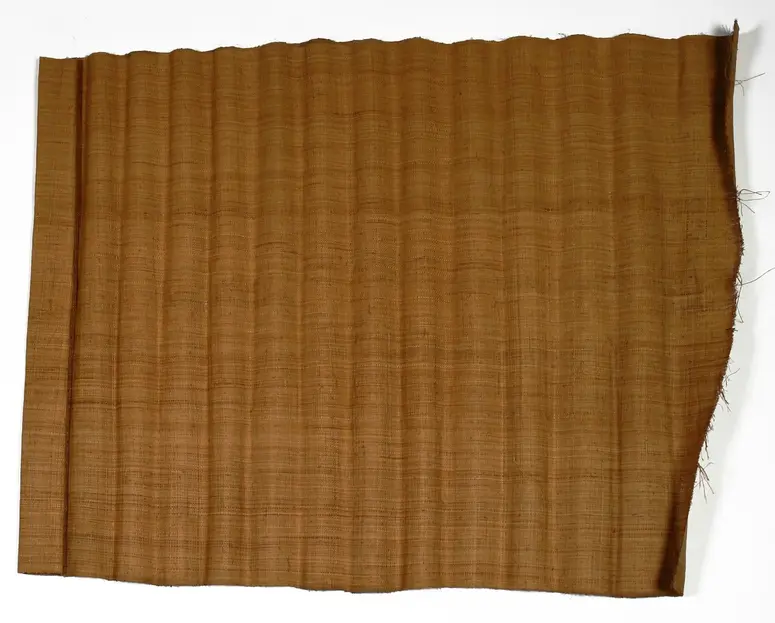
Headscarf
Pasapu-ulu
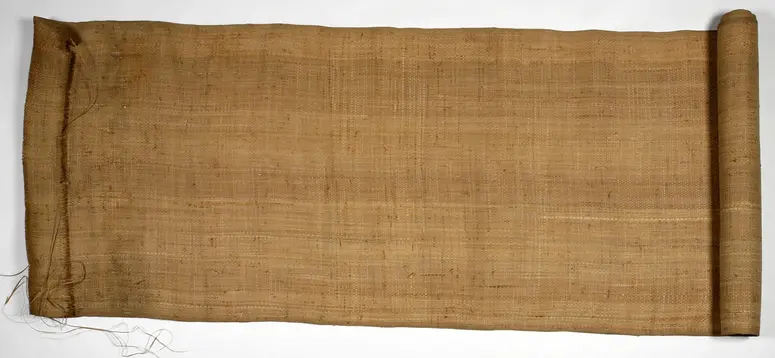
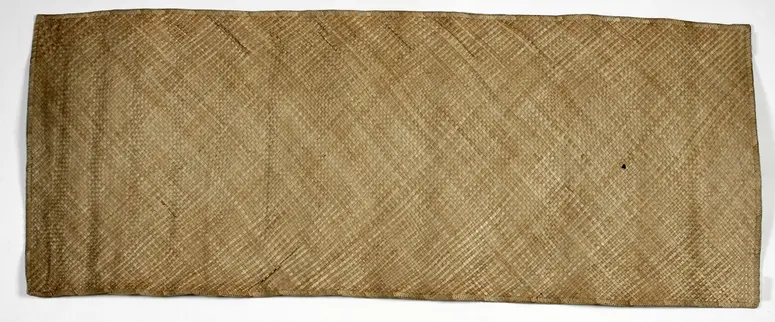
Note: The following text is taken from a 19th-century collection catalog and, in its language and perspective, partially reflects colonial thought patterns. We present the text in its original version to make the collection's history transparent and promote a critical examination of the colonial legacy. Certain terms and formulations may be perceived as problematic today. A 2009 research project concluded that most descriptions are factually correct and still usable; only a few details were found to be inaccurate or incorrect. The results of this project were published in the following collection catalog: khm-wmw-tm-library.on.worldcat.org/oclc/1457155265"556 - 557. Head cloths - "Pasapu-ulu"About one square meter of smooth cotton, one blue, the other red; The blue one has a hem of light-blue stripes, the red with a hem of white and green stripes. Both are very stiff and smooth like the two sarongs, above. It has already been mentioned that the head scarf belongs to the national dress of all the Muslim natives in the Indian archipelago. Some ethnic groups only use a head covering that never is taken off the head. It has also already been said that each of the ethnic groups, each tribe, binds the cloth in a different way around the head, and it is thus possible to identify both the ethnic group and the geographic area of the wearer. The Makassars and the Buginese wear it in the most picturesque manner, so that two ends are pulled out and up above the head making them look like wings. If the cloth is stiffened, then these pulled-out, wing-like points stand up, if un-stiffened, they sink to half size."Translation of: Czurda, F. A. J. (1883). Catalog mit Erklärungen der Etnografischen Privatsammlung des Dr. F. A. J. Czurda in Postelberg (Böhmen). (p. 144-145). Wien, Wilhelm Braumüller
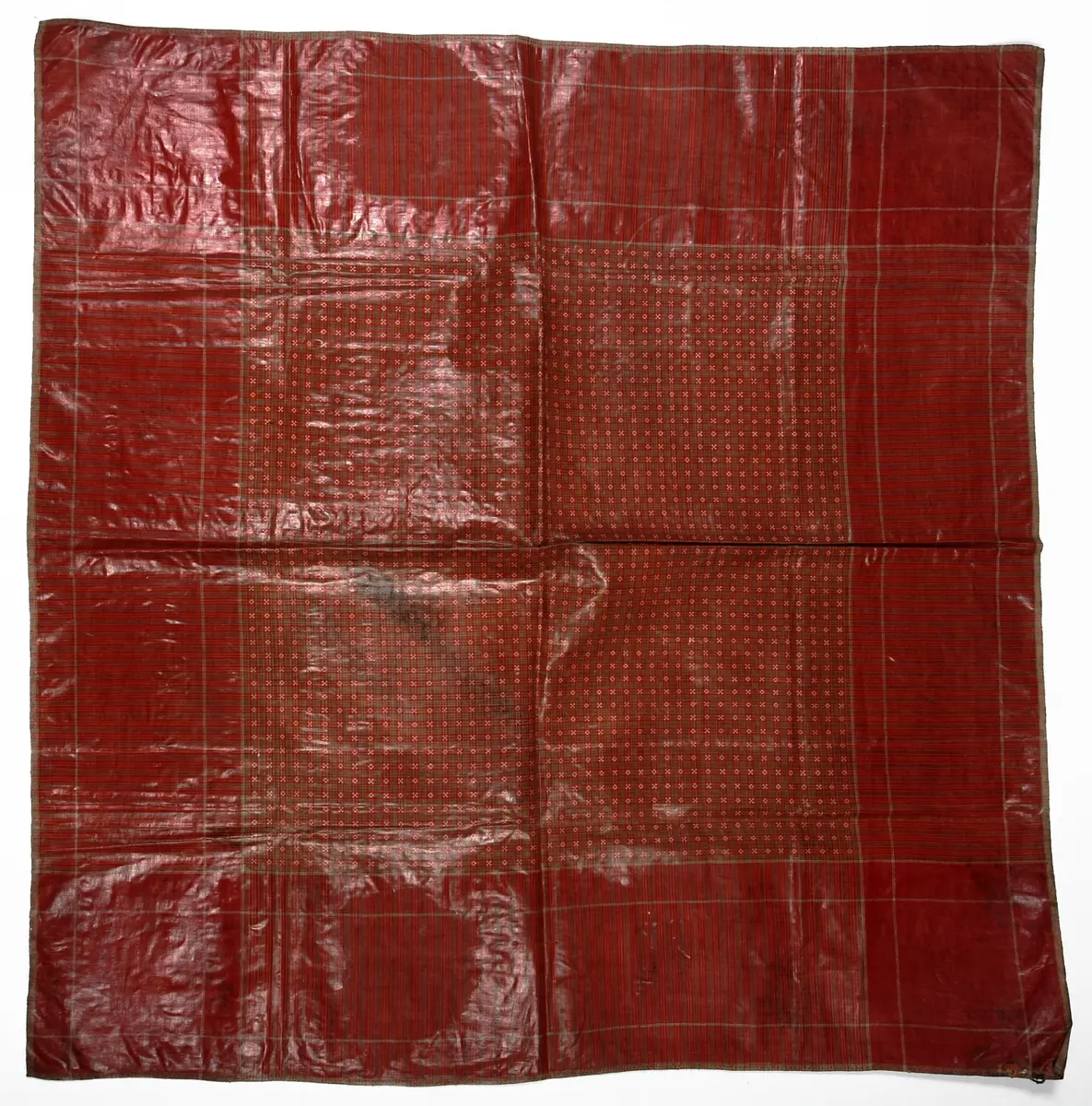
Note: The following text is taken from a 19th-century collection catalog and, in its language and perspective, partially reflects colonial thought patterns. We present the text in its original version to make the collection's history transparent and promote a critical examination of the colonial legacy. Certain terms and formulations may be perceived as problematic today. A 2009 research project concluded that most descriptions are factually correct and still usable; only a few details were found to be inaccurate or incorrect. The results of this project were published in the following collection catalog: khm-wmw-tm-library.on.worldcat.org/oclc/1457155265"556 - 557. Head cloths - "Pasapu-ulu"About one square meter of smooth cotton, one blue, the other red; The blue one has a hem of light-blue stripes, the red with a hem of white and green stripes. Both are very stiff and smooth like the two sarongs, above. It has already been mentioned that the head scarf belongs to the national dress of all the Muslim natives in the Indian archipelago. Some ethnic groups only use a head covering that never is taken off the head. It has also already been said that each of the ethnic groups, each tribe, binds the cloth in a different way around the head, and it is thus possible to identify both the ethnic group and the geographic area of the wearer. The Makassars and the Buginese wear it in the most picturesque manner, so that two ends are pulled out and up above the head making them look like wings. If the cloth is stiffened, then these pulled-out, wing-like points stand up, if un-stiffened, they sink to half size."Translation of: Czurda, F. A. J. (1883). Catalog mit Erklärungen der Etnografischen Privatsammlung des Dr. F. A. J. Czurda in Postelberg (Böhmen). (p. 144-145). Wien, Wilhelm Braumüller
Collector:
František A. J. Czurda (1844 Pisek - 1886 Cirebon) DNB
Entry Date:
1883
Object Name
Headscarf
Culture
Süd-Sulawesi, Mallasoro
Material/technology:
Cotton; stitched, plain weave, chintzed
Copyright
Weltmuseum Wien
Collection area
Insular Southeast Asia
Invs.
17786