Hunting trousers
vor April 2001 | Franz Trost
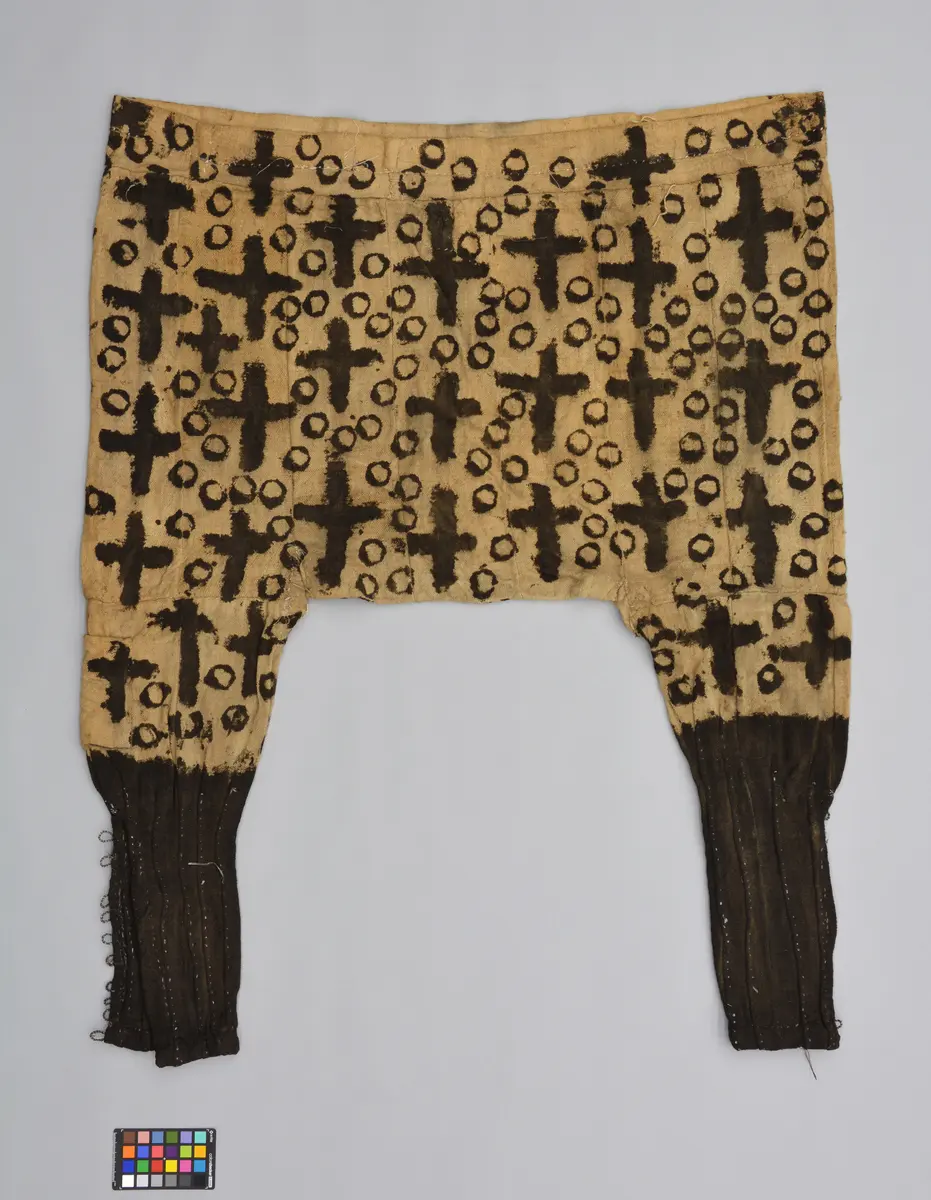
These trousers are part of a three-piece outfit consisting of a shirt, trousers, and cap. The base fabric of narrow, hand-woven cotton strips joined together to form a fabric surface is just as interesting as the sewing material: synthetic threads that were presumably obtained from synthetic fibre packaging tarpaulins. The motifs applied to the finished garment were not only intended to camouflage the wearer, but also to protect them from the spirits of slain animals. This type of painting is a version of the ‘stain resist dyeing technique’: The motifs were painted and printed with a predominantly plant-based paste and the fabric was then covered with mineral-rich mud. Only the painted areas turned black due to a chemical reaction, while the unpainted areas took on a light brownish colour.
These trousers are part of a three-piece outfit consisting of a shirt, trousers, and cap. The base fabric of narrow, hand-woven cotton strips joined together to form a fabric surface is just as interesting as the sewing material: synthetic threads that were presumably obtained from synthetic fibre packaging tarpaulins. The motifs applied to the finished garment were not only intended to camouflage the wearer, but also to protect them from the spirits of slain animals. This type of painting is a version of the ‘stain resist dyeing technique’: The motifs were painted and printed with a predominantly plant-based paste and the fabric was then covered with mineral-rich mud. Only the painted areas turned black due to a chemical reaction, while the unpainted areas took on a light brownish colour.
Collector:
Franz Trost
Time:
vor April 2001
Entry Date:
2001
Object Name
Hunting trousers
Material/technology:
Baumwolle, Leinwandbindung, bemalt/bedruckt; Handnähte und Maschinnähte
Copyright
Weltmuseum Wien
Collection area
Sub-Saharan Africa
Invs.
179275_a