Indra
14./ 15. Jahrhundert | René Nebesky-Wojkowitz
In the early Indian Vedic religion, Indra is presented as the supreme, warlike god of the sky, the god of storms and rain, "without whom no victory is possible, whom one invokes in battle ..." (Rigveda 2,12,9 ) He is the god of warriors, of the Kshatriya caste. He is also regarded as the god of fertility, creation and rain as well as the king of the gods. In general, he embodies the productive forces of nature. Indra is the most famous god of the Vedic period and is the most invoked and sung god: around 250 hymns of the Rigveda are addressed to him alone. According to the Vedic scriptures, it is he who crushes all resistance
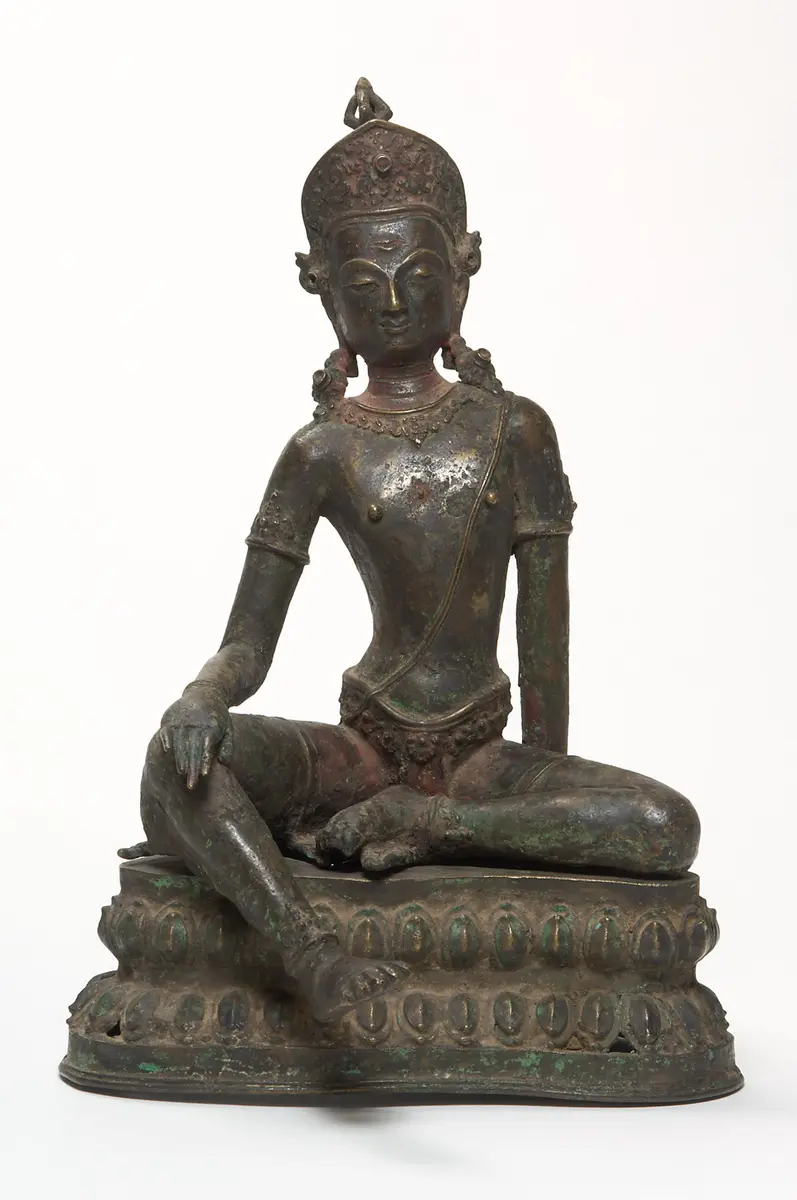
In the early Indian Vedic religion, Indra is presented as the supreme, warlike god of the sky, the god of storms and rain, "without whom no victory is possible, whom one invokes in battle ..." (Rigveda 2,12,9 ) He is the god of warriors, of the Kshatriya caste. He is also regarded as the god of fertility, creation and rain as well as the king of the gods. In general, he embodies the productive forces of nature. Indra is the most famous god of the Vedic period and is the most invoked and sung god: around 250 hymns of the Rigveda are addressed to him alone. According to the Vedic scriptures, it is he who crushes all resistance
Collector:
René Nebesky-Wojkowitz (1923 Groß-Hoschütz - 1959 Wien) DNB
Time:
14./ 15. Jahrhundert
Object Name
Statue
Culture
Newar / Nepal
Material/technology:
Bronze
Copyright
Weltmuseum Wien
Collection area
South Asia, Southeast Asia, Himalayas
Geography
Südasien/Himalaya/Nepal
Invs.
136889