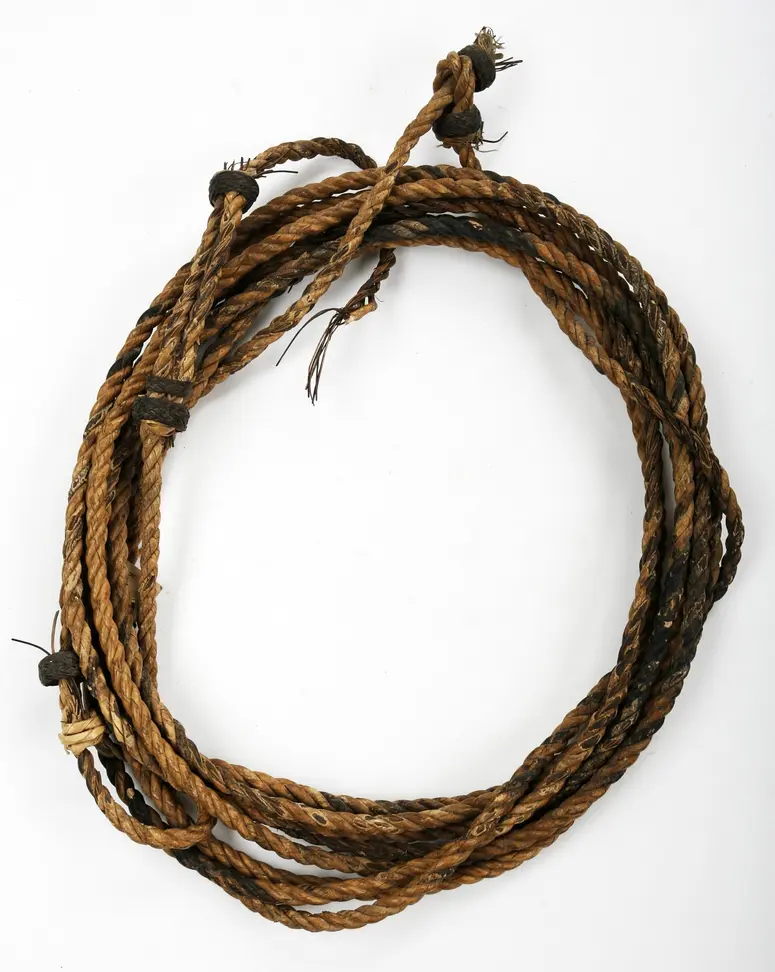
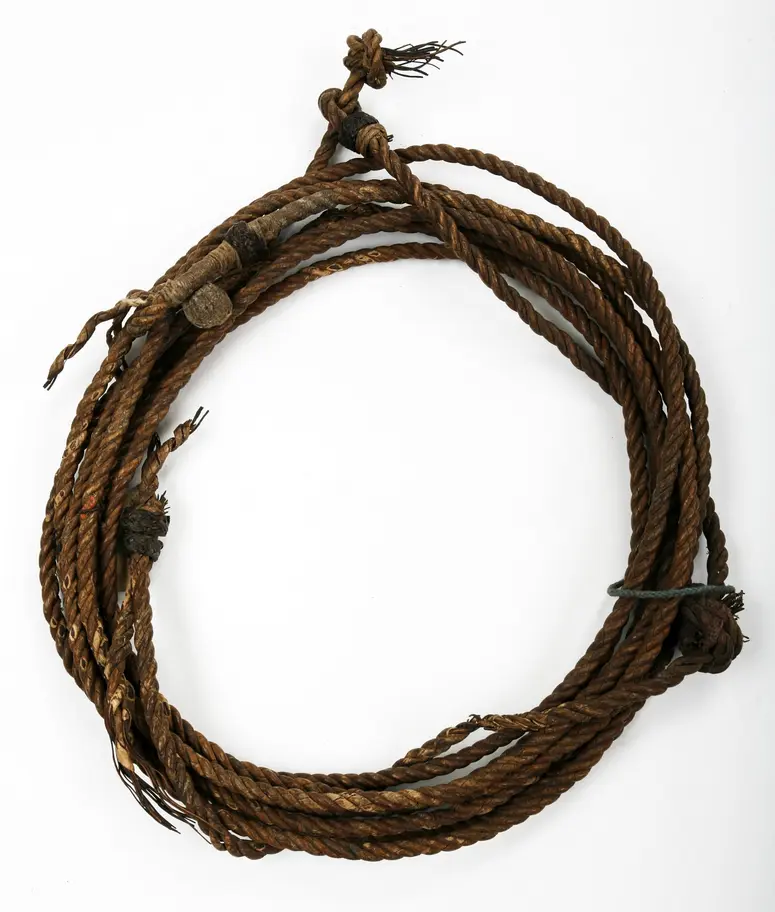
Lance
Basi Banrangang
Note: The following text is taken from a 19th-century collection catalog and, in its language and perspective, partially reflects colonial thought patterns. We present the text in its original version to make the collection's history transparent and promote a critical examination of the colonial legacy. Certain terms and formulations may be perceived as problematic today. A 2009 research project concluded that most descriptions are factually correct and still usable; only a few details were found to be inaccurate or incorrect. The results of this project were published in the following collection catalog: khm-wmw-tm-library.on.worldcat.org/oclc/1457155265"51. Lance - "Bassi baranga".Like the previous one, the lance shaft is decorated with black buck hairs, the head is not flat but rather four-cornered, bayonet-like, thin, with double ribs running lengthwise. The fittings are of brass, the sheath is wooden."Translation of: Czurda, F. A. J. (1883). Catalog mit Erklärungen der Etnografischen Privatsammlung des Dr. F. A. J. Czurda in Postelberg (Böhmen). (p. 9). Wien, Wilhelm Braumüller
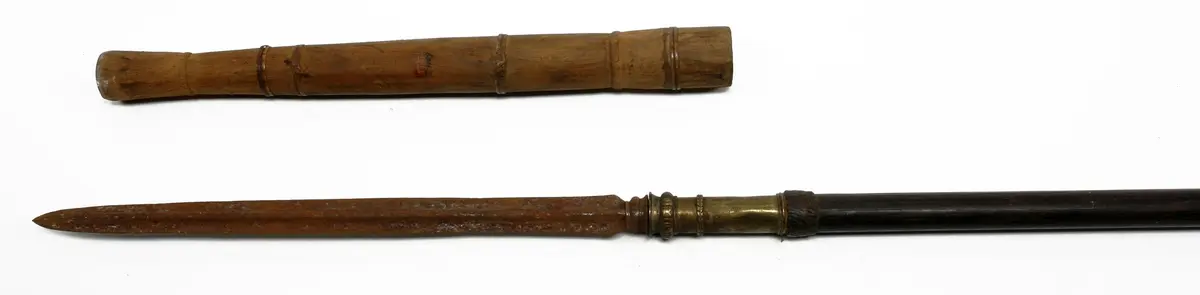
Note: The following text is taken from a 19th-century collection catalog and, in its language and perspective, partially reflects colonial thought patterns. We present the text in its original version to make the collection's history transparent and promote a critical examination of the colonial legacy. Certain terms and formulations may be perceived as problematic today. A 2009 research project concluded that most descriptions are factually correct and still usable; only a few details were found to be inaccurate or incorrect. The results of this project were published in the following collection catalog: khm-wmw-tm-library.on.worldcat.org/oclc/1457155265"51. Lance - "Bassi baranga".Like the previous one, the lance shaft is decorated with black buck hairs, the head is not flat but rather four-cornered, bayonet-like, thin, with double ribs running lengthwise. The fittings are of brass, the sheath is wooden."Translation of: Czurda, F. A. J. (1883). Catalog mit Erklärungen der Etnografischen Privatsammlung des Dr. F. A. J. Czurda in Postelberg (Böhmen). (p. 9). Wien, Wilhelm Braumüller
Collector:
František A. J. Czurda (1844 Pisek - 1886 Cirebon) DNB
Entry Date:
1883
Object Name
Lance
Culture
Süd-Sulawesi, Makassar
Material/technology:
Iron; forged, wood, brass, Sheath: wood, rattan
Copyright
Weltmuseum Wien
Collection area
Insular Southeast Asia
Invs.
17367