Rein
Sittakang-galang
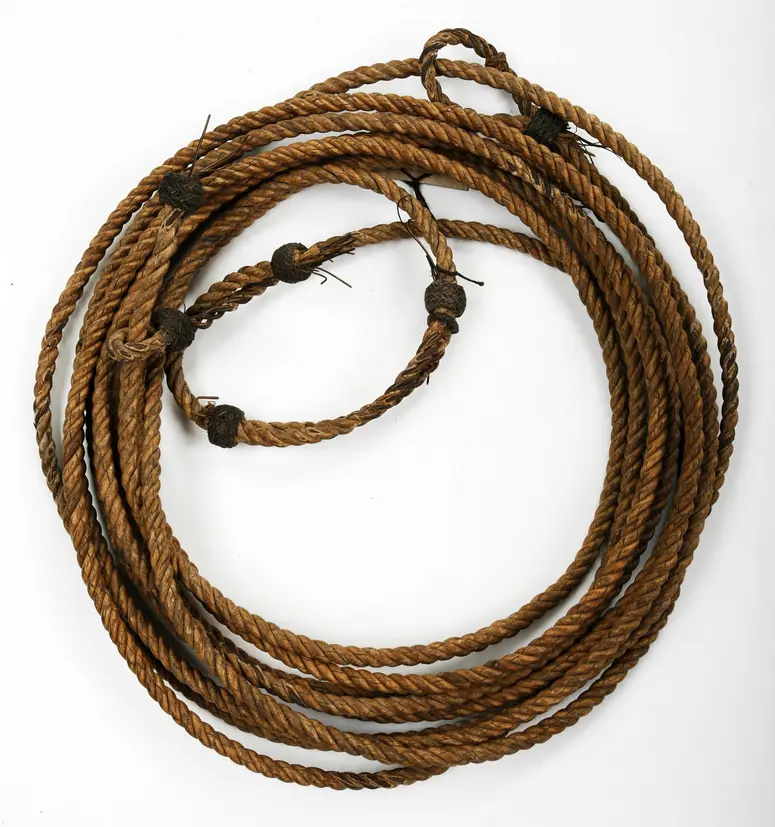
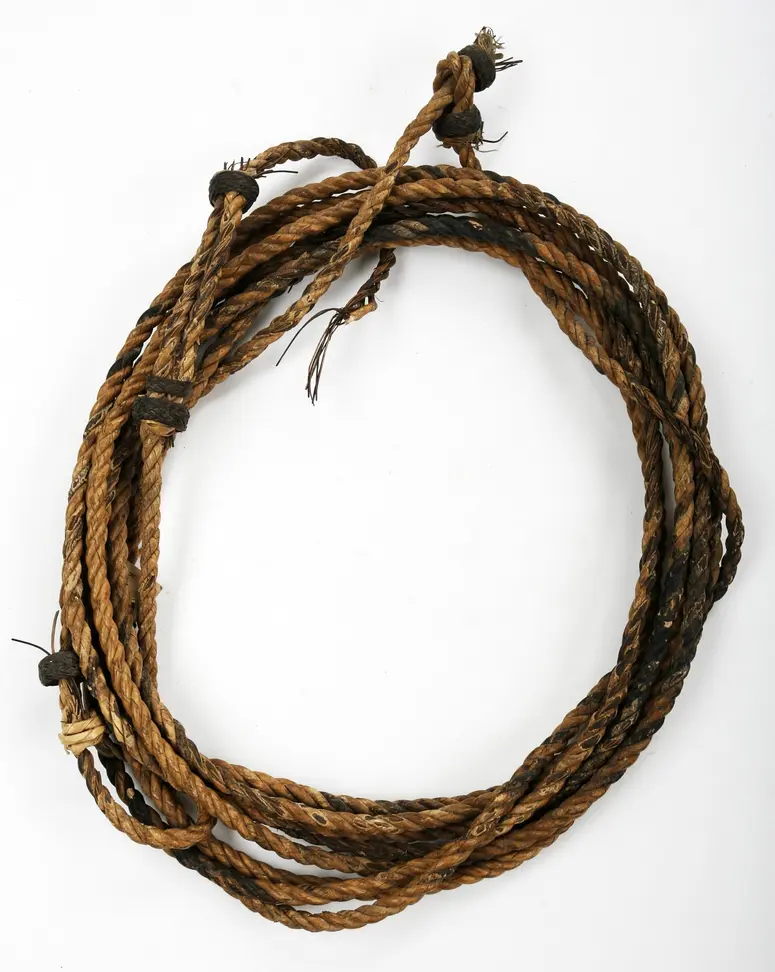
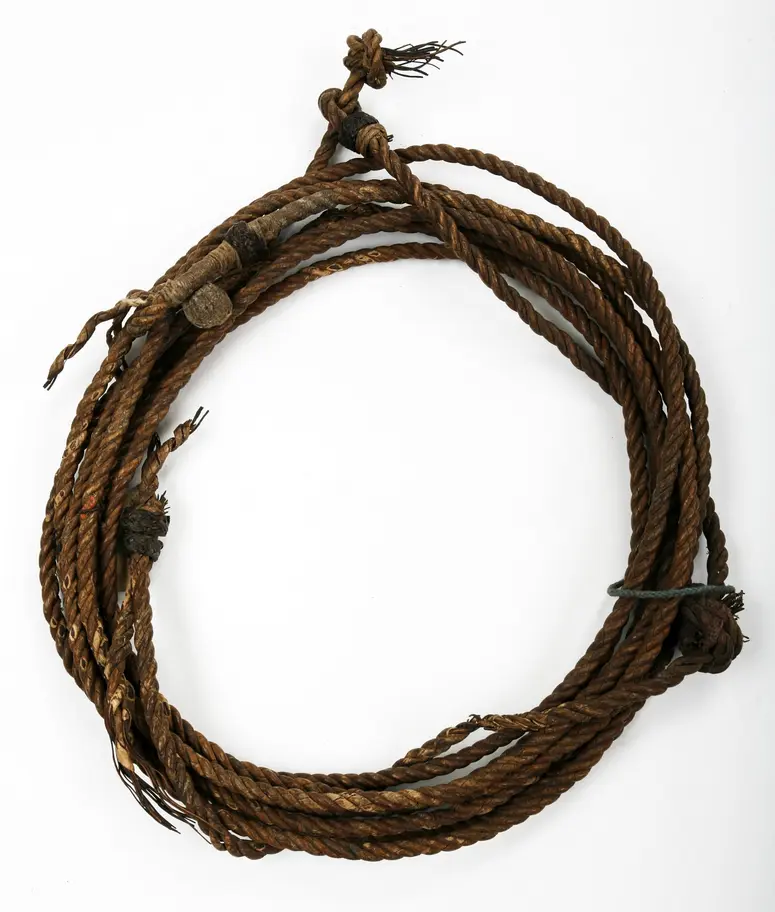
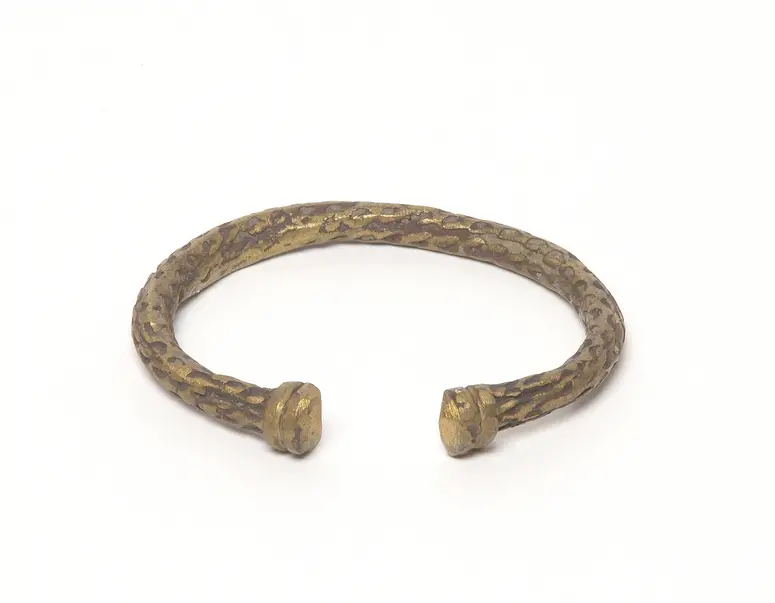
Note: The following text is taken from a 19th-century collection catalog and, in its language and perspective, partially reflects colonial thought patterns. We present the text in its original version to make the collection's history transparent and promote a critical examination of the colonial legacy. Certain terms and formulations may be perceived as problematic today. A 2009 research project concluded that most descriptions are factually correct and still usable; only a few details were found to be inaccurate or incorrect. The results of this project were published in the following collection catalog: khm-wmw-tm-library.on.worldcat.org/oclc/1457155265"412 - 415. Rein and bridle - "Sittakang-galang" The bridles and halters of the Makassars and Buginese are very primitive. The reins are made of a simple bit of brass which is connected to a bow of rattan that is covered with a hemp cord or copper or silver wire. The halter is normally a simple rope, often decorated with glass beads or brass rings, which leads from the bit over the head of the horse so that it lies between the ears and the heavy mane of the horse. With nobles and privileged people this simple rope is replaced by a chain of silver or gold, made of wide, plate-shaped links. The bow-shaped, stiff rattan reins described above are so short that they lie behind the ears of the horse on the mane, and cannot be pulled down over the neck. This peculiarity allows the rider to develop a greater strength than with a longer rein which is necessary for the Makassar race with their very short and thick necks. The rider sits, so to speak, on the shoulders of the horse and holds tight the bow-shaped reins behind the ears of the horse with his extended left hand and the man's fist rests on the heavy mane; mostly he holds the hair as well. The right hand is either holding his lance or it is placed on his hip. The Makassars and the Buginese are a people of riders since the horses have become wild here and are very numerous; either they belong to no one, roam through the forests and fields or they are the property of the princes. The race of horses of the Makassars is small but very strong and well proportioned except for the slightly shorter neck. They are the only race in the Indian Archipelago which has the advantage of being used as a military horse. The Makassar horse is extremely intelligent, used to all kinds of hardships, is persevering in its work and has a lively temperament. The natives on Celebes catch the wild horses with their rope lances similar to the way they catch deer. They all ride without saddles, which incidentally are unknown in all of the Indian Archipelago. They are good cross-country riders who, however, cling like monkeys to the neck of their horse when in difficult terrain. One peculiarity is the way they ride with their legs pulled up. If the rider is tired he pulls one or both his legs up onto the back of the horse and he can trot or even gallop moderately in this crouching, ape-like position for rather long distances. Only noblemen, chiefs and privileged people are allowed to use horses, the common folk may not ride for their enjoyment without the permission of the prince. Finally it should be mentioned that in the whole of East India only stallions are ridden., the mares are not used for any work - also not by the Europeans. The carriage horses of the latter are also stallions, as are those of the entire Dutch cavalry in India. The castration of animals is completely unknown to the natives and is also not practiced here by the Europeans. The natives do not shoe their horses, and only in the mountain stations are they shod for the cavalry, and then only the fore-hooves. The Makassar horses are an important export article from South Celebes. Two of the present reins are equipped with long, elastic horse ropes which have been twisted from a type of rattan."Translation of: Czurda, F. A. J. (1883). Catalog mit Erklärungen der Etnografischen Privatsammlung des Dr. F. A. J. Czurda in Postelberg (Böhmen). (p. 92-94). Wien, Wilhelm Braumüller
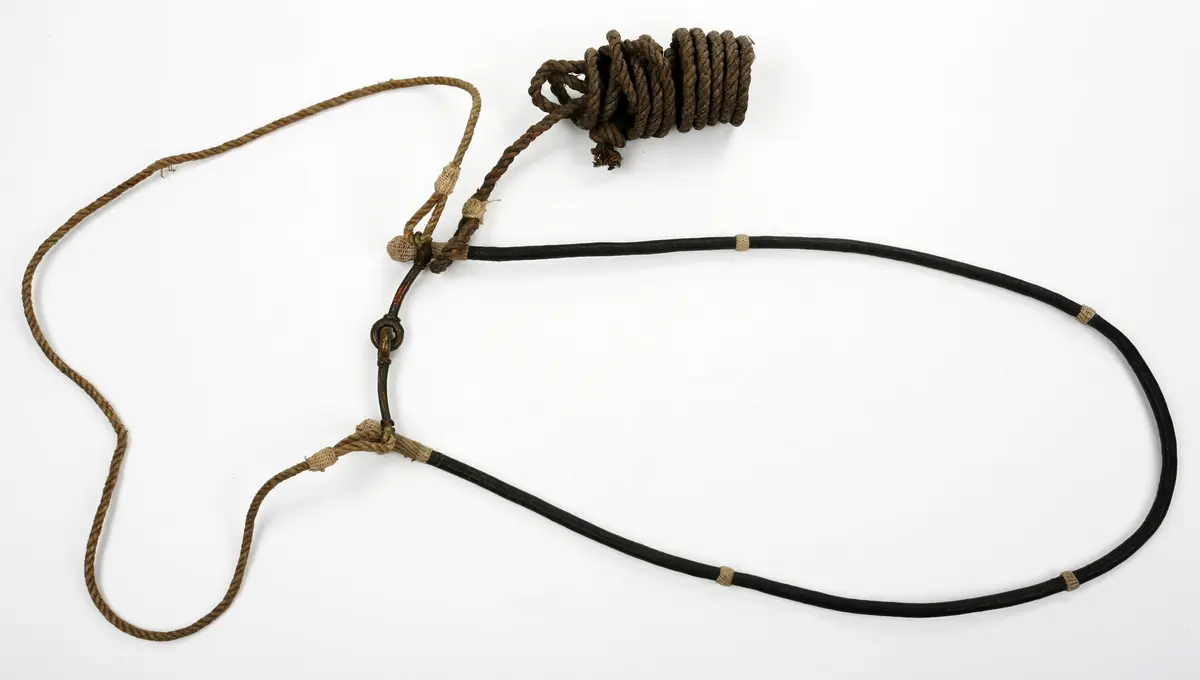
Note: The following text is taken from a 19th-century collection catalog and, in its language and perspective, partially reflects colonial thought patterns. We present the text in its original version to make the collection's history transparent and promote a critical examination of the colonial legacy. Certain terms and formulations may be perceived as problematic today. A 2009 research project concluded that most descriptions are factually correct and still usable; only a few details were found to be inaccurate or incorrect. The results of this project were published in the following collection catalog: khm-wmw-tm-library.on.worldcat.org/oclc/1457155265"412 - 415. Rein and bridle - "Sittakang-galang" The bridles and halters of the Makassars and Buginese are very primitive. The reins are made of a simple bit of brass which is connected to a bow of rattan that is covered with a hemp cord or copper or silver wire. The halter is normally a simple rope, often decorated with glass beads or brass rings, which leads from the bit over the head of the horse so that it lies between the ears and the heavy mane of the horse. With nobles and privileged people this simple rope is replaced by a chain of silver or gold, made of wide, plate-shaped links. The bow-shaped, stiff rattan reins described above are so short that they lie behind the ears of the horse on the mane, and cannot be pulled down over the neck. This peculiarity allows the rider to develop a greater strength than with a longer rein which is necessary for the Makassar race with their very short and thick necks. The rider sits, so to speak, on the shoulders of the horse and holds tight the bow-shaped reins behind the ears of the horse with his extended left hand and the man's fist rests on the heavy mane; mostly he holds the hair as well. The right hand is either holding his lance or it is placed on his hip. The Makassars and the Buginese are a people of riders since the horses have become wild here and are very numerous; either they belong to no one, roam through the forests and fields or they are the property of the princes. The race of horses of the Makassars is small but very strong and well proportioned except for the slightly shorter neck. They are the only race in the Indian Archipelago which has the advantage of being used as a military horse. The Makassar horse is extremely intelligent, used to all kinds of hardships, is persevering in its work and has a lively temperament. The natives on Celebes catch the wild horses with their rope lances similar to the way they catch deer. They all ride without saddles, which incidentally are unknown in all of the Indian Archipelago. They are good cross-country riders who, however, cling like monkeys to the neck of their horse when in difficult terrain. One peculiarity is the way they ride with their legs pulled up. If the rider is tired he pulls one or both his legs up onto the back of the horse and he can trot or even gallop moderately in this crouching, ape-like position for rather long distances. Only noblemen, chiefs and privileged people are allowed to use horses, the common folk may not ride for their enjoyment without the permission of the prince. Finally it should be mentioned that in the whole of East India only stallions are ridden., the mares are not used for any work - also not by the Europeans. The carriage horses of the latter are also stallions, as are those of the entire Dutch cavalry in India. The castration of animals is completely unknown to the natives and is also not practiced here by the Europeans. The natives do not shoe their horses, and only in the mountain stations are they shod for the cavalry, and then only the fore-hooves. The Makassar horses are an important export article from South Celebes. Two of the present reins are equipped with long, elastic horse ropes which have been twisted from a type of rattan."Translation of: Czurda, F. A. J. (1883). Catalog mit Erklärungen der Etnografischen Privatsammlung des Dr. F. A. J. Czurda in Postelberg (Böhmen). (p. 92-94). Wien, Wilhelm Braumüller
Collector:
František A. J. Czurda (1844 Pisek - 1886 Cirebon) DNB
Entry Date:
1883
Object Name
Rein
Culture
Süd-Sulawesi
Material/technology:
Brass, rattan, hemp
Copyright
Weltmuseum Wien
Collection area
Insular Southeast Asia
Invs.
17663