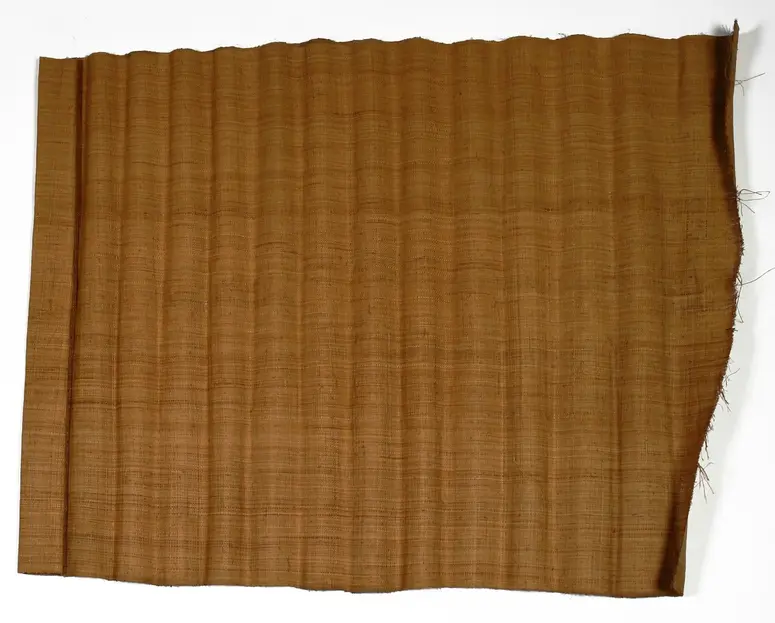
Sarong
Lipa
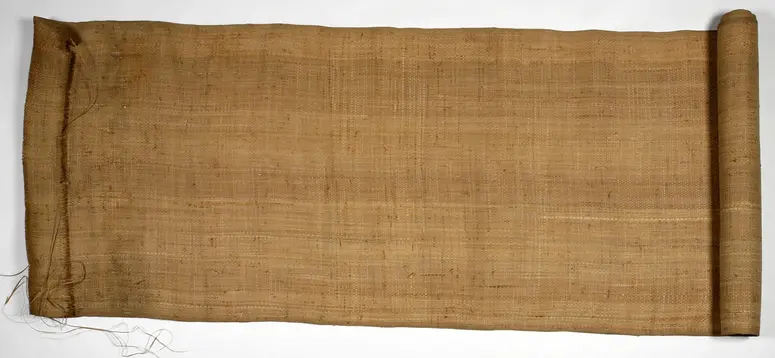
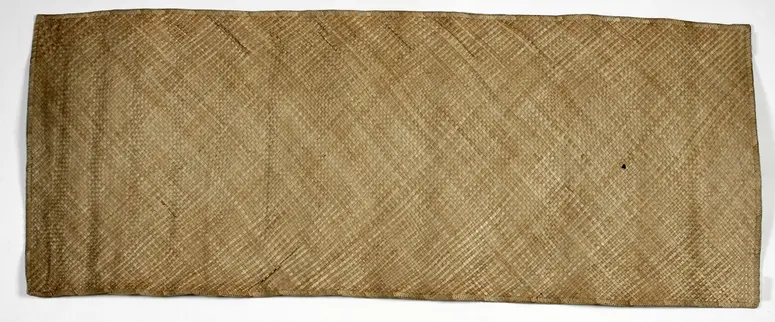
Note: The following text is taken from a 19th-century collection catalog and, in its language and perspective, partially reflects colonial thought patterns. We present the text in its original version to make the collection's history transparent and promote a critical examination of the colonial legacy. Certain terms and formulations may be perceived as problematic today. A 2009 research project concluded that most descriptions are factually correct and still usable; only a few details were found to be inaccurate or incorrect. The results of this project were published in the following collection catalog: khm-wmw-tm-library.on.worldcat.org/oclc/1457155265"552 - 553. Skirts - "Lipa"The sarong, on South Celebes called Lipa, differs from the sarongs in the rest of the Indian Archipelago by its size. The fabric is narrow, about ¾ of a meter wide, but 2 meters long. Two such pieces are sewn together lengthwise and then sewn together at the narrow ends, similar to the common sarongs. Thus a skirt is made without folds or pleats which is 1 ½ meters long and has a circumference of 2 meters. If one wants to wear it in the normal manner around the waist, then about one-third needs to be folded in. The men, who always wear these short, fold them over by half. Both men and women cover themselves with this, but even more completely than the previous ones; and women understand, in their completely open manner, to wind it in the most graceful way around their bodies and throw it over their shoulders. The way this sarong is worn requires many folds, because it is so large. When the women are enveloped in one of these large, heavy sarongs, one can admire the true classical laying of folds and be reminded of the clothing of the Greeks and Romans. If the women have no other piece of clothing besides the sarong, then they pull it up over their back in such a way that it is stretched over their breast and under their armpits to the back. The right hand is held up and holds the sarong over her head towards the front so that her face is fully protected from the sun and also from curious eyes. The part of the sarong that is pulled up when worn and held with the right hand can also be pulled completely to the front over the armpit, where it is then stretched with the arm bent at the elbow, similar to an antique toga. For festive occasions two such sarongs are needed, one slightly folded up and fastened around the waist, the other in the way described, thrown over the upper body. These two sarongs here both are very nice work; especially the "heads", or "kapala" are exceptional in the raised designs, in blue, brown, white and violet."Translation of: Czurda, F. A. J. (1883). Catalog mit Erklärungen der Etnografischen Privatsammlung des Dr. F. A. J. Czurda in Postelberg (Böhmen). (p. 143-144). Wien, Wilhelm Braumüller
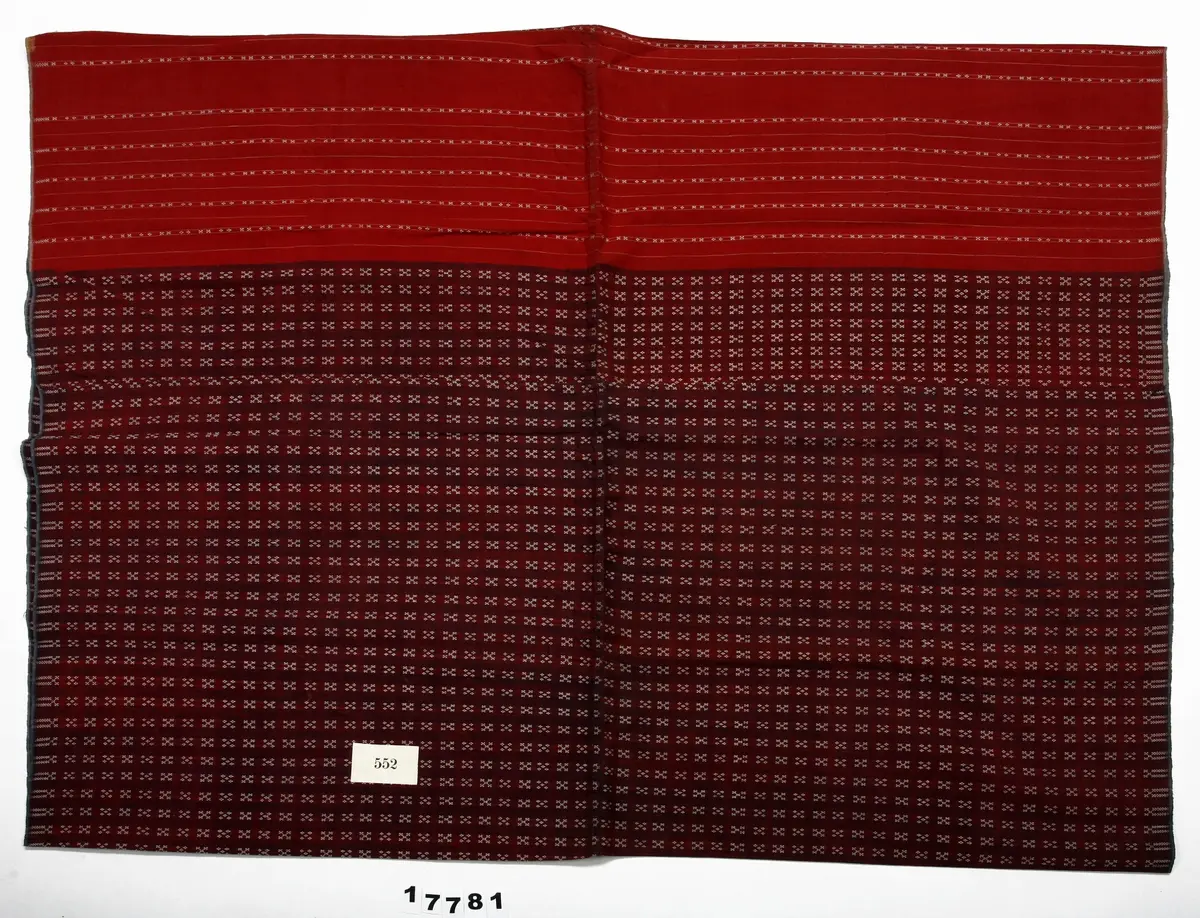
Note: The following text is taken from a 19th-century collection catalog and, in its language and perspective, partially reflects colonial thought patterns. We present the text in its original version to make the collection's history transparent and promote a critical examination of the colonial legacy. Certain terms and formulations may be perceived as problematic today. A 2009 research project concluded that most descriptions are factually correct and still usable; only a few details were found to be inaccurate or incorrect. The results of this project were published in the following collection catalog: khm-wmw-tm-library.on.worldcat.org/oclc/1457155265"552 - 553. Skirts - "Lipa"The sarong, on South Celebes called Lipa, differs from the sarongs in the rest of the Indian Archipelago by its size. The fabric is narrow, about ¾ of a meter wide, but 2 meters long. Two such pieces are sewn together lengthwise and then sewn together at the narrow ends, similar to the common sarongs. Thus a skirt is made without folds or pleats which is 1 ½ meters long and has a circumference of 2 meters. If one wants to wear it in the normal manner around the waist, then about one-third needs to be folded in. The men, who always wear these short, fold them over by half. Both men and women cover themselves with this, but even more completely than the previous ones; and women understand, in their completely open manner, to wind it in the most graceful way around their bodies and throw it over their shoulders. The way this sarong is worn requires many folds, because it is so large. When the women are enveloped in one of these large, heavy sarongs, one can admire the true classical laying of folds and be reminded of the clothing of the Greeks and Romans. If the women have no other piece of clothing besides the sarong, then they pull it up over their back in such a way that it is stretched over their breast and under their armpits to the back. The right hand is held up and holds the sarong over her head towards the front so that her face is fully protected from the sun and also from curious eyes. The part of the sarong that is pulled up when worn and held with the right hand can also be pulled completely to the front over the armpit, where it is then stretched with the arm bent at the elbow, similar to an antique toga. For festive occasions two such sarongs are needed, one slightly folded up and fastened around the waist, the other in the way described, thrown over the upper body. These two sarongs here both are very nice work; especially the "heads", or "kapala" are exceptional in the raised designs, in blue, brown, white and violet."Translation of: Czurda, F. A. J. (1883). Catalog mit Erklärungen der Etnografischen Privatsammlung des Dr. F. A. J. Czurda in Postelberg (Böhmen). (p. 143-144). Wien, Wilhelm Braumüller
Collector:
František A. J. Czurda (1844 Pisek - 1886 Cirebon) DNB
Entry Date:
1883
Object Name
Sarong
Culture
Süd-Sulawesi, Mallasoro
Material/technology:
Silk ?; plain weave, hand seam
Copyright
Weltmuseum Wien
Collection area
Insular Southeast Asia
Invs.
17781