Sculpture
Singa Ambara Raja
19th century | Helene Potjewijd
In bali, a statue of a winged lion is often placed at the joining of the beams of a building's roof structure. The sculpture acts as a symbolic protector to fend off spirits that might disturb the occupants. The ridge of a tent-shaped roof in Bali rests upon a vertical post; this post rests on a horizontal beam, and this in its turn rest upon the poles of the house or small temple structure. The place where the vertical post rests on the horizontal beam is often embellished with a fine piece of wood-carving, such as garuda. This winged lion served the purpose indicated.
Aus: Sri Kuhnt-Saptodewo [u.a]: Balinese Art in Transition. Wien: Museum für Völkerkunde Wien and The Embassy of the Republic of Indonesia, 2010, S.11.

In bali, a statue of a winged lion is often placed at the joining of the beams of a building's roof structure. The sculpture acts as a symbolic protector to fend off spirits that might disturb the occupants. The ridge of a tent-shaped roof in Bali rests upon a vertical post; this post rests on a horizontal beam, and this in its turn rest upon the poles of the house or small temple structure. The place where the vertical post rests on the horizontal beam is often embellished with a fine piece of wood-carving, such as garuda. This winged lion served the purpose indicated.
Aus: Sri Kuhnt-Saptodewo [u.a]: Balinese Art in Transition. Wien: Museum für Völkerkunde Wien and The Embassy of the Republic of Indonesia, 2010, S.11.
Collection:
Helene Potjewijd (1872 Meester Cornelis /Java - 1949 Wien)
Time:
19th century
Entry Date:
1946
Object Name
Sculpture
Culture
Bali
Material/technology:
Wood
Copyright
Weltmuseum Wien
Collection area
Insular Southeast Asia
Geography
Insulares Südostasien/Indonesien/Bali
Invs.
130570
Browse more Similar items you might be interested in

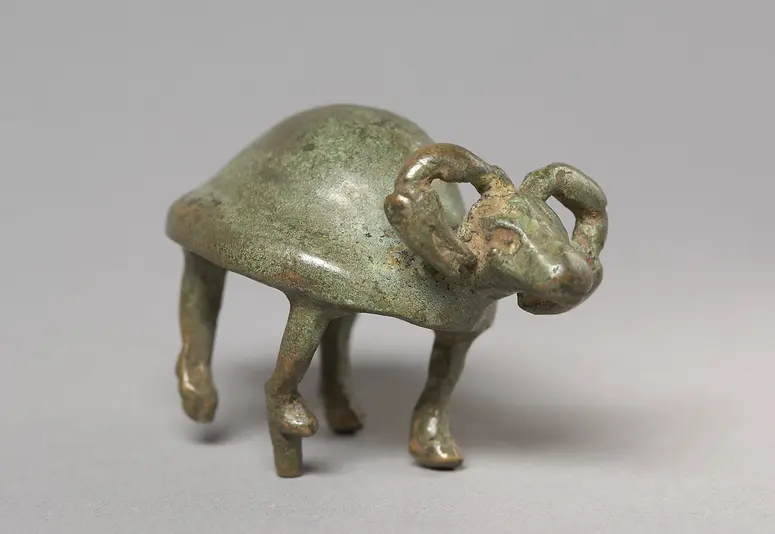
Water buffalo k. k. Münz- und Antikenkabinett Bronze-Iron Age (3rd century BC - 14th century AD)

Anklet Franz Ferdinand von Österreich-Este before 1893

Neck ornament Franz Ferdinand von Österreich-Este before 1893