Shamanic drums in the museum of Minusinsk
1891/1892 | Fredrik Robert Martin
The illustrated shamanic drums are today counted amongst the archaic maps. In contrast to a physical map, they instead functioned as cognitive maps, as a spiritual model of the external realm. The cognitive map portrays the direct, sensorily represented environment, but also the abstract, indirectly mediated environment. It enables the shaman to gather information regarding the spatial environment, organise it, save it, retrieve it, and process it. The cognitive map is a subjective construction of the shaman, shaped by his world knowledge and intentions. His drum is, so to speak, a computer, and the user may exploit its capacity according to his own knowledge which is only accessible to the initiated. The "greater" the power of the shaman who uses the drum, the more differentiated is the information that he can retrieve from it. After the death of the shaman, the drumskin is slit open so that the drum's spirit can escape.

The illustrated shamanic drums are today counted amongst the archaic maps. In contrast to a physical map, they instead functioned as cognitive maps, as a spiritual model of the external realm. The cognitive map portrays the direct, sensorily represented environment, but also the abstract, indirectly mediated environment. It enables the shaman to gather information regarding the spatial environment, organise it, save it, retrieve it, and process it. The cognitive map is a subjective construction of the shaman, shaped by his world knowledge and intentions. His drum is, so to speak, a computer, and the user may exploit its capacity according to his own knowledge which is only accessible to the initiated. The "greater" the power of the shaman who uses the drum, the more differentiated is the information that he can retrieve from it. After the death of the shaman, the drumskin is slit open so that the drum's spirit can escape.
Photographer:
Fredrik Robert Martin (1868 Stockholm - 1933 Kairo) DNB
Time:
1891/1892
Object Name
Print
Culture
Russia, Siberia; Soyot, Evenki
Material/technology:
Albumen print, mounted on card
Copyright
Weltmuseum Wien, Fotosammlung
Collection area
Photo Collection
Geography
Nordasien/Russland/Sibirien
Browse more Similar items you might be interested in




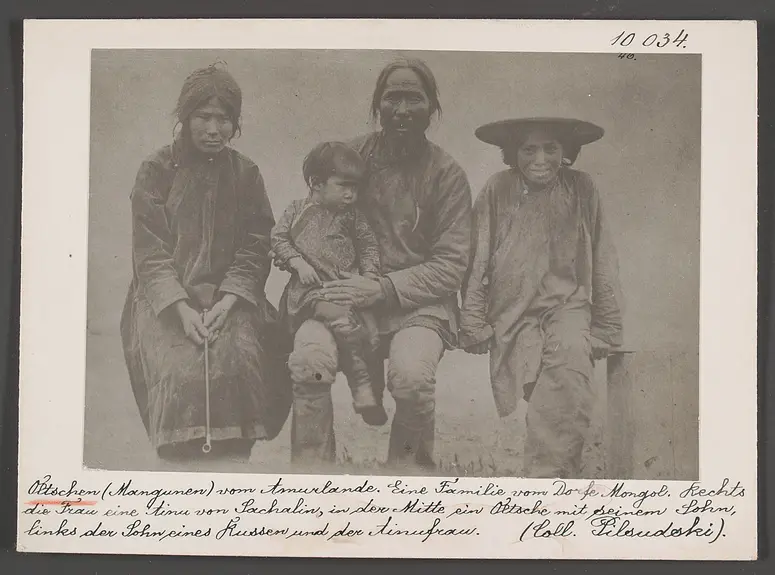
Eine Familie von Mongol. Links die Frau eine Ainu von Sachalin, rechts der Sohn eines Russen und der Ainufrau. Bronislaw Piotr Pilsudski um 1900