Spinning wheel
Ganra
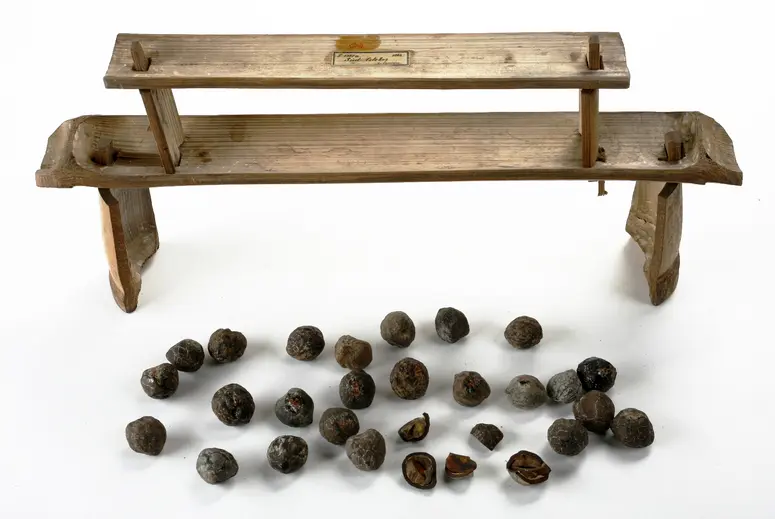
Note: The following text is taken from a 19th-century collection catalog and, in its language and perspective, partially reflects colonial thought patterns. We present the text in its original version to make the collection's history transparent and promote a critical examination of the colonial legacy. Certain terms and formulations may be perceived as problematic today. A 2009 research project concluded that most descriptions are factually correct and still usable; only a few details were found to be inaccurate or incorrect. The results of this project were published in the following collection catalog: khm-wmw-tm-library.on.worldcat.org/oclc/1457155265"529. Spinning wheel - "Ganra"A spinning wheel, about half a meter high and very light and delicately built. It consists of two rows of spokes which are connected to each other on the periphery by wool cord which has been applied cross-wise. Over this wool cord, which connects the two rows of spokes, runs a long driving cord to a slat about a foot long which has been fastened to two vertical posts so that it can rotate between cane rings. The large wheel is only set into motion by a crank, whereby these round sticks are also driven by the driving cord and rotate quickly. As one person turns the large wheel, the woman who is spinning lets the cotton fibres, which are in a basket, run onto the little slat which has, at the top, is an attachment of horn onto which the beginning of the thread is tied."Translation of: Czurda, F. A. J. (1883). Catalog mit Erklärungen der Etnografischen Privatsammlung des Dr. F. A. J. Czurda in Postelberg (Böhmen). (p. 136). Wien, Wilhelm Braumüller
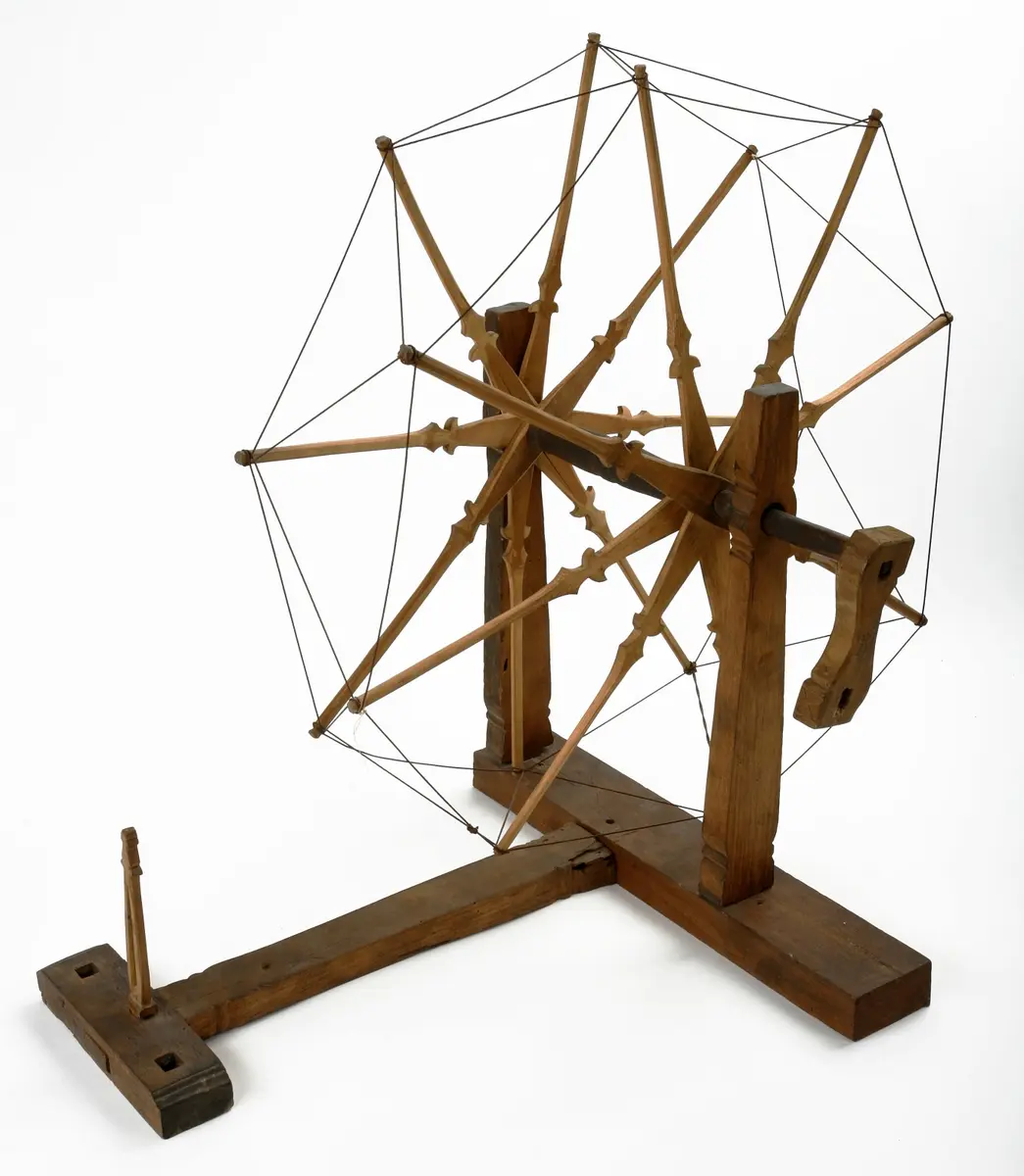
Note: The following text is taken from a 19th-century collection catalog and, in its language and perspective, partially reflects colonial thought patterns. We present the text in its original version to make the collection's history transparent and promote a critical examination of the colonial legacy. Certain terms and formulations may be perceived as problematic today. A 2009 research project concluded that most descriptions are factually correct and still usable; only a few details were found to be inaccurate or incorrect. The results of this project were published in the following collection catalog: khm-wmw-tm-library.on.worldcat.org/oclc/1457155265"529. Spinning wheel - "Ganra"A spinning wheel, about half a meter high and very light and delicately built. It consists of two rows of spokes which are connected to each other on the periphery by wool cord which has been applied cross-wise. Over this wool cord, which connects the two rows of spokes, runs a long driving cord to a slat about a foot long which has been fastened to two vertical posts so that it can rotate between cane rings. The large wheel is only set into motion by a crank, whereby these round sticks are also driven by the driving cord and rotate quickly. As one person turns the large wheel, the woman who is spinning lets the cotton fibres, which are in a basket, run onto the little slat which has, at the top, is an attachment of horn onto which the beginning of the thread is tied."Translation of: Czurda, F. A. J. (1883). Catalog mit Erklärungen der Etnografischen Privatsammlung des Dr. F. A. J. Czurda in Postelberg (Böhmen). (p. 136). Wien, Wilhelm Braumüller
Collector:
František A. J. Czurda (1844 Pisek - 1886 Cirebon) DNB
Entry Date:
1883
Object Name
Spinning wheel
Culture
Süd-Sulawesi, Mallasoro
Material/technology:
Wood, thread
Copyright
Weltmuseum Wien
Collection area
Insular Southeast Asia
Invs.
17758