Sword
Sumara
Note: The following text is taken from a 19th-century collection catalog and, in its language and perspective, partially reflects colonial thought patterns. We present the text in its original version to make the collection's history transparent and promote a critical examination of the colonial legacy. Certain terms and formulations may be perceived as problematic today. A 2009 research project concluded that most descriptions are factually correct and still usable; only a few details were found to be inaccurate or incorrect. The results of this project were published in the following collection catalog: khm-wmw-tm-library.on.worldcat.org/oclc/1457155265"90. Sword - "Kalewang".A "Kalewang", similar to those described above. The hilt has is bent away from the cutting edge to be nearly at right angles and is handsomely carved. The simple wooden sheath is bound with split rattan, the blade damascened."Translation of: Czurda, F. A. J. (1883). Catalog mit Erklärungen der Etnografischen Privatsammlung des Dr. F. A. J. Czurda in Postelberg (Böhmen). (p. 19-20). Wien, Wilhelm Braumüller
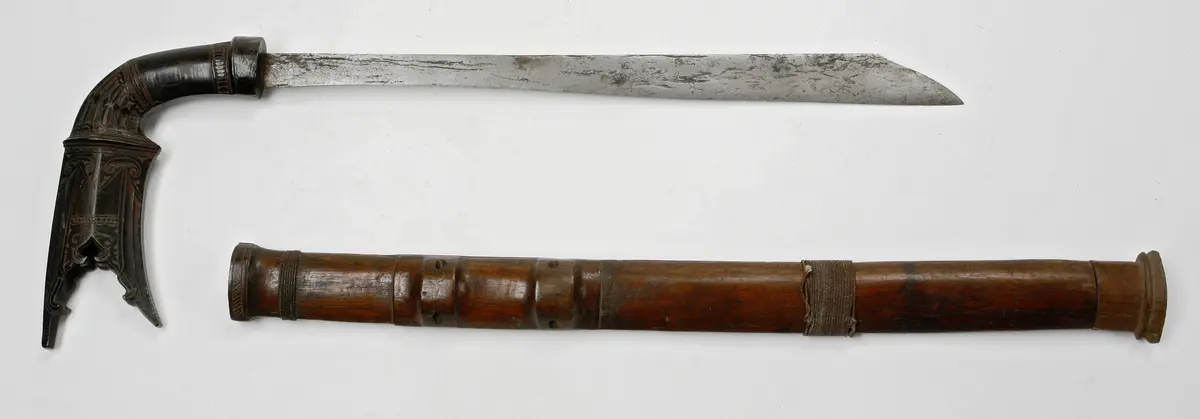
Note: The following text is taken from a 19th-century collection catalog and, in its language and perspective, partially reflects colonial thought patterns. We present the text in its original version to make the collection's history transparent and promote a critical examination of the colonial legacy. Certain terms and formulations may be perceived as problematic today. A 2009 research project concluded that most descriptions are factually correct and still usable; only a few details were found to be inaccurate or incorrect. The results of this project were published in the following collection catalog: khm-wmw-tm-library.on.worldcat.org/oclc/1457155265"90. Sword - "Kalewang".A "Kalewang", similar to those described above. The hilt has is bent away from the cutting edge to be nearly at right angles and is handsomely carved. The simple wooden sheath is bound with split rattan, the blade damascened."Translation of: Czurda, F. A. J. (1883). Catalog mit Erklärungen der Etnografischen Privatsammlung des Dr. F. A. J. Czurda in Postelberg (Böhmen). (p. 19-20). Wien, Wilhelm Braumüller
Collector:
František A. J. Czurda (1844 Pisek - 1886 Cirebon) DNB
Entry Date:
1883
Object Name
Sword
Culture
Sulawesi
Material/technology:
Iron; forged, horn. Sheath: wood, thread
Copyright
Weltmuseum Wien
Collection area
Insular Southeast Asia
Invs.
17405