Tattoo template with Christian motifs
before 1976 | Peter Wolfgang Schienerl
In Cairo the most famous saints have their weekly visiting day. For Imam Shafi’i it is Friday. The mausoleum of the legal scholar, who died in 820, is located in the southern necropolis, the Qarafa, and counts amongst the most popular site for Muslim pilgrimage in the city. In the mid-1970s a wandering tattoo artist sets up his reverse glass paintings every week on the market place in front of the Shafi’i Mausoleum and waits for customers: Muslims as well as Copts, men and women, adults and children. One of the reverse glass paintings acquired from him shows crosses in a variety of appearances, and two images of the Virgin Mary, once as the Mother of God, and again as Our Lady of Sorrows. This latter image served as a model for the Mater Dolorosa of the Florentine seventeenth century master Carlo Dolci, as it attained cult status from Alexandria to Aswan among Christians. It is said that, in a church on the west bank of the Nile, a coloured print of Dolci's Our Lady of Sorrows "cried tears of blood" from her right eye for the persecuted Copts. In times of religious affliction, Christian Egyptians increasingly identify with the stigma of the cross, and have the image of it tattooed over their pulse vein on their right wrist.
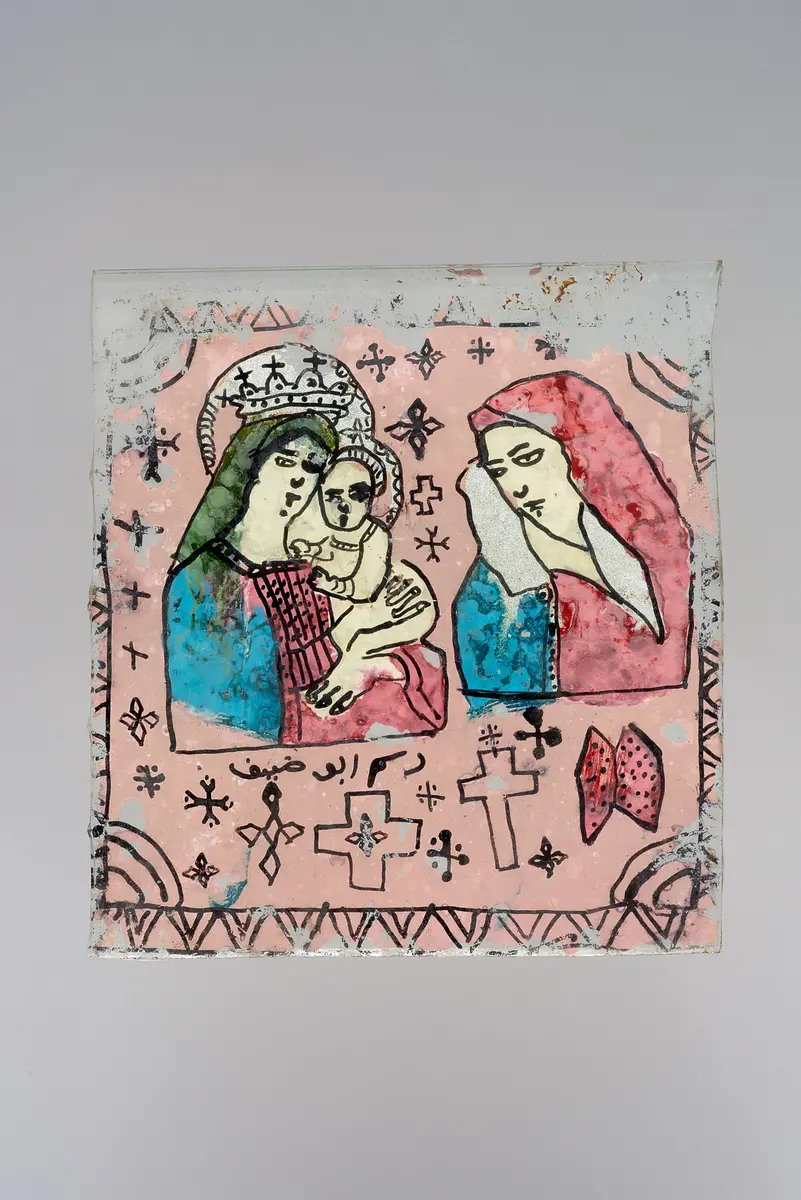
In Cairo the most famous saints have their weekly visiting day. For Imam Shafi’i it is Friday. The mausoleum of the legal scholar, who died in 820, is located in the southern necropolis, the Qarafa, and counts amongst the most popular site for Muslim pilgrimage in the city. In the mid-1970s a wandering tattoo artist sets up his reverse glass paintings every week on the market place in front of the Shafi’i Mausoleum and waits for customers: Muslims as well as Copts, men and women, adults and children. One of the reverse glass paintings acquired from him shows crosses in a variety of appearances, and two images of the Virgin Mary, once as the Mother of God, and again as Our Lady of Sorrows. This latter image served as a model for the Mater Dolorosa of the Florentine seventeenth century master Carlo Dolci, as it attained cult status from Alexandria to Aswan among Christians. It is said that, in a church on the west bank of the Nile, a coloured print of Dolci's Our Lady of Sorrows "cried tears of blood" from her right eye for the persecuted Copts. In times of religious affliction, Christian Egyptians increasingly identify with the stigma of the cross, and have the image of it tattooed over their pulse vein on their right wrist.
Collector:
Peter Wolfgang Schienerl (1940 Wien - 2001 München) DNB
Time:
before 1976
Entry Date:
1977
Object Name
Reverse painting on glass
Culture
Egypt, Cairo; Copts
Material/technology:
Glass, pigment
Dimensions:
14.1 × 12.8 cm
Signed
Abu Seif
Copyright
Weltmuseum Wien
Collection area
North Africa, Middle East, Central Asia and Siberia
Invs.
158264