The Day of Judgement, Rūz-e mahshar
qalamkār-e taswīrī
late 19th century | Saeed Motamed
Iraq, Kerbala, 10 October 680. Superior forces of the Sunni Umayyad Caliph Yazid slaughter the small group of the Shiite Imam Hussein. The bloodbath destroys the hope of the Shiites to install their religious-political leader as caliph – and seals the schism of the Muslim community. For the Shiites, the battle of Kerbala becomes an archetype of religious martyrdom and the rebellion against illegitimate Muslim rulers. Iran, Isfahan, late 19th century. A painted wall-hanging depicts the Day of Judgement from a Shiite perspective. The main theme is the reward given in paradise to the martyrs who fell at Kerbala, and the agonies of their enemies on Judgement Day. Yet the final tohuwabohu is flirting with elements of Christian iconography. There is the trumpeting angel who blows into the bugle at the Last Judgement; the receiving of the arisen into heaven; the two angels who attend to the weighing scale of the souls; the chosen ones who in rows await their entry into paradise; the blood witnesses who in advance enjoy the delights of paradise; and finally those of different faith and traitors, who, already condemned, stand before the infernal ground. But there are also new elements: the prophet of Islam is now an established, important figure, and Christ, the judge of the world, assumes the part of a precursor-prophet. Visions of the end of days are projections of earthly blood courts.Syria, Aleppo, Christmas 2016. After the capturing of the city, Shiite fighters hoist their flag up above the Umayyad Mosque, as if in doing so, the death of the martyrs in Kerbala over 1,300 years ago has now been avenged.
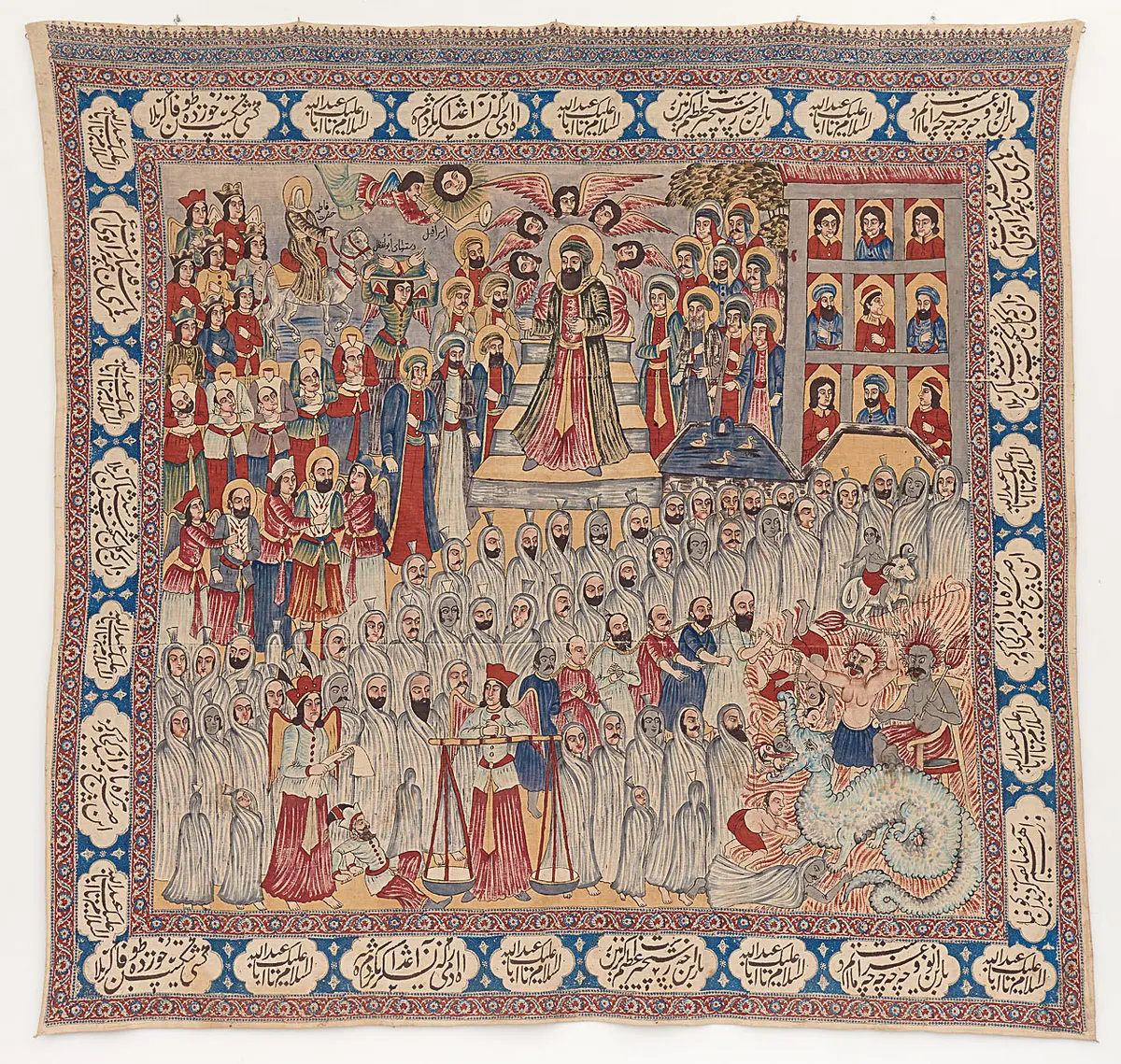
Iraq, Kerbala, 10 October 680. Superior forces of the Sunni Umayyad Caliph Yazid slaughter the small group of the Shiite Imam Hussein. The bloodbath destroys the hope of the Shiites to install their religious-political leader as caliph – and seals the schism of the Muslim community. For the Shiites, the battle of Kerbala becomes an archetype of religious martyrdom and the rebellion against illegitimate Muslim rulers. Iran, Isfahan, late 19th century. A painted wall-hanging depicts the Day of Judgement from a Shiite perspective. The main theme is the reward given in paradise to the martyrs who fell at Kerbala, and the agonies of their enemies on Judgement Day. Yet the final tohuwabohu is flirting with elements of Christian iconography. There is the trumpeting angel who blows into the bugle at the Last Judgement; the receiving of the arisen into heaven; the two angels who attend to the weighing scale of the souls; the chosen ones who in rows await their entry into paradise; the blood witnesses who in advance enjoy the delights of paradise; and finally those of different faith and traitors, who, already condemned, stand before the infernal ground. But there are also new elements: the prophet of Islam is now an established, important figure, and Christ, the judge of the world, assumes the part of a precursor-prophet. Visions of the end of days are projections of earthly blood courts.Syria, Aleppo, Christmas 2016. After the capturing of the city, Shiite fighters hoist their flag up above the Umayyad Mosque, as if in doing so, the death of the martyrs in Kerbala over 1,300 years ago has now been avenged.
Collector:
Saeed Motamed (1925 - 2013)
Time:
late 19th century
Entry Date:
1958
Object Name
Painted wall-hanging
Culture
Iran, Isfahan
Material/technology:
Cotton, pigment
Dimensions:
H. 350 cm, W. 370 cm
Copyright
Weltmuseum Wien
Collection area
North Africa, Middle East, Central Asia and Siberia
Period
Qajaren-Zeit
Invs.
137901