Yurupari trumpet
before 1972 | Wolfgang Ptak
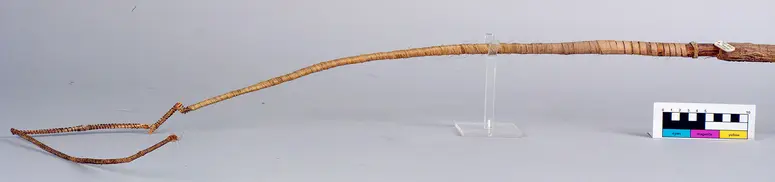
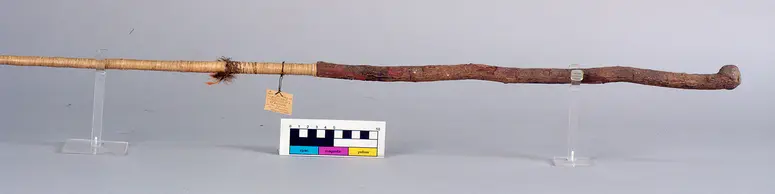
The flutes and trumpets of the Yurupari represent the bones of the primordial human being, the creator that brought the first ancestors of all human peoples into being. In the course of his initiation, the creator’s father pushed him into the fire. Out of the ashes rose a palm tree, which the father used to fashion the Yurupari instruments. When he was still alive, the primordial human being already had numerous orifices emitting music. This music can still be heard – also by those uninitiated – when the Yurupari instruments are played during rituals. As the instruments may not be shown in public, there is no photo of this object in the online database.

The flutes and trumpets of the Yurupari represent the bones of the primordial human being, the creator that brought the first ancestors of all human peoples into being. In the course of his initiation, the creator’s father pushed him into the fire. Out of the ashes rose a palm tree, which the father used to fashion the Yurupari instruments. When he was still alive, the primordial human being already had numerous orifices emitting music. This music can still be heard – also by those uninitiated – when the Yurupari instruments are played during rituals. As the instruments may not be shown in public, there is no photo of this object in the online database.
Collection:
Wolfgang Ptak
Collection:
Fritz Trupp (geb. 1943) DNB
Time:
before 1972
Entry Date:
1973
Object Name
Yurupari trumpet
Culture
Makuna Ide hino masá
Material/technology:
Chonta palm wood, bark strips, wood, bast
Copyright
Weltmuseum Wien
Collection area
South America
Invs.
154026
Browse more Similar items you might be interested in




Aufnahmen vom Besuch der Pacaas Novos am Ouro Preto; Francisco Mereiles, ein Tupari Indio, zwei Pacaas Novos Etta Becker-Donner 1956