Jump to navigation Jump to content Jump to contact Jump to search Jump to search Jump to footer

East Asia: China, Korea, Japan

In the year 2017, the East Asia Collection with its objects from China, Korea, and Japan comprises ca. 28,500 objects, 15,000 of which are from just one country: Japan.

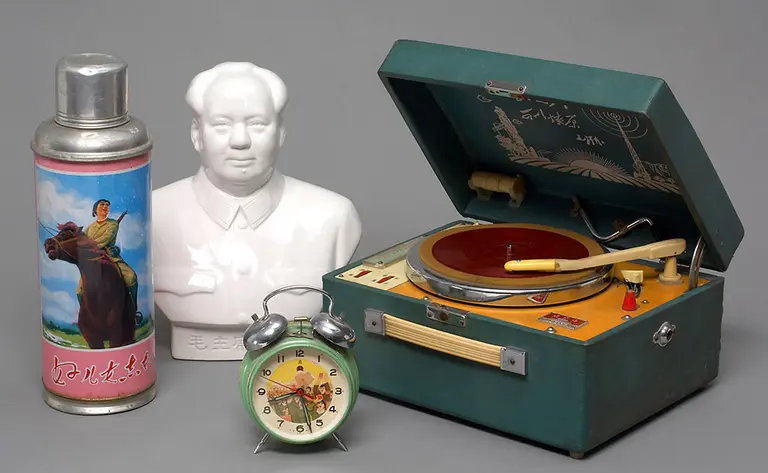
A vintage green phonograph with a red turntable sits open, next to a white porcelain bust of a man. Also displayed are a silver spray can featuring a colorful image and a round alarm clock with a cartoon character. The background is plain gray.

About the collection

While almost 12,000 artefacts were collected in the cultural region of China, the small collection of ca. 1,500 objects on Korea was primarily assembled in the late 19th century. The focus of the collection is on objects of daily life from these regions. As the greater part of the collection was compiled in the 19th century, it is an important witness of cultural history as well as a fundamental document of economic history.

The collection also features exceptional artistic objects from Japan, such as the throne screen from the Qing dynasty, Qianlong period ( 1736 - 1795 ), or the house model of a daimyō residence presented at the Vienna World’s Fair in 1873.

Research projects on the collection

Publications

Danced Creation
Exhibition Catalogue 2013 Danced Creation
Danced Creation
Exhibition Catalogue 2013 Danced Creation

Contact

Dr. Bettina Zorn
Curator
+43 1 534 30 – 5117
bettina.zorn@weltmuseumwien.at

History of the collection

The earliest object listed in the collection is a Chinese glass armlet imitating jade. It was part of the Parkinson Collection of Sir Ashton Lever. As part of the Cook Collection, few artefacts of this collection were acquired for the imperial family at an auction in London in 1806. One of the focus areas of the collection are artistic and ethnographic objects from Japan, not least due to the collection of Heinrich von Siebold, which has been at the Weltmuseum Wien as a donation to the ethnographic-anthropological department of the Imperial and Royal Court Museum of Natural History (Museum of Ethnology as of 1928) since 1888, and encompasses 5,315 objects. Moreover, no less than the heir to the throne, Archduke Franz Ferdinand of Austria-Este, contributed to this Japanese emphasis, assembling numerous valuable objects on his voyage of circumnavigation in 1892/1893. Among the highlights of his collection are gigaku masks that were believed to originate in the 8th or 9th century for more than 100 years. According to more recent research, the masks, were given the status of national treasures in Japan, are copies made in the 19th century. The collection also includes objects of the Ainu and Ryûkyû people.   

In the 1960s, the period of Japan’s industrialisation, japanologists and ethnologists collected artefacts of traditional folk culture as well as agricultural objects. They are already considered important historical documents.

The collections on China were not assembled in such homogenous manner. The earliest holdings from China and Korea derive from 19th century voyages around the world or from consular collections. Most objects were collected in the large cities of the coastal region and cover the southwest and northwest of China. A few years ago, the Museum was able to acquire an extensive collection on the personality cult of Mao Zedong from the time of the cultural revolution (1966 – 1976).  In the course of the exhibition of shamanism of 1998/99, a Korean shamanist altar was acquired.

Further collections and departments