Jump to navigation Jump to content Jump to contact Jump to search Jump to search Jump to footer

North Africa, West and Central Asia, Siberia

With its inventory of nearly 25,000 objects, the North Africa, Middle East, Central Asia and Siberia Collection at the Weltmuseum Wien ranks among the world’s most important collections pertaining to the everyday culture and characteristic objects of the respective region.

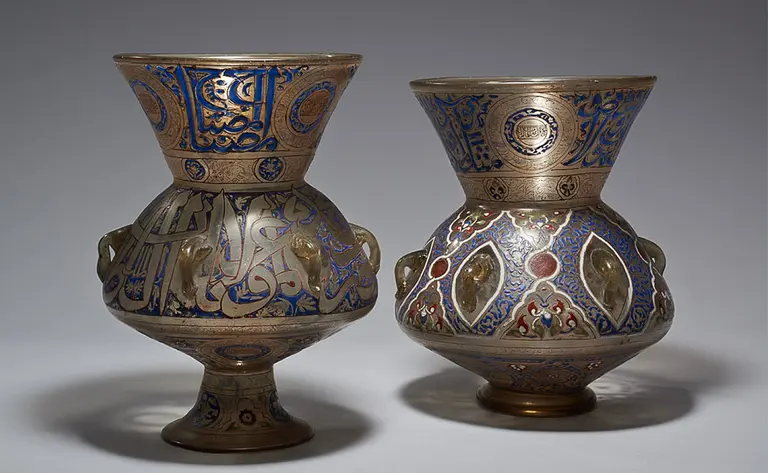
Two decorative vases side by side, featuring intricate designs. The vase on the left has ornate calligraphy and colorful patterns in gold and blue, while the vase on the right displays a mix of geometric shapes and floral motifs in similar hues.

About the collection

The objectives that determined the collecting strategy of this department over the past decades are reflected in the individual areas of the collection.

One major goal during the second half of the 20th century was to systematically and selectively document Oriental craftsmanship throughout the ages, while another was to cover the symbolic forms in which folk piety was expressed in the four great monotheistic religions of the Middle East (Zoroastrianism, Judaism, Christianity, and Islam). This approach meant that only very few, if any, objects were documented and collected as “artwork”, most being instead acquired and studied in their historical, socioeconomic and cultural contexts. The by now mainly historical collections cover everyday culture in the Maghreb, Egypt, Anatolia, Iran, and Afghanistan during the 19th and 20th century, as well as the material culture of the so-called “small-numbered indigenous peoples” of the Russian Far East around 1900.

Research projects on the collection

Publications

Veiled, Unveiled! The Headscarf
Exhibition Catalogue 2018 Veiled, Unveiled! The Headscarf
Veiled, Unveiled! The Headscarf
Exhibition Catalogue 2018 Veiled, Unveiled! The Headscarf
Straps and Bands
Exhibition Catalogue 2008 Straps and Bands

Contact

Dr. Tobias Mörike
Curator
+43 1 534 30- 5030
tobias.moerike@weltmuseumwien.at

History of the collection

The collection’s oldest entries date back to the year 1804. This small core inventory experienced successive expansion at the beginning of the 19th century thanks to the collecting activities of researchers and amateur ethnologists, such as Karl Alexander Anselm von Hügel (1795–1870) who collected numerous ethnographic items in places including Syria, South Yemen and Iran on his voyage of circumnavigation between 1831 and 1836. In 1880 and 1881, the anthropological-ethnographic department of the Imperial and Royal Court Museum of Natural History was entrusted with parts of the famous Ambras Collection, including several objects from Nubia, which had been collected by Filippo Agnello on site in 1804, as well as collections attributed to other members of the House of Habsburg, including ethnographic objects of exceptional value from the Islamic world. Between 1881 and 1891, Franz Heger (1853–1931), head of the anthropological-ethnographic department as of 1884, conducted several collecting journeys that took him to Russia, Georgia, and today’s Uzbekistan. Between 1884 and 1892, Josef Troll (1844–1919), a representative of Vienna’s wealthy bourgeoisie, brought back over 1,100 ethnographic objects from his four extended trips to Asia – Turkey, Syria, Iran, Iraq, Uzbekistan, and southern Siberia – which found their way into the Oriental collections of the Museum.

The lion’s share of the Northern Eurasia Collection was acquired between 1881 and 1911. Alongside the small Sami Collection, there is the extensive Siberian Collection donated by the German-Russian entrepreneurs Adolph Traugott Dattan and Adolf Wasiljewitsch Dattan (1854–1924), a collection which impressively documents the everyday culture, economic life, rituals, and religion of the so-called “small-numbered indigenous peoples” of the Russian Far East.

Targeted academic collecting and documentation activities only began in 1902, when Wilhelm Hein (1861–1903) together with his wife Marie conducted ethnographic and linguistic research in Qishn, southern Yemen, among the Mahra tribe. Thanks to this Mahra Collection, the Weltmuseum Wien is the only museum in the world to possess the entire repertoire of specifically Mahra objects in one place, thus documenting a group which, despite its simplicity, is both highly diverse and unique in its cultural-historical context.

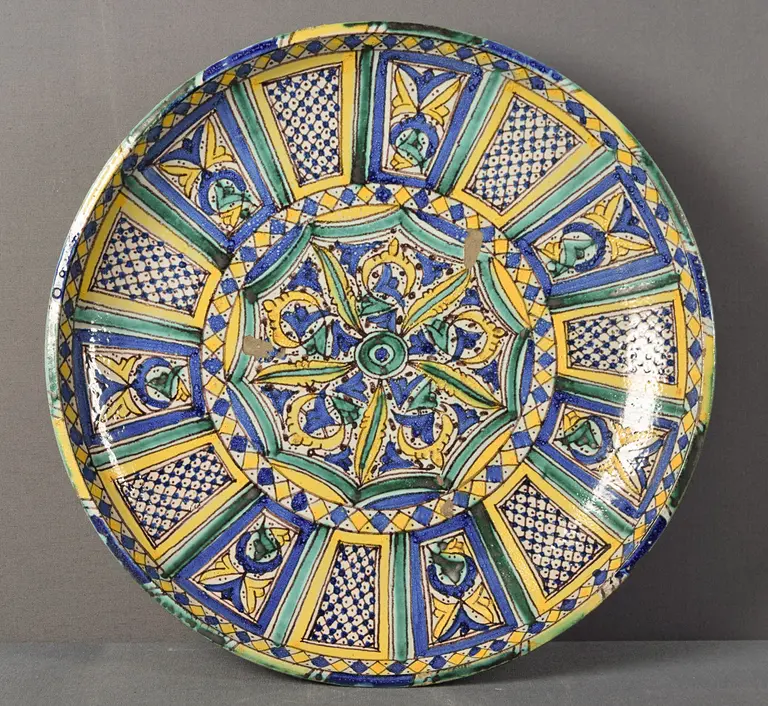
When the Ethnographic Department was removed from the Museum of Natural History and became an independent Museum of Ethnology in the Imperial Palace’s [Hofburg] Corps the Logis in 1927, North Africa was one of the regions that had been hardly or not at all documented. Nevertheless, there been early acquisitions, such as the faience objects from Morocco, ceramics of the Kabyle people of northern Algeria, textiles interwoven with gold and silver from Tunisia, Upper Egyptian ceramics, and smoking pipe bowls as well as all kinds of hollow vessels in a mixed historical-Egyptian style from the period before World War I. During the 1930s, the ethnologists Julia Humann-Wagner-Jauregg and Ludwig Gustav Alois Zöhrer began putting together a small Touareg Collection from scratch. This collection was expanded by the ethnologist and art historian Gertraud Bogner who added metalworking devices, amulets, and jewellery in 1981. A systematic enlargement of the collection on the popular culture of Egypt was only initiated in 1973 thanks to the collaboration between the ethnologist and jewellery expert Peter W. Schienerl (1940–2001) and the department head of the time, Alfred Janata (1933–1993). In addition to the ethnographic objects (which had been either purchased from merchants and craftsmen in Cairo as well as other places in Egypt, or collected during field research in the oases of Siwa, Fayyum, Bahriyya as well as on the Sinai Peninsula), Islamic, Jewish and Coptic religious objects also entered the collection. The Siwa Collection was complemented by contributions from the Swiss collector Bettina Leopoldo in the late 1980s.

In 1979 under the university assistant Josef Salat (1947–1985), students from the Department of Ethnology at the University of Vienna began putting together a collection on Turkish craftsmanship. At the same time, Werner Finke and Markus De Zordo spent several years, mostly for the Museum of Ethnology, documenting traditional crafts from the Istanbul region and the popular culture of Anatolia, including the material culture of the Kurds of eastern Anatolia and the Yörük nomads.

The early 1980s saw the compilation of an entirely new collection of Oriental Jewish artefacts. While Western Jewish craftsmanship is well documented in Jewish museums, this collection seems to be one of the very few in Europe to recognise products of Oriental Jewish popular culture as an independent area of collecting.

In the early 1960s, the Museum received its first high-quality and extensive collection from Afghanistan thanks to Ludwig G. A. Zöhrer. Alfred Janata, for the most part working together with his wife Irmgard, expanded the Viennese Afghanistan Collection in the years that followed. A prominent position in this collection is dedicated to everyday items and textile products of the western Afghan Chahar Aimak people, tools and products of Tajik craftsmen, and objects of daily life of the sedentary and nomadic Pashtuns from the country’s south-eastern province of Paktya. In the 1970s, a small Nuristan Collection was put together with the help of art historian and ethnologist Max Klimburg. In 1977, the textile expert Wilfried Stanzer acquired a yurt of the Zai Reza Firuzkuhi for the Museum. During the 1970s and 1980s, objects from the Afghanistan Collection were among the Museum’s more frequently exhibited pieces. In the year 2003, the special exhibition “Afghanistan” at the then Museum of Ethnology provided insight into the history and special character of the collection in Vienna.

Further collections and departments