Jump to navigation Jump to content Jump to contact Jump to search Jump to search Jump to footer

Oceania and Australia

Some 30,000 objects tell of the everyday and ritual worlds in Polynesia, Melanesia, Micronesia, and Australia.

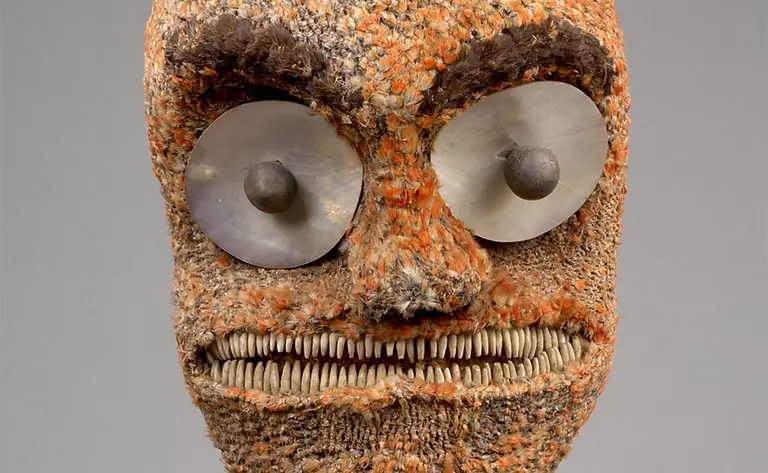
A textured mask with exaggerated facial features, including large round eyes made from shell materials and a wide, toothy grin. The mask displays a mix of earthy colors, primarily orange and brown, and has a rough, woven surface.

About the collection

Feather objects from Hawaii that James Cook collected on his journeys, Maori artefacts from New Zealand, an ornamental shield decorated with nautilus shells from the Solomon Islands, extensive collections from New Guinea, and Australian boomerangs, dot paintings, and didgeridoos – to name but a few examples.

The objects document the outstanding technical abilities and artistic achievements of the Pacific inhabitants, as well as their exceptional creativity in fashioning living spaces, social organisations, and world views. Boatbuilding, architecture, clothing, and objects of daily use as well as valuables and ritual artefacts strikingly illustrate regional traditions, yet also material innovation and cultural reform emerging through external influences, exchange and trade relations, colonisation and missionizing, wars and conquests, national resistance movements, and political independence.

Research projects on the collection

Contact

+43 1 534 30-5052
info@weltmuseumwien.at

History of the collection

The tireless passion for collecting of European world travellers, naturalists, colonial officials, missionaries, doctors, diplomats, and patrons of the arts, but also the innovative scientific spirit and the impressive findings of Austrian social and cultural anthropologists are reflected in the Pacific collections. Many objects document Pacific culture at the time when contact was first established with Europe until the present, and as carriers of meaning have high scholarly value.

One of the oldest ethnographic collections of the Weltmuseum Wien derives from the expeditions of the British seafarer James Cook (1728–1779); a total of 238 objects were acquired at a museum auction in London in 1806.

From 1877 to 1889, the Austrian naturalist Andreas Reischek (1845–1902) explored New Zealand. His collection encompasses 467 Maori artefacts that are significant from the perspective of cultural history.

Austria’s first voyage around the world, on the frigate Novara (1857–1859), expanded the Museum’s inventory by 130 objects from the South Seas, of which an ornamental shield from the Solomon Islands decorated with nautilus shells has found worldwide regard.

A meticulously documented collection of 1,600 objects from Melanesia and Micronesia was added by the German zoologist and ethnologist Otto Finsch (1839–1917).

Around 2,000 objects from the South Pacific were assembled on the world tour of the cruiser “Kaiserin Elisabeth” (1892–1893), in which Archduke Franz Ferdinand of Austria-Este took part.

The Viennese doctor and anthropologist Rudolf Pöch (1870–1921) returned from a research expedition to New Guinea (1904–1906) with 3,800 ethnographic objects and extensive audio, photo, and film material. He was entrusted with the professorship in Anthropology and Ethnography at the University of Vienna in 1919.

Numerous research stays between 1969 and 1992 enabled the Viennese ethnologist and curator Hanns Peter (1931–1993) to significantly expand the Museum’s inventory on New Guinea and Australia. The Australia Collection contains 860 objects altogether, including many different forms of throwing sticks and boomerangs, spear throwers, shields, clubs, carrying vessels, clapsticks, and didgeridoos as well as contemporary bark and dot paintings.

Further collections and departments