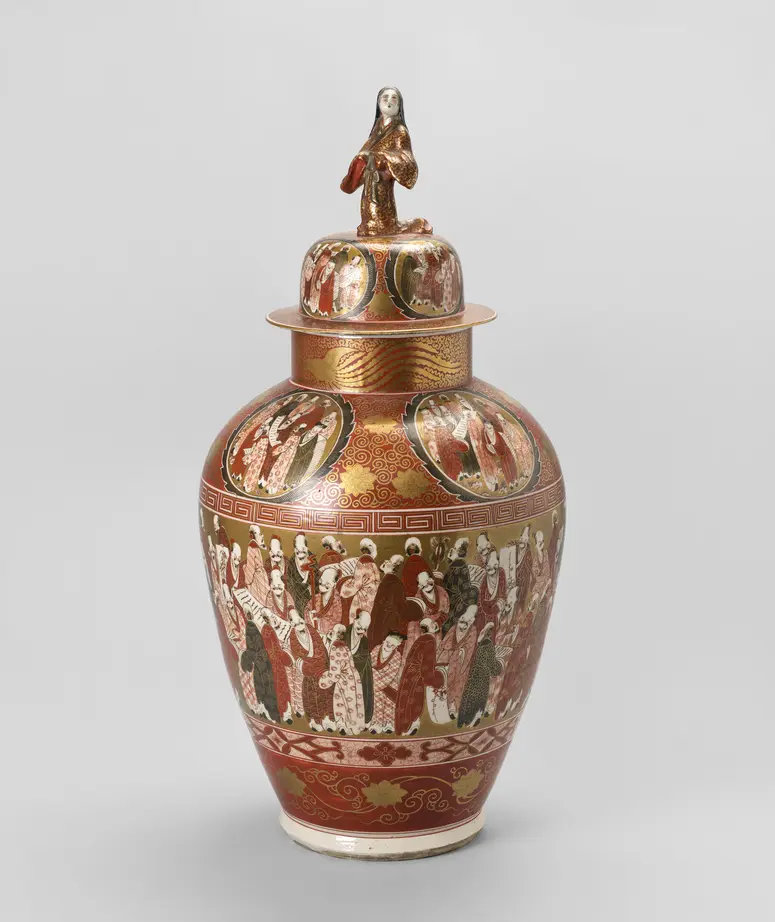
This large jar with a lid is Kutani ware from Ishikawa prefecture. The style of covering an entire vessel’s surface with three painted colors (red, gold, and black) in an intricate pattern is called aka-e aibyo saiko. It was popular from the mid nineteenth century to the early twentieth century. On this work’s body, sides, and lid, in circular frames we find auspicious images of one hundred old people with a very long lifespan. Such images were actively produced in the Kutani ware areas of Nōmi and Kanazawa. This jar is called a jinko tsubo. While the origins of jinko tsubo’s shape lie in Ming dynasty (1638–1644) Jingdezhen kilns, its direct model was the Hizen Koimari gold-plated porcelain produced from the latter half of the seventeenth century into the first half of the eighteenth century in Japan. During this time Koimari jinko tsubo were exported overseas and became very popular amongst royalty and nobility in the West. They decorated castles and palaces. This piece can be described as a Koimari jinko tsubo updated with Kutani ware’s detailed red coloring. Such works were primarily produced in the 1870s and 1880s for export to the West. Masaki ARAKAWA

This large jar with a lid is Kutani ware from Ishikawa prefecture. The style of covering an entire vessel’s surface with three painted colors (red, gold, and black) in an intricate pattern is called aka-e aibyo saiko. It was popular from the mid nineteenth century to the early twentieth century. On this work’s body, sides, and lid, in circular frames we find auspicious images of one hundred old people with a very long lifespan. Such images were actively produced in the Kutani ware areas of Nōmi and Kanazawa. This jar is called a jinko tsubo. While the origins of jinko tsubo’s shape lie in Ming dynasty (1638–1644) Jingdezhen kilns, its direct model was the Hizen Koimari gold-plated porcelain produced from the latter half of the seventeenth century into the first half of the eighteenth century in Japan. During this time Koimari jinko tsubo were exported overseas and became very popular amongst royalty and nobility in the West. They decorated castles and palaces. This piece can be described as a Koimari jinko tsubo updated with Kutani ware’s detailed red coloring. Such works were primarily produced in the 1870s and 1880s for export to the West. Masaki ARAKAWA
Collector:
Heinrich von Siebold (1852 St. Martin/Boppard - 1908 Schloss Freudenstein/Bozen) DNB
Material/technology:
Porcelain
Copyright
Weltmuseum Wien
Collection area
East Asia: China, Korea, Japan
Invs.
34706_b
Browse more Similar items you might be interested in
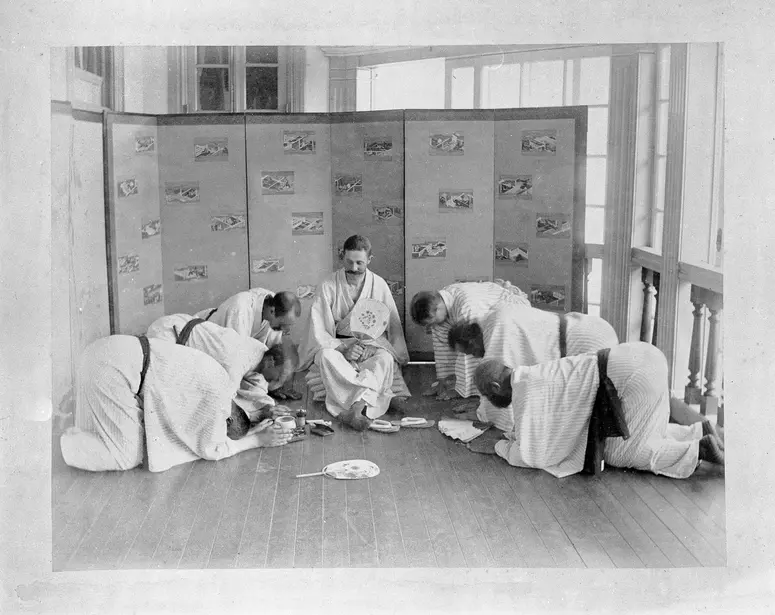
His k.u.k. Highness and entourage in japanese clothing Franz Ferdinand von Österreich-Este 16.8.1893
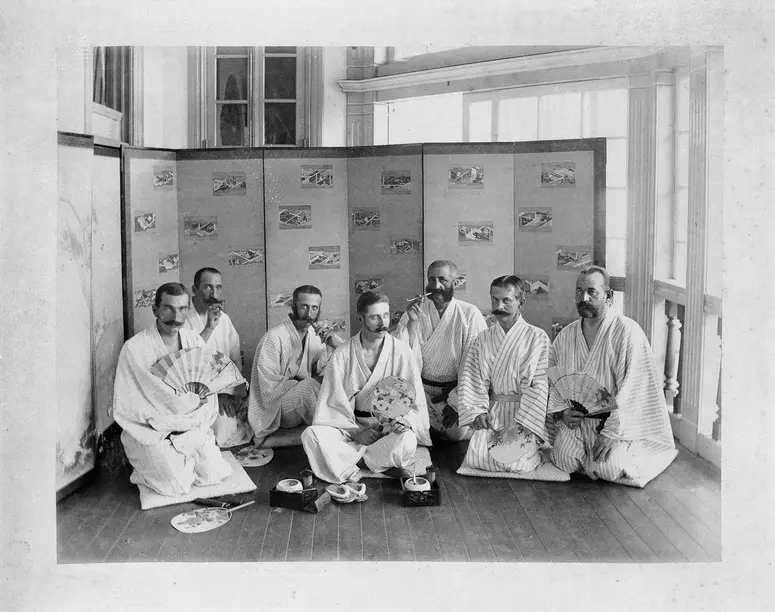
Erzherzog Franz Ferdinand of Austria-Este with Entourage in Japanese costume at the Fujiya Hotel Franz Ferdinand von Österreich-Este 16 August 1893