Al-Malik az-Zahir Baibars
ca. 1900 | Franz Pernegger
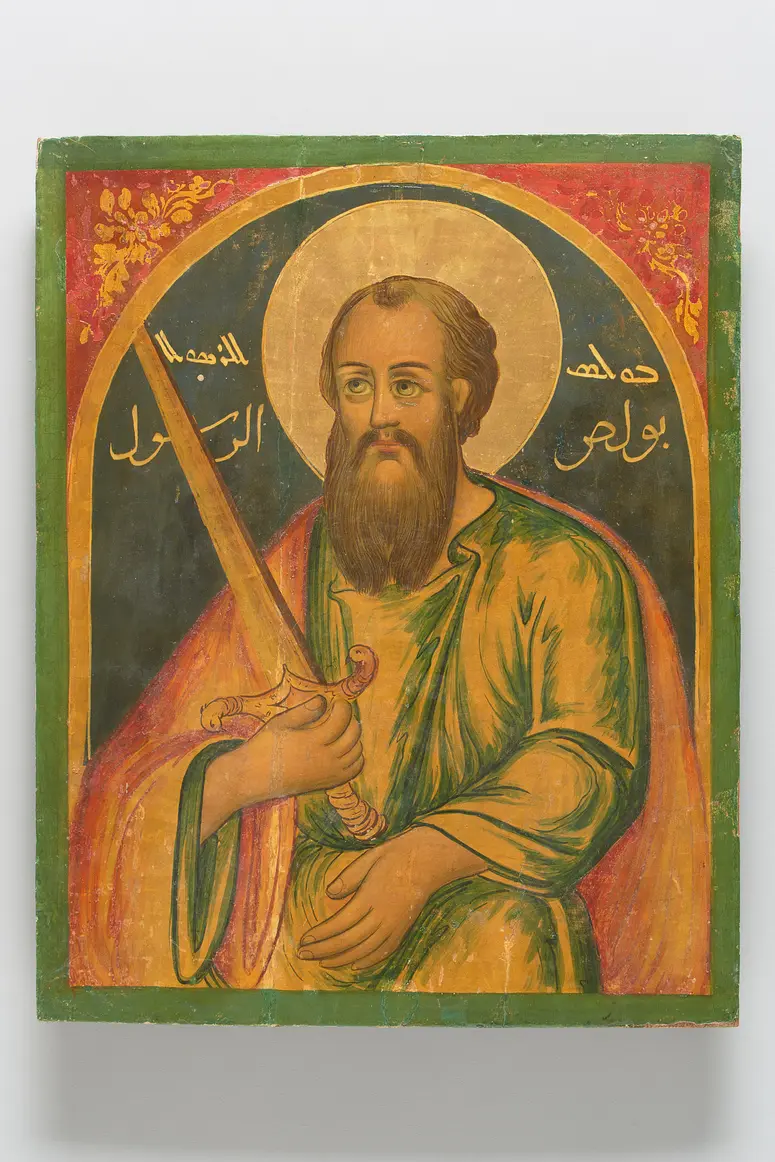
A famous heroic epic painted on glass is played out in Palestine in 1260. The great moment for the former slave, al-Malik az-Zahir Baibars, arrives when, during battle, he inflicts the first defeat on the Mongols and destroys the myth of their invincibility. In the same year, Baibars, by now Sultan of Egypt, begins to gradually shut down the final strongholds of the Christian crusaders in the Levant; not so much due to religious zeal, but rather to eradicate "the Franks" as a source of unrest. Essentially, this saviour of Islam would lend himself to religious warriors as an icon. In 2005, during the fasting month of Ramadan, the television series Al-Zahir Baybars is broadcast in Syria. The programme avoids, however, any religious instrumentalisation of the material. The image of the "clash of cultures" is not very helpful for an adequate description of complex historical circumstances. Given the religious furore in the Arabic world and beyond, the television series transmits a remarkable message: Muslims and Christians, in spite of their chequered and difficult historical relationship, are supporters of the same civilisation; both are called upon to contribute together to its continued existence.

A famous heroic epic painted on glass is played out in Palestine in 1260. The great moment for the former slave, al-Malik az-Zahir Baibars, arrives when, during battle, he inflicts the first defeat on the Mongols and destroys the myth of their invincibility. In the same year, Baibars, by now Sultan of Egypt, begins to gradually shut down the final strongholds of the Christian crusaders in the Levant; not so much due to religious zeal, but rather to eradicate "the Franks" as a source of unrest. Essentially, this saviour of Islam would lend himself to religious warriors as an icon. In 2005, during the fasting month of Ramadan, the television series Al-Zahir Baybars is broadcast in Syria. The programme avoids, however, any religious instrumentalisation of the material. The image of the "clash of cultures" is not very helpful for an adequate description of complex historical circumstances. Given the religious furore in the Arabic world and beyond, the television series transmits a remarkable message: Muslims and Christians, in spite of their chequered and difficult historical relationship, are supporters of the same civilisation; both are called upon to contribute together to its continued existence.
Collector:
Franz Pernegger
Time:
ca. 1900
Entry Date:
1993
Object Name
Reverse painting on glass
Culture
Syria
Material/technology:
Glass, pigment, wood
Dimensions:
42 × 33 cm
Copyright
Weltmuseum Wien
Collection area
North Africa, Middle East, Central Asia and Siberia
Geography
Westasien/Vorderer Orient/Syrien
Invs.
174890