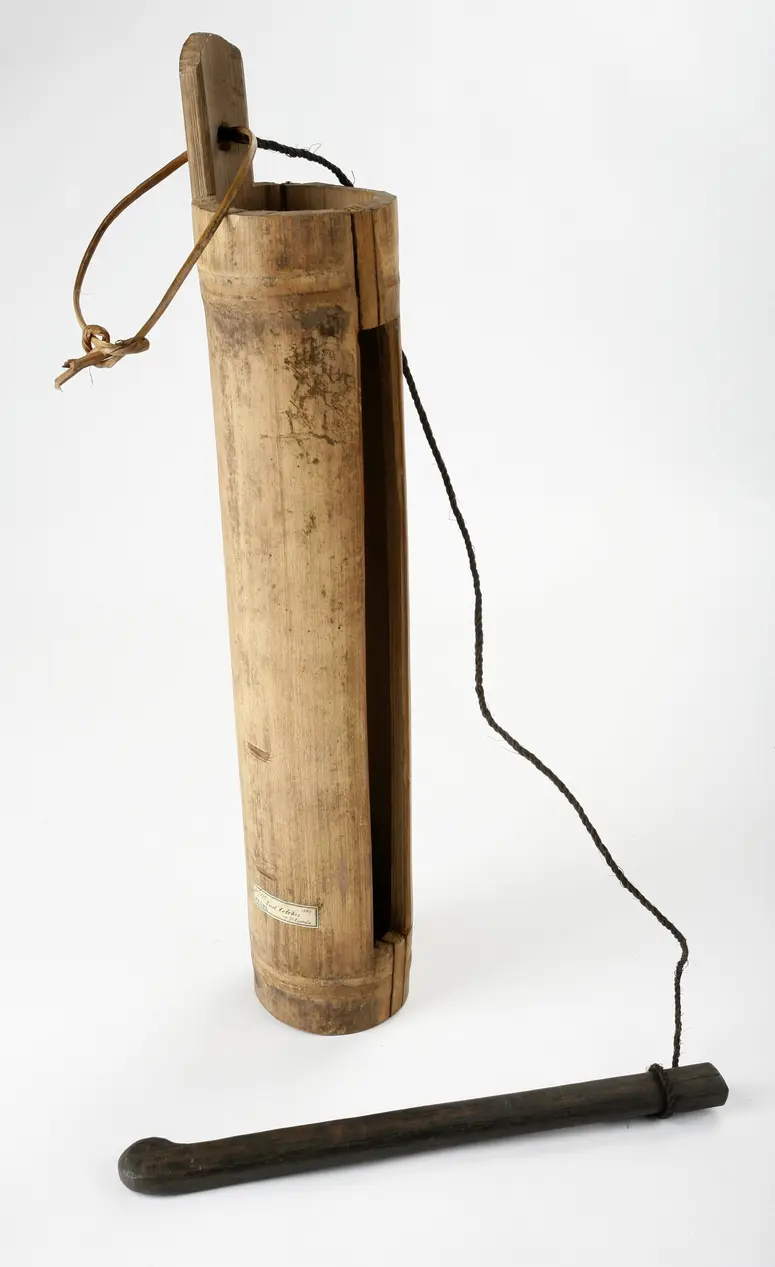
Alarm block
Tong-tong
Note: The following text is taken from a 19th-century collection catalog and, in its language and perspective, partially reflects colonial thought patterns. We present the text in its original version to make the collection's history transparent and promote a critical examination of the colonial legacy. Certain terms and formulations may be perceived as problematic today. A 2009 research project concluded that most descriptions are factually correct and still usable; only a few details were found to be inaccurate or incorrect. The results of this project were published in the following collection catalog: khm-wmw-tm-library.on.worldcat.org/oclc/1457155265"446. Alarm block - "Tong-tong"A hollowed-out block of wood, one meter long, twenty cm in diameter, which is hit with a wooden club. The sound of this wooden alarm is used throughout the Indian Archipelago. Such blocks hang either near the mosques, the houses of the chiefs, in squares or, where the Europeans live, near the police stations. Alarm is sounded when there is fire or other danger. In areas where there are Europeans the natives are required by forced service to stand watch at night in various places and there is also the guard-house with the "tong-tong" on which the watchmen have to strike the hours. The first signal of the hour begins at the apartment of the police official and runs from guard-house to guard-house through the whole town."Translation of: Czurda, F. A. J. (1883). Catalog mit Erklärungen der Etnografischen Privatsammlung des Dr. F. A. J. Czurda in Postelberg (Böhmen). (p. 103-104). Wien, Wilhelm Braumüller

Note: The following text is taken from a 19th-century collection catalog and, in its language and perspective, partially reflects colonial thought patterns. We present the text in its original version to make the collection's history transparent and promote a critical examination of the colonial legacy. Certain terms and formulations may be perceived as problematic today. A 2009 research project concluded that most descriptions are factually correct and still usable; only a few details were found to be inaccurate or incorrect. The results of this project were published in the following collection catalog: khm-wmw-tm-library.on.worldcat.org/oclc/1457155265"446. Alarm block - "Tong-tong"A hollowed-out block of wood, one meter long, twenty cm in diameter, which is hit with a wooden club. The sound of this wooden alarm is used throughout the Indian Archipelago. Such blocks hang either near the mosques, the houses of the chiefs, in squares or, where the Europeans live, near the police stations. Alarm is sounded when there is fire or other danger. In areas where there are Europeans the natives are required by forced service to stand watch at night in various places and there is also the guard-house with the "tong-tong" on which the watchmen have to strike the hours. The first signal of the hour begins at the apartment of the police official and runs from guard-house to guard-house through the whole town."Translation of: Czurda, F. A. J. (1883). Catalog mit Erklärungen der Etnografischen Privatsammlung des Dr. F. A. J. Czurda in Postelberg (Böhmen). (p. 103-104). Wien, Wilhelm Braumüller
Collector:
František A. J. Czurda (1844 Pisek - 1886 Cirebon) DNB
Entry Date:
1883
Object Name
Alarm block
Culture
Süd-Sulawesi
Material/technology:
Wood
Copyright
Weltmuseum Wien
Collection area
Insular Southeast Asia
Invs.
17691