Architrave
Papan (BI)
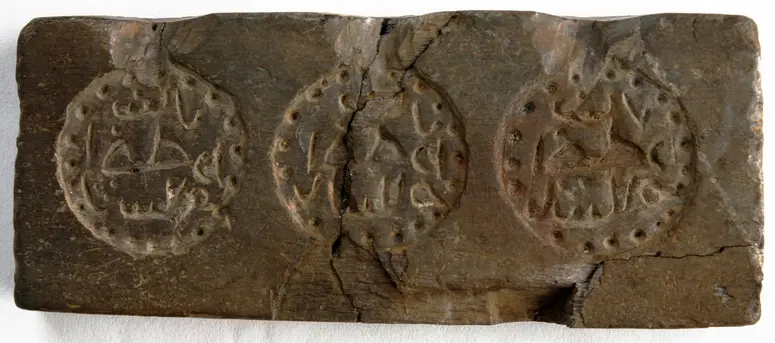
Note: The following text is taken from a 19th-century collection catalog and, in its language and perspective, partially reflects colonial thought patterns. We present the text in its original version to make the collection's history transparent and promote a critical examination of the colonial legacy. Certain terms and formulations may be perceived as problematic today. A 2009 research project concluded that most descriptions are factually correct and still usable; only a few details were found to be inaccurate or incorrect. The results of this project were published in the following collection catalog: khm-wmw-tm-library.on.worldcat.org/oclc/1457155265"439. Architrave A nicely carved heavy board of dense, hard wood, the so-called iron wood of the Indian Oak. This board, only a small part of the original length, forms the architrave, or lintel, that runs under the roof of the house which stands on stilts. Both the previously mentioned planks and also this board show the great skill in the artful working of wood. All these pieces were taken from a village which had been conquered and burned down by the Dutch troops and they were carried away by my servant. Wood carving is a favourite pastime of all the natives of the Indian Archipelago and is of great quality everywhere. One finds both buildings and all kinds of wood implements, and apartments often with the most beautiful carvings on all the islands and these are truly works of art and do not suffer at all from comparisons with European work. Carving itself is done with the most primitive of instruments, a common knife is enough."Translation of: Czurda, F. A. J. (1883). Catalog mit Erklärungen der Etnografischen Privatsammlung des Dr. F. A. J. Czurda in Postelberg (Böhmen). (p. 101). Wien, Wilhelm Braumüller
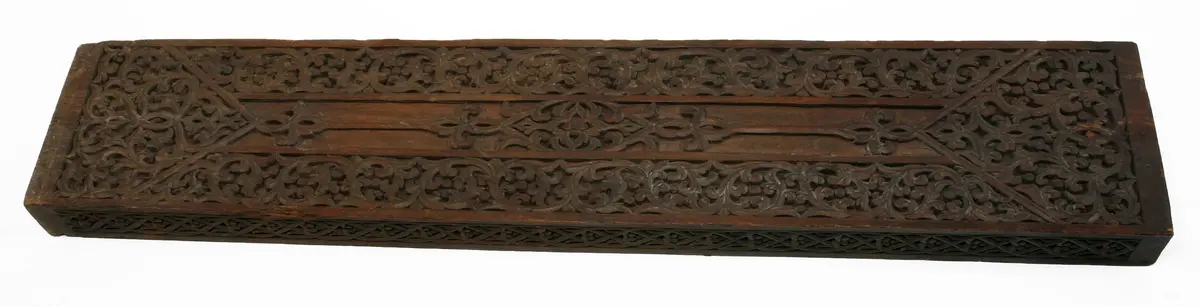
Note: The following text is taken from a 19th-century collection catalog and, in its language and perspective, partially reflects colonial thought patterns. We present the text in its original version to make the collection's history transparent and promote a critical examination of the colonial legacy. Certain terms and formulations may be perceived as problematic today. A 2009 research project concluded that most descriptions are factually correct and still usable; only a few details were found to be inaccurate or incorrect. The results of this project were published in the following collection catalog: khm-wmw-tm-library.on.worldcat.org/oclc/1457155265"439. Architrave A nicely carved heavy board of dense, hard wood, the so-called iron wood of the Indian Oak. This board, only a small part of the original length, forms the architrave, or lintel, that runs under the roof of the house which stands on stilts. Both the previously mentioned planks and also this board show the great skill in the artful working of wood. All these pieces were taken from a village which had been conquered and burned down by the Dutch troops and they were carried away by my servant. Wood carving is a favourite pastime of all the natives of the Indian Archipelago and is of great quality everywhere. One finds both buildings and all kinds of wood implements, and apartments often with the most beautiful carvings on all the islands and these are truly works of art and do not suffer at all from comparisons with European work. Carving itself is done with the most primitive of instruments, a common knife is enough."Translation of: Czurda, F. A. J. (1883). Catalog mit Erklärungen der Etnografischen Privatsammlung des Dr. F. A. J. Czurda in Postelberg (Böhmen). (p. 101). Wien, Wilhelm Braumüller
Collector:
František A. J. Czurda (1844 Pisek - 1886 Cirebon) DNB
Entry Date:
1883
Object Name
Architrave
Culture
Aceh
Material/technology:
Wood; carved
Copyright
Weltmuseum Wien
Collection area
Insular Southeast Asia
Invs.
18083