Blunderbuss
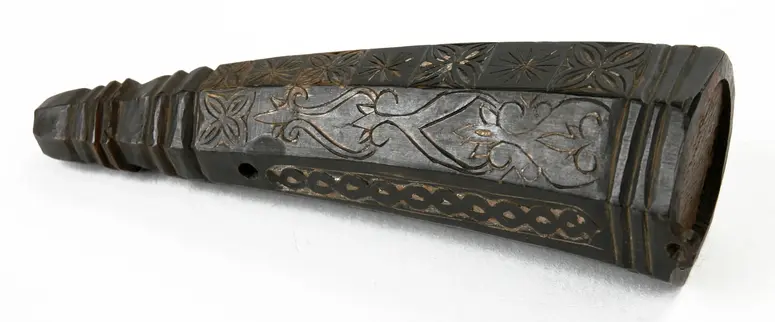
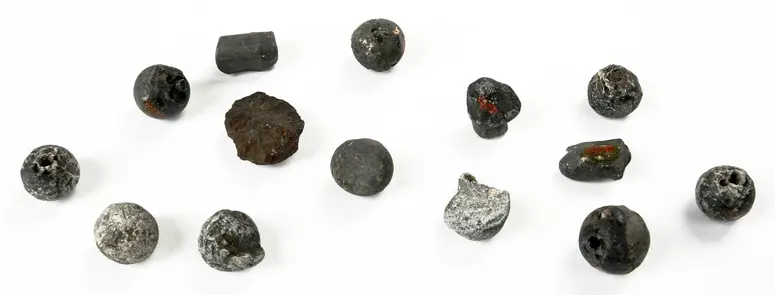
Note: The following text is taken from a 19th-century collection catalog and, in its language and perspective, partially reflects colonial thought patterns. We present the text in its original version to make the collection's history transparent and promote a critical examination of the colonial legacy. Certain terms and formulations may be perceived as problematic today. A 2009 research project concluded that most descriptions are factually correct and still usable; only a few details were found to be inaccurate or incorrect. The results of this project were published in the following collection catalog: khm-wmw-tm-library.on.worldcat.org/oclc/1457155265"126. Blunderbuss The European blunderbuss is found in great numbers among the Acehnese. They all come from the English arsenal and are marked with the crown and the trademark "Dower". The English sell all their old firearms: cannon, blunderbusses and percussion guns to the different warring peoples of Asia, primarily those of the East Indian Archipelago. On Aceh there are thousands of such old English firearms which were bought by the natives in Singapore and Penang in the Straits of Malacca. Despite the strict prohibition from the English Government against the sale of weapons to the Acehnese, who are waging war against Holland, a nation which is friendly to England, and despite a tight blockade of all the coasts of Aceh by the Dutch, the English merchants and the Acehnese know how to smuggle these old irons in sizeable numbers. The blunderbusses, all flintlocks, similar to the cannons, which are for the most part old ships cannons, are all loaded up to the mouth with pieces of lead and iron and often there is so much gunpowder used that these firearms are more dangerous to the gunner than to the enemy and it is not rare that the Acehnese are found dead alongside their exploded weapons."Translation of: Czurda, F. A. J. (1883). Catalog mit Erklärungen der Etnografischen Privatsammlung des Dr. F. A. J. Czurda in Postelberg (Böhmen). (p. 29). Wien, Wilhelm Braumüller
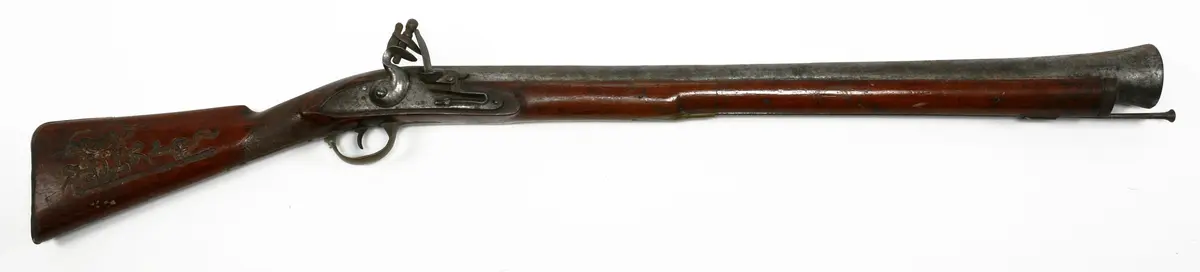
Note: The following text is taken from a 19th-century collection catalog and, in its language and perspective, partially reflects colonial thought patterns. We present the text in its original version to make the collection's history transparent and promote a critical examination of the colonial legacy. Certain terms and formulations may be perceived as problematic today. A 2009 research project concluded that most descriptions are factually correct and still usable; only a few details were found to be inaccurate or incorrect. The results of this project were published in the following collection catalog: khm-wmw-tm-library.on.worldcat.org/oclc/1457155265"126. Blunderbuss The European blunderbuss is found in great numbers among the Acehnese. They all come from the English arsenal and are marked with the crown and the trademark "Dower". The English sell all their old firearms: cannon, blunderbusses and percussion guns to the different warring peoples of Asia, primarily those of the East Indian Archipelago. On Aceh there are thousands of such old English firearms which were bought by the natives in Singapore and Penang in the Straits of Malacca. Despite the strict prohibition from the English Government against the sale of weapons to the Acehnese, who are waging war against Holland, a nation which is friendly to England, and despite a tight blockade of all the coasts of Aceh by the Dutch, the English merchants and the Acehnese know how to smuggle these old irons in sizeable numbers. The blunderbusses, all flintlocks, similar to the cannons, which are for the most part old ships cannons, are all loaded up to the mouth with pieces of lead and iron and often there is so much gunpowder used that these firearms are more dangerous to the gunner than to the enemy and it is not rare that the Acehnese are found dead alongside their exploded weapons."Translation of: Czurda, F. A. J. (1883). Catalog mit Erklärungen der Etnografischen Privatsammlung des Dr. F. A. J. Czurda in Postelberg (Böhmen). (p. 29). Wien, Wilhelm Braumüller
Collector:
František A. J. Czurda (1844 Pisek - 1886 Cirebon) DNB
Entry Date:
1883
Object Name
Blunderbuss
Culture
Aceh
Material/technology:
Wood, iron
Copyright
Weltmuseum Wien
Collection area
Insular Southeast Asia
Invs.
18060