Bamboo zither
Gesokesong (B); Ganrang Bulo (M)
Note: The following text is taken from a 19th-century collection catalog and, in its language and perspective, partially reflects colonial thought patterns. We present the text in its original version to make the collection's history transparent and promote a critical examination of the colonial legacy. Certain terms and formulations may be perceived as problematic today. A 2009 research project concluded that most descriptions are factually correct and still usable; only a few details were found to be inaccurate or incorrect. The results of this project were published in the following collection catalog: khm-wmw-tm-library.on.worldcat.org/oclc/1457155265"453. Violin - "Gesokesong"A very interesting instrument which I found only in the interior of Celebes and which is evidence of the great inventiveness of the natives. On a bamboo tube about half a meter long some strings have been stretched across small bridges on the surface. These strings, however, are all made from one piece of the bamboo itself. Cuts are made lengthwise into the still-green uppermost layer of the bamboo tube so that one can lift up the thin strands which, since the bamboo is still green and elastic, can be stretched across the already mentioned bridges. That is, the bridges are shoved under these cut, natural strings. When the whole thing dries after a time, not only will the bamboo pole resonate but also these unique strings are tightened and produce, when they are bowed or plucked with the fingers, rather good tones. Since such an instrument has both long and short strings, rather pleasant - at least for the ears of the natives - nice sounding music can be produced."Translation of: Czurda, F. A. J. (1883). Catalog mit Erklärungen der Etnografischen Privatsammlung des Dr. F. A. J. Czurda in Postelberg (Böhmen). (p. 107-108). Wien, Wilhelm Braumüller
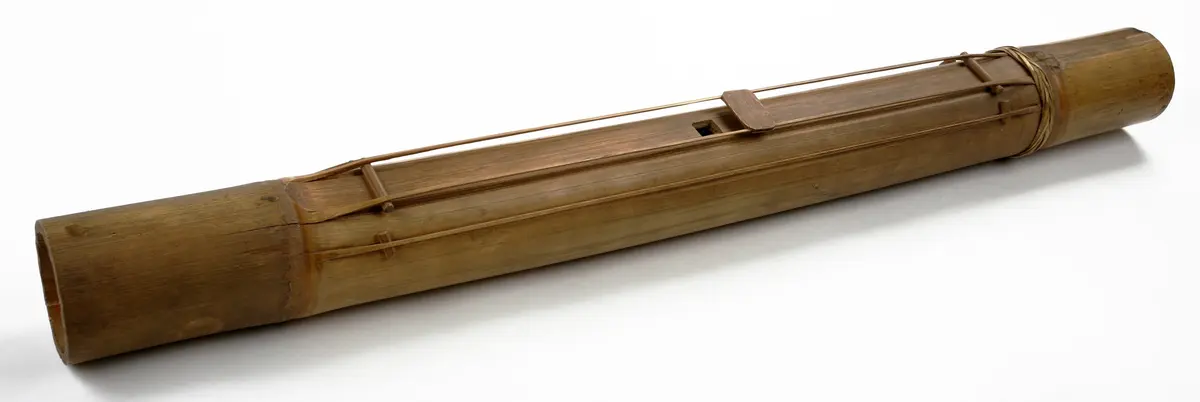
Note: The following text is taken from a 19th-century collection catalog and, in its language and perspective, partially reflects colonial thought patterns. We present the text in its original version to make the collection's history transparent and promote a critical examination of the colonial legacy. Certain terms and formulations may be perceived as problematic today. A 2009 research project concluded that most descriptions are factually correct and still usable; only a few details were found to be inaccurate or incorrect. The results of this project were published in the following collection catalog: khm-wmw-tm-library.on.worldcat.org/oclc/1457155265"453. Violin - "Gesokesong"A very interesting instrument which I found only in the interior of Celebes and which is evidence of the great inventiveness of the natives. On a bamboo tube about half a meter long some strings have been stretched across small bridges on the surface. These strings, however, are all made from one piece of the bamboo itself. Cuts are made lengthwise into the still-green uppermost layer of the bamboo tube so that one can lift up the thin strands which, since the bamboo is still green and elastic, can be stretched across the already mentioned bridges. That is, the bridges are shoved under these cut, natural strings. When the whole thing dries after a time, not only will the bamboo pole resonate but also these unique strings are tightened and produce, when they are bowed or plucked with the fingers, rather good tones. Since such an instrument has both long and short strings, rather pleasant - at least for the ears of the natives - nice sounding music can be produced."Translation of: Czurda, F. A. J. (1883). Catalog mit Erklärungen der Etnografischen Privatsammlung des Dr. F. A. J. Czurda in Postelberg (Böhmen). (p. 107-108). Wien, Wilhelm Braumüller
Collector:
František A. J. Czurda (1844 Pisek - 1886 Cirebon) DNB
Entry Date:
1883
Object Name
Bamboo zither
Culture
Süd-Sulawesi, Mallasoro
Material/technology:
Bamboo
Copyright
Weltmuseum Wien
Collection area
Insular Southeast Asia
Invs.
17698