Box
Katumbu
Note: The following text is taken from a 19th-century collection catalog and, in its language and perspective, partially reflects colonial thought patterns. We present the text in its original version to make the collection's history transparent and promote a critical examination of the colonial legacy. Certain terms and formulations may be perceived as problematic today. A 2009 research project concluded that most descriptions are factually correct and still usable; only a few details were found to be inaccurate or incorrect. The results of this project were published in the following collection catalog: khm-wmw-tm-library.on.worldcat.org/oclc/1457155265"187-190. Boxes - "Katumbu".Four boxes, or chests, with lockable lids, for the storage of clothes. They are of different sizes, but all of the same shape and decreasing in size so that they can be nestled one inside the next. They are very artful and in good taste and made by fastening large leaves and bast from trees together. The edges and corners are stiffened by reeds having been woven in so that even a very light chest can achieve a high degree of strength. The inside is lined with narrow palm leaves which are un-dyed straw-yellow, while the outside, made of wood-bast and large leaves, is painted red, black, and yellow. One side is decorated with figures which are formed from little white sea shells which have been appliquéd. These boxes are usually stacked one atop the other in a pyramid so that the side decorated with the shells shows to the front. The completely removable cover is a very solidly worked beading."Translation of: Czurda, F. A. J. (1883). Catalog mit Erklärungen der Etnografischen Privatsammlung des Dr. F. A. J. Czurda in Postelberg (Böhmen). (p. 46). Wien, Wilhelm Braumüller
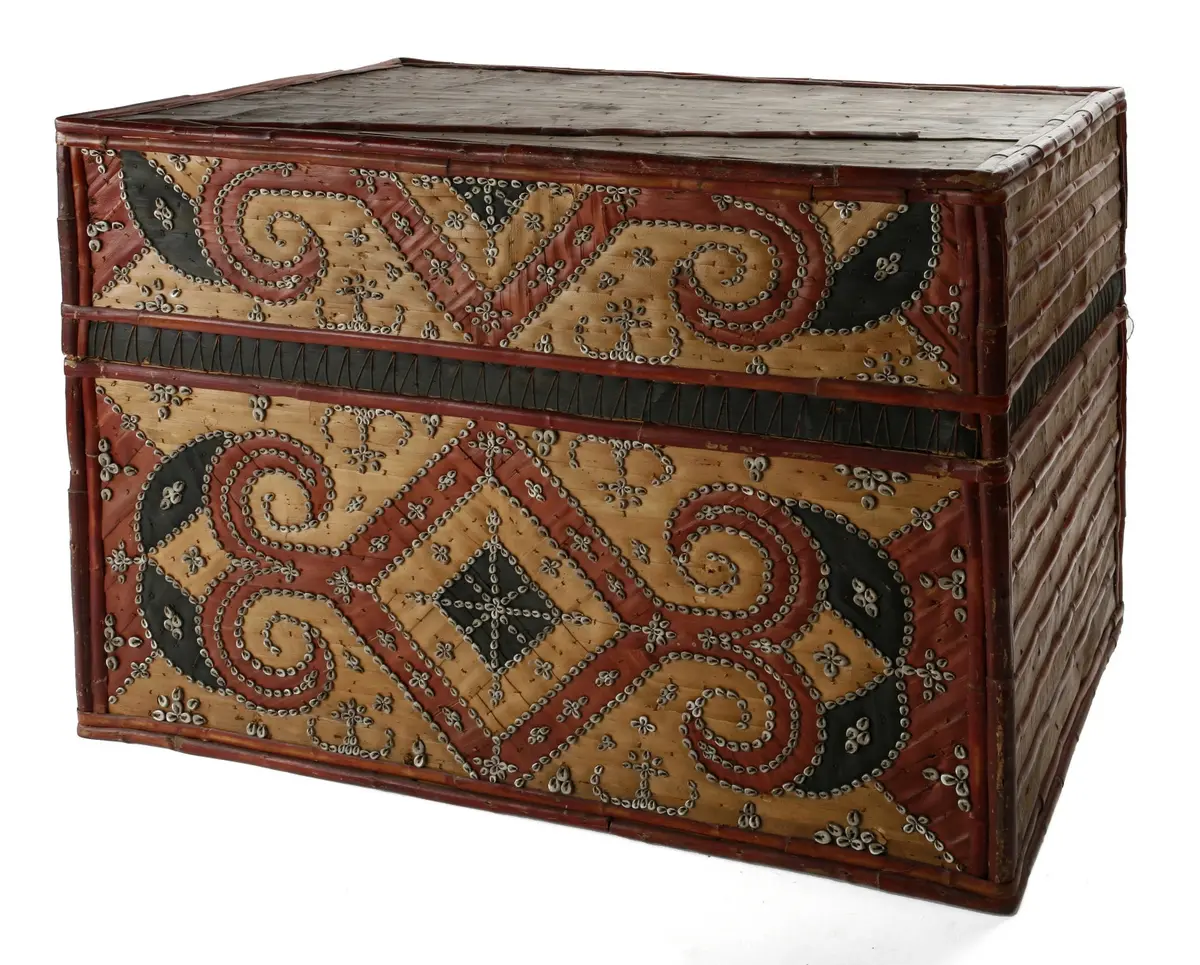
Note: The following text is taken from a 19th-century collection catalog and, in its language and perspective, partially reflects colonial thought patterns. We present the text in its original version to make the collection's history transparent and promote a critical examination of the colonial legacy. Certain terms and formulations may be perceived as problematic today. A 2009 research project concluded that most descriptions are factually correct and still usable; only a few details were found to be inaccurate or incorrect. The results of this project were published in the following collection catalog: khm-wmw-tm-library.on.worldcat.org/oclc/1457155265"187-190. Boxes - "Katumbu".Four boxes, or chests, with lockable lids, for the storage of clothes. They are of different sizes, but all of the same shape and decreasing in size so that they can be nestled one inside the next. They are very artful and in good taste and made by fastening large leaves and bast from trees together. The edges and corners are stiffened by reeds having been woven in so that even a very light chest can achieve a high degree of strength. The inside is lined with narrow palm leaves which are un-dyed straw-yellow, while the outside, made of wood-bast and large leaves, is painted red, black, and yellow. One side is decorated with figures which are formed from little white sea shells which have been appliquéd. These boxes are usually stacked one atop the other in a pyramid so that the side decorated with the shells shows to the front. The completely removable cover is a very solidly worked beading."Translation of: Czurda, F. A. J. (1883). Catalog mit Erklärungen der Etnografischen Privatsammlung des Dr. F. A. J. Czurda in Postelberg (Böhmen). (p. 46). Wien, Wilhelm Braumüller
Collector:
František A. J. Czurda (1844 Pisek - 1886 Cirebon) DNB
Entry Date:
1883
Object Name
Box
Culture
Molukken
Material/technology:
Rattan, reed, painted palm leaves, seashells; woven
Copyright
Weltmuseum Wien
Collection area
Insular Southeast Asia
Invs.
17438