Chain mail
Waju-rante
Note: The following text is taken from a 19th-century collection catalog and, in its language and perspective, partially reflects colonial thought patterns. We present the text in its original version to make the collection's history transparent and promote a critical examination of the colonial legacy. Certain terms and formulations may be perceived as problematic today. A 2009 research project concluded that most descriptions are factually correct and still usable; only a few details were found to be inaccurate or incorrect. The results of this project were published in the following collection catalog: khm-wmw-tm-library.on.worldcat.org/oclc/1457155265"94. Coat of mail - Wadju-rante.A mail jacket of small copper rings, very artfully and delicately made, similar to European shirts of mail. This jacket is only worn by noble persons in battle and also only made by blood relatives of the prince; for centuries these have kept the art of making them as a sacred secret. The present jacket comes from a prince of the capital city of Goa, of the same-named Principality, close to the main city of South Celebes, Makassar. For a long time it was falsely believed that these were originally from the Portuguese and that they were copies of the European coats of mail. It has been proved, however, that these jackets were already native to Celebes when the Portuguese landed there the first time. It is very probable that this very interesting jacket came from Asia, to be precise, China, since the Chinese had already traded with the natives centuries before the Portuguese arrived; sometimes they visited Celebes, sometimes the bold Buginese seafarers called at Chinese ports. In this way the originals of the present copies came to the natives of Celebes."Translation of: Czurda, F. A. J. (1883). Catalog mit Erklärungen der Etnografischen Privatsammlung des Dr. F. A. J. Czurda in Postelberg (Böhmen). (p. 20-21). Wien, Wilhelm Braumüller
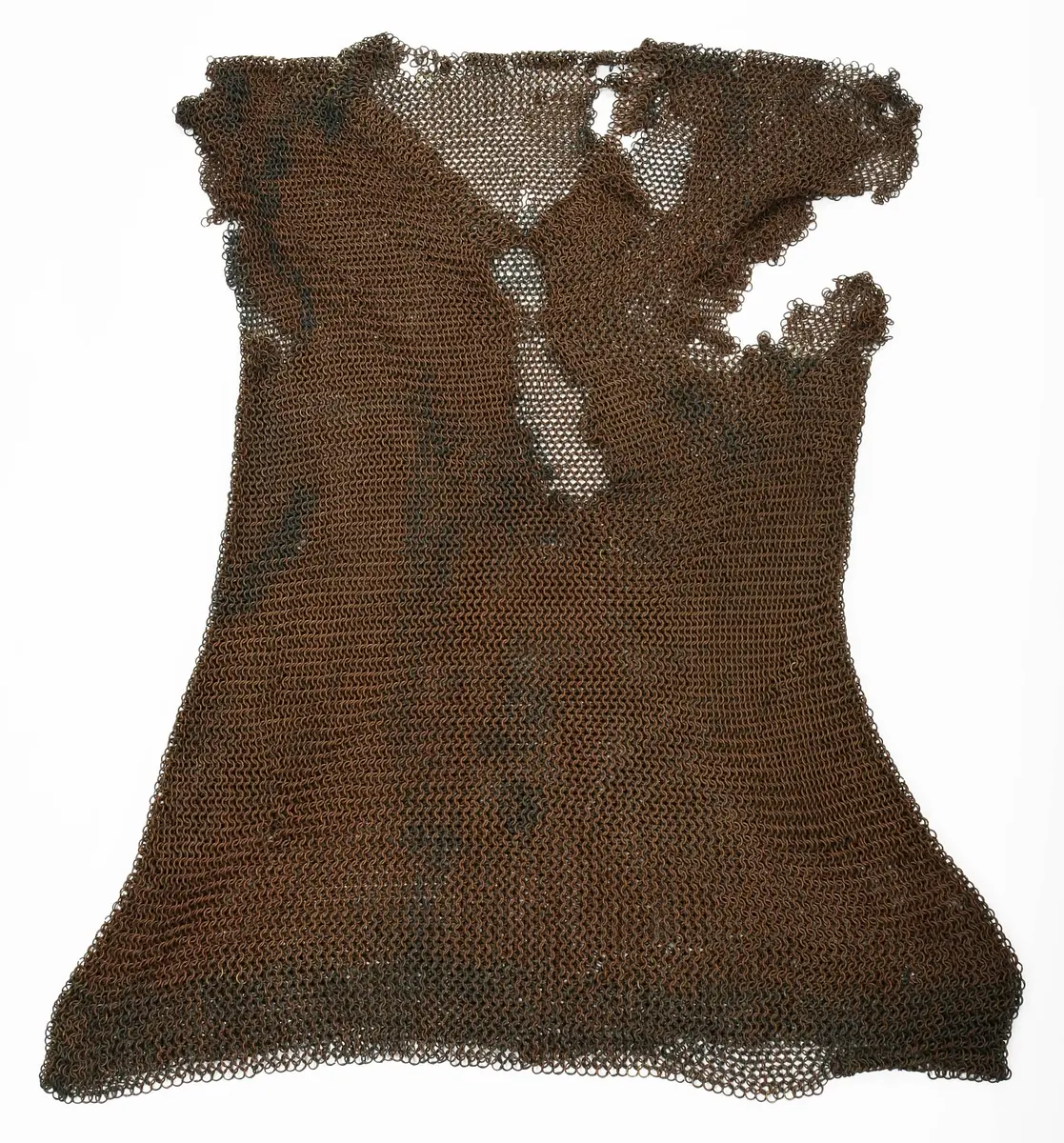
Note: The following text is taken from a 19th-century collection catalog and, in its language and perspective, partially reflects colonial thought patterns. We present the text in its original version to make the collection's history transparent and promote a critical examination of the colonial legacy. Certain terms and formulations may be perceived as problematic today. A 2009 research project concluded that most descriptions are factually correct and still usable; only a few details were found to be inaccurate or incorrect. The results of this project were published in the following collection catalog: khm-wmw-tm-library.on.worldcat.org/oclc/1457155265"94. Coat of mail - Wadju-rante.A mail jacket of small copper rings, very artfully and delicately made, similar to European shirts of mail. This jacket is only worn by noble persons in battle and also only made by blood relatives of the prince; for centuries these have kept the art of making them as a sacred secret. The present jacket comes from a prince of the capital city of Goa, of the same-named Principality, close to the main city of South Celebes, Makassar. For a long time it was falsely believed that these were originally from the Portuguese and that they were copies of the European coats of mail. It has been proved, however, that these jackets were already native to Celebes when the Portuguese landed there the first time. It is very probable that this very interesting jacket came from Asia, to be precise, China, since the Chinese had already traded with the natives centuries before the Portuguese arrived; sometimes they visited Celebes, sometimes the bold Buginese seafarers called at Chinese ports. In this way the originals of the present copies came to the natives of Celebes."Translation of: Czurda, F. A. J. (1883). Catalog mit Erklärungen der Etnografischen Privatsammlung des Dr. F. A. J. Czurda in Postelberg (Böhmen). (p. 20-21). Wien, Wilhelm Braumüller
Collector:
František A. J. Czurda (1844 Pisek - 1886 Cirebon) DNB
Entry Date:
1883
Object Name
Chain mail
Culture
Süd-Sulawesi, Gowa
Material/technology:
Iron
Copyright
Weltmuseum Wien
Collection area
Insular Southeast Asia
Invs.
17410