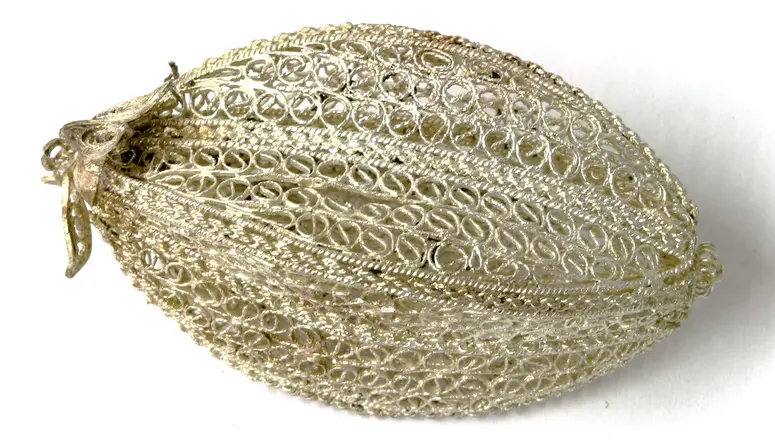
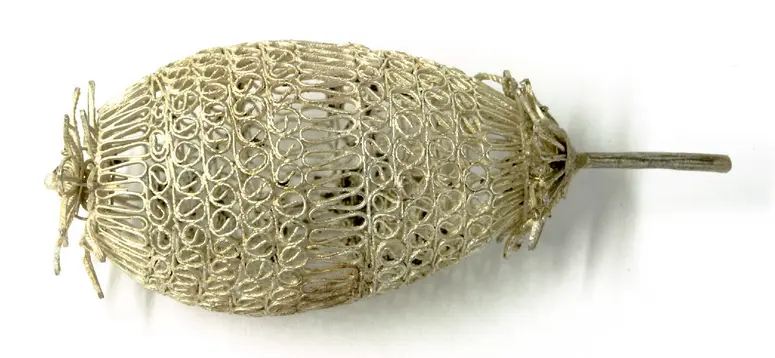
Ear plugs
Subang
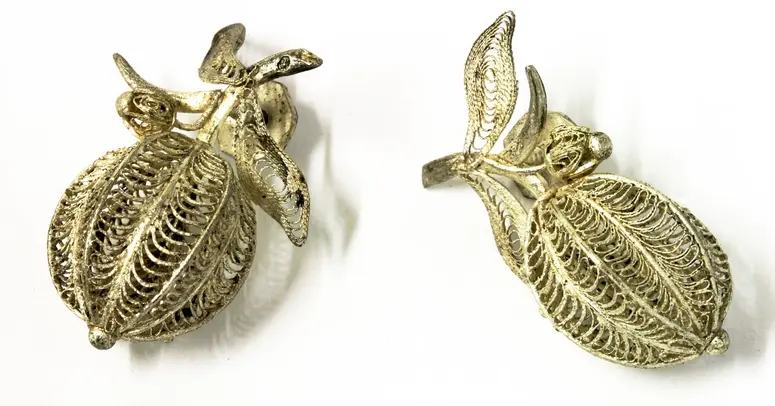
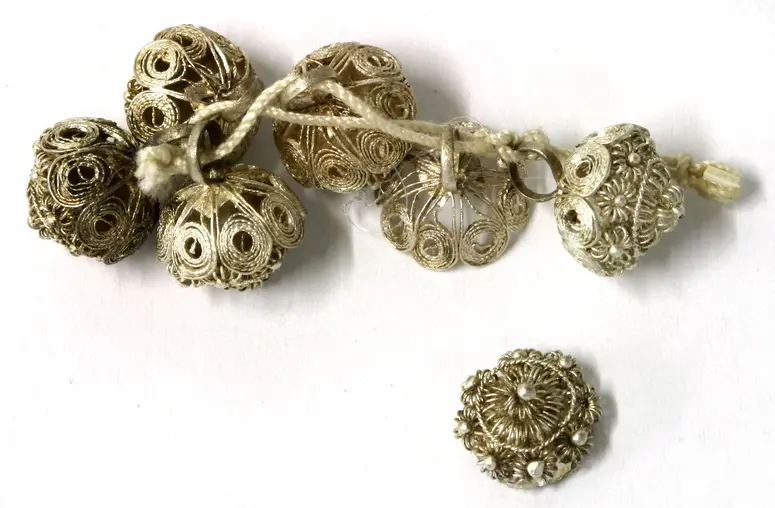
Note: The following text is taken from a 19th-century collection catalog and, in its language and perspective, partially reflects colonial thought patterns. We present the text in its original version to make the collection's history transparent and promote a critical examination of the colonial legacy. Certain terms and formulations may be perceived as problematic today. A 2009 research project concluded that most descriptions are factually correct and still usable; only a few details were found to be inaccurate or incorrect. The results of this project were published in the following collection catalog: khm-wmw-tm-library.on.worldcat.org/oclc/1457155265"708 - 709. Ear ornamentsTwo pairs of quite peculiarly shaped ear ornaments made of silver, with the shape of a cylinder. These large, button-shaped massive ear ornaments are entirely pushed through the earlobe opening, which must be large enough to hold the piece. These two examples are not even the largest. One finds on Sumatra and Borneo disc-shaped ear ornaments which are as large as a Thaler, and which are also inserted into the openings in the extended earlobes. To make the openings large enough to accept these objects, the elastic leaf of a plant which has been tightly rolled is pushed into a hole in the ear - which has been created by simply piercing the earlobe. The leaf constantly works like a spring to expand the opening and in a few weeks the opening is large enough that a new, larger leaf can be inserted with even more strength to further widen the opening. This procedure is continued until the desired size is reached to enable the piece of jewellery to be inserted. But since these ear ornaments of metal are rather heavy, the ear openings are extended more and more so that one must insert ever larger discs or cylinders until finally the whole earlobe is only a very thin ring of skin which hangs limp on the neck when there is no piece of jewellery in it."Translation of: Czurda, F. A. J. (1883). Catalog mit Erklärungen der Etnografischen Privatsammlung des Dr. F. A. J. Czurda in Postelberg (Böhmen). (p. 165). Wien, Wilhelm Braumüller
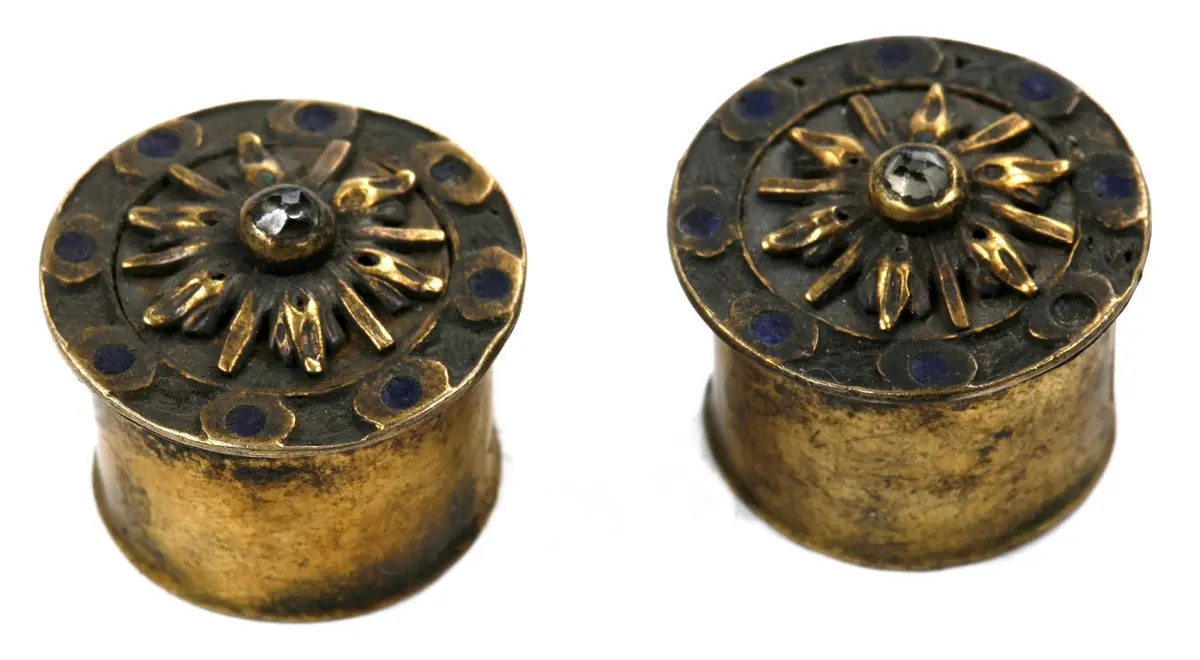
Note: The following text is taken from a 19th-century collection catalog and, in its language and perspective, partially reflects colonial thought patterns. We present the text in its original version to make the collection's history transparent and promote a critical examination of the colonial legacy. Certain terms and formulations may be perceived as problematic today. A 2009 research project concluded that most descriptions are factually correct and still usable; only a few details were found to be inaccurate or incorrect. The results of this project were published in the following collection catalog: khm-wmw-tm-library.on.worldcat.org/oclc/1457155265"708 - 709. Ear ornamentsTwo pairs of quite peculiarly shaped ear ornaments made of silver, with the shape of a cylinder. These large, button-shaped massive ear ornaments are entirely pushed through the earlobe opening, which must be large enough to hold the piece. These two examples are not even the largest. One finds on Sumatra and Borneo disc-shaped ear ornaments which are as large as a Thaler, and which are also inserted into the openings in the extended earlobes. To make the openings large enough to accept these objects, the elastic leaf of a plant which has been tightly rolled is pushed into a hole in the ear - which has been created by simply piercing the earlobe. The leaf constantly works like a spring to expand the opening and in a few weeks the opening is large enough that a new, larger leaf can be inserted with even more strength to further widen the opening. This procedure is continued until the desired size is reached to enable the piece of jewellery to be inserted. But since these ear ornaments of metal are rather heavy, the ear openings are extended more and more so that one must insert ever larger discs or cylinders until finally the whole earlobe is only a very thin ring of skin which hangs limp on the neck when there is no piece of jewellery in it."Translation of: Czurda, F. A. J. (1883). Catalog mit Erklärungen der Etnografischen Privatsammlung des Dr. F. A. J. Czurda in Postelberg (Böhmen). (p. 165). Wien, Wilhelm Braumüller
Collector:
František A. J. Czurda (1844 Pisek - 1886 Cirebon) DNB
Entry Date:
1883
Object Name
Ear plugs
Culture
West-Java
Material/technology:
Brass, gemstones
Copyright
Weltmuseum Wien
Collection area
Insular Southeast Asia
Invs.
18038