Knife
Bade-bade
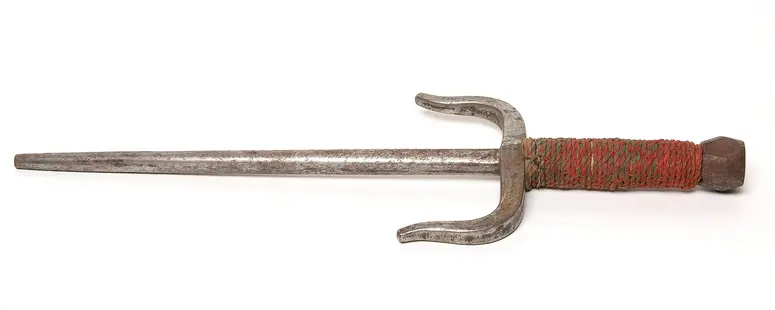
Note: The following text is taken from a 19th-century collection catalog and, in its language and perspective, partially reflects colonial thought patterns. We present the text in its original version to make the collection's history transparent and promote a critical examination of the colonial legacy. Certain terms and formulations may be perceived as problematic today. A 2009 research project concluded that most descriptions are factually correct and still usable; only a few details were found to be inaccurate or incorrect. The results of this project were published in the following collection catalog: khm-wmw-tm-library.on.worldcat.org/oclc/1457155265"100. Knife - "Bade-bade".This type of knife has a straight blade which is equally wide top to bottom, compared to the similar knives of the Buginese and Makassars. The hilt is bent at a blunt angle away from the cutting edge of the blade. This knife, much lighter than those of the Buginese, are not so much for work as for use as a weapon or as an ornament and are worn in the belt alongside the kris; also worn by privileged women. The present knife has a black hilt of horn, the sheath is of wood, decorated with wide silver rings. The upper and lower ends of this have a simple horn edging."Translation of: Czurda, F. A. J. (1883). Catalog mit Erklärungen der Etnografischen Privatsammlung des Dr. F. A. J. Czurda in Postelberg (Böhmen). (p. 22). Wien, Wilhelm Braumüller
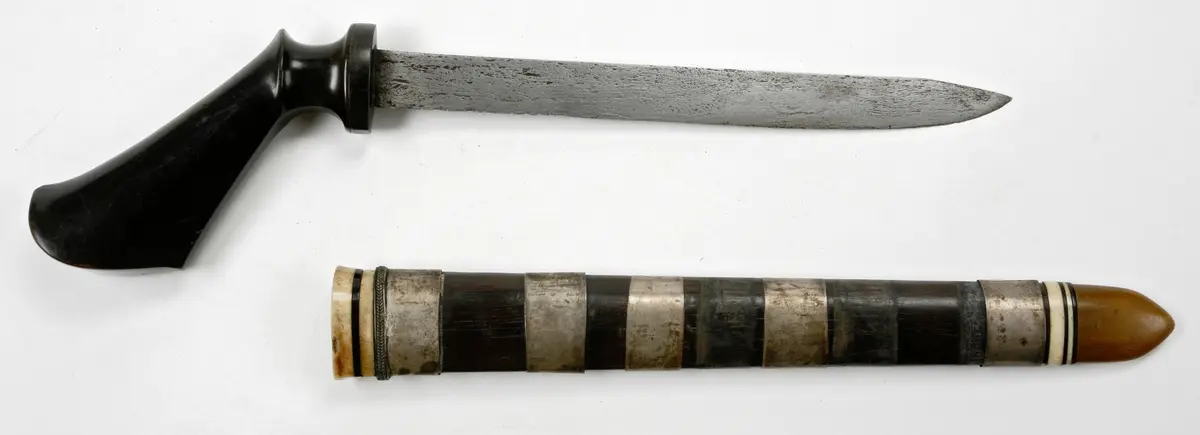
Note: The following text is taken from a 19th-century collection catalog and, in its language and perspective, partially reflects colonial thought patterns. We present the text in its original version to make the collection's history transparent and promote a critical examination of the colonial legacy. Certain terms and formulations may be perceived as problematic today. A 2009 research project concluded that most descriptions are factually correct and still usable; only a few details were found to be inaccurate or incorrect. The results of this project were published in the following collection catalog: khm-wmw-tm-library.on.worldcat.org/oclc/1457155265"100. Knife - "Bade-bade".This type of knife has a straight blade which is equally wide top to bottom, compared to the similar knives of the Buginese and Makassars. The hilt is bent at a blunt angle away from the cutting edge of the blade. This knife, much lighter than those of the Buginese, are not so much for work as for use as a weapon or as an ornament and are worn in the belt alongside the kris; also worn by privileged women. The present knife has a black hilt of horn, the sheath is of wood, decorated with wide silver rings. The upper and lower ends of this have a simple horn edging."Translation of: Czurda, F. A. J. (1883). Catalog mit Erklärungen der Etnografischen Privatsammlung des Dr. F. A. J. Czurda in Postelberg (Böhmen). (p. 22). Wien, Wilhelm Braumüller
Collector:
František A. J. Czurda (1844 Pisek - 1886 Cirebon) DNB
Entry Date:
1883
Object Name
Knife
Culture
Ost-Java
Material/technology:
Iron, horn, sheath: wood, iron, silver
Copyright
Weltmuseum Wien
Collection area
Insular Southeast Asia
Invs.
17930