Loom
Alat tenun (BI)
Note: The following text is taken from a 19th-century collection catalog and, in its language and perspective, partially reflects colonial thought patterns. We present the text in its original version to make the collection's history transparent and promote a critical examination of the colonial legacy. Certain terms and formulations may be perceived as problematic today. A 2009 research project concluded that most descriptions are factually correct and still usable; only a few details were found to be inaccurate or incorrect. The results of this project were published in the following collection catalog: khm-wmw-tm-library.on.worldcat.org/oclc/1457155265"526. LoomThe Indian loom, in which form it is to be found in use in nearly all of the Indian Archipelago, is a rather primitive implement. The yarn or the silk for the weaving is rolled up on a board of about one meter in length, in the width of the piece to be woven. This board is stuck at its ends in two heavy wooden blocks which are fastened in some way to the floor of the house. From this board the yarn runs through a rake-like apparatus in which each strand of yarn is held separately. In front of and behind this rake there are, between the threads, and in the way the design requires, meter-long slats inserted which are pulled out when the threads cross each other and are then reinserted. The finished woven piece is wrapped around another meter-long board and this and the whole thing is stretched by means of a bent yoke-shaped piece of wood which is stretched by the woman who has it on her back, sitting on the floor in front of her loom, so that the leaning back of the body causes the whole apparatus to go taught; when she leans forward the whole thing goes slack. In front of the rake, mentioned above, through which the threads run, there is still another cross-slat which has as many little loops as there are threads and through which the threads of the cloth also run. By raising this slat it is possible to raise the threads and thus control the act of weaving, primarily the throwing-through of the weaving bobbin.Weaving is done exclusively by the women, and every woman knows how to weave whether she is high born or low, and weaving is done in every house; there is a loom in every house. Everything the family needs in clothing must be woven by the women of the house. If more is made than needed then this cloth is taken to the market. The present loom is in use in West Java, the so-called Sunda Lands. The cloths that the women weave are known for their strength; they usually have a colorful plaid pattern, dominated by green and red."Translation of: Czurda, F. A. J. (1883). Catalog mit Erklärungen der Etnografischen Privatsammlung des Dr. F. A. J. Czurda in Postelberg (Böhmen). (p. 134-135). Wien, Wilhelm Braumüller
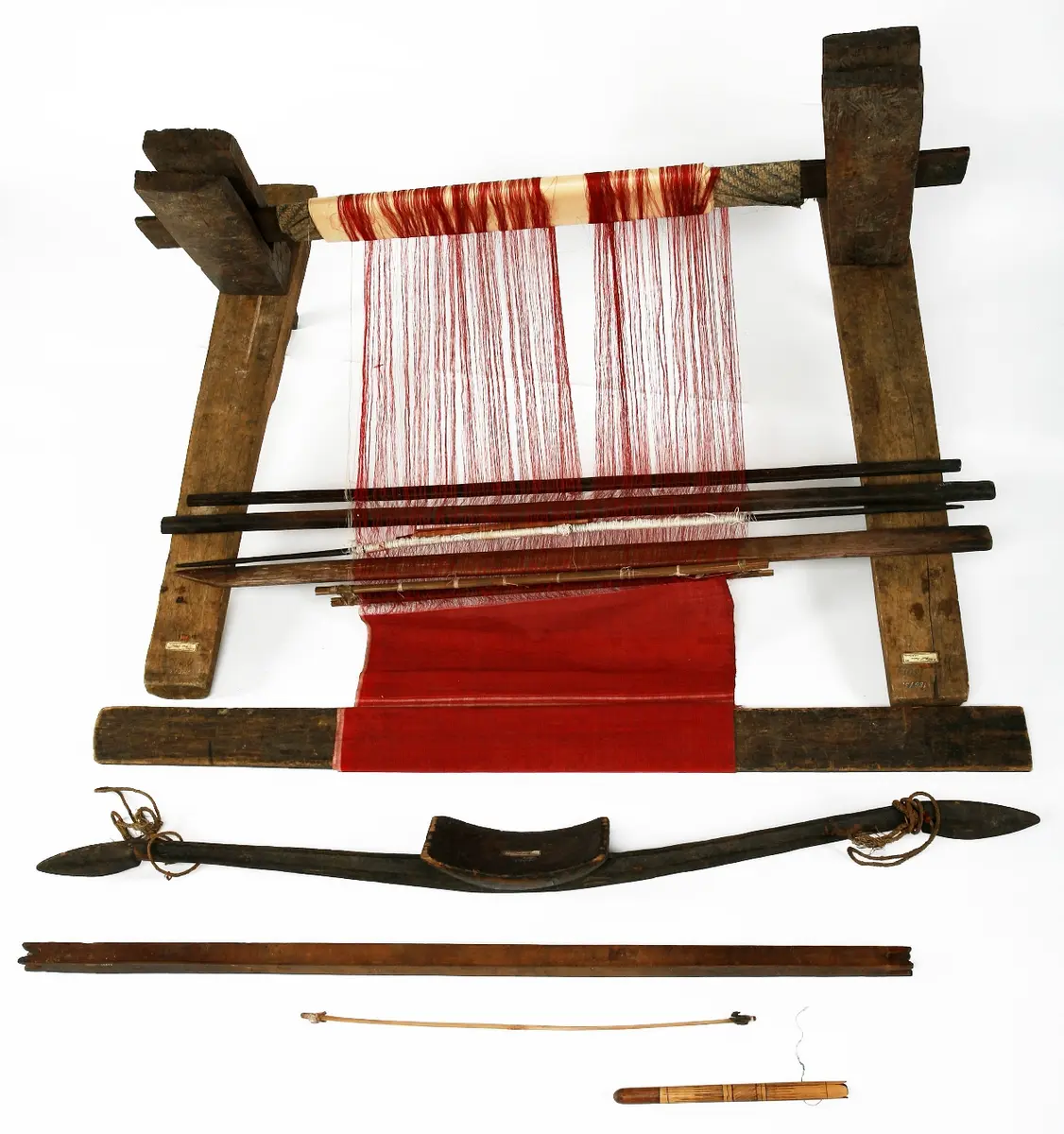
Note: The following text is taken from a 19th-century collection catalog and, in its language and perspective, partially reflects colonial thought patterns. We present the text in its original version to make the collection's history transparent and promote a critical examination of the colonial legacy. Certain terms and formulations may be perceived as problematic today. A 2009 research project concluded that most descriptions are factually correct and still usable; only a few details were found to be inaccurate or incorrect. The results of this project were published in the following collection catalog: khm-wmw-tm-library.on.worldcat.org/oclc/1457155265"526. LoomThe Indian loom, in which form it is to be found in use in nearly all of the Indian Archipelago, is a rather primitive implement. The yarn or the silk for the weaving is rolled up on a board of about one meter in length, in the width of the piece to be woven. This board is stuck at its ends in two heavy wooden blocks which are fastened in some way to the floor of the house. From this board the yarn runs through a rake-like apparatus in which each strand of yarn is held separately. In front of and behind this rake there are, between the threads, and in the way the design requires, meter-long slats inserted which are pulled out when the threads cross each other and are then reinserted. The finished woven piece is wrapped around another meter-long board and this and the whole thing is stretched by means of a bent yoke-shaped piece of wood which is stretched by the woman who has it on her back, sitting on the floor in front of her loom, so that the leaning back of the body causes the whole apparatus to go taught; when she leans forward the whole thing goes slack. In front of the rake, mentioned above, through which the threads run, there is still another cross-slat which has as many little loops as there are threads and through which the threads of the cloth also run. By raising this slat it is possible to raise the threads and thus control the act of weaving, primarily the throwing-through of the weaving bobbin.Weaving is done exclusively by the women, and every woman knows how to weave whether she is high born or low, and weaving is done in every house; there is a loom in every house. Everything the family needs in clothing must be woven by the women of the house. If more is made than needed then this cloth is taken to the market. The present loom is in use in West Java, the so-called Sunda Lands. The cloths that the women weave are known for their strength; they usually have a colorful plaid pattern, dominated by green and red."Translation of: Czurda, F. A. J. (1883). Catalog mit Erklärungen der Etnografischen Privatsammlung des Dr. F. A. J. Czurda in Postelberg (Böhmen). (p. 134-135). Wien, Wilhelm Braumüller
Collector:
František A. J. Czurda (1844 Pisek - 1886 Cirebon) DNB
Entry Date:
1883
Object Name
Loom
Culture
West-Java
Material/technology:
Wood, cotton
Copyright
Weltmuseum Wien
Collection area
Insular Southeast Asia
Invs.
18013