Stove
Dapo
Note: The following text is taken from a 19th-century collection catalog and, in its language and perspective, partially reflects colonial thought patterns. We present the text in its original version to make the collection's history transparent and promote a critical examination of the colonial legacy. Certain terms and formulations may be perceived as problematic today. A 2009 research project concluded that most descriptions are factually correct and still usable; only a few details were found to be inaccurate or incorrect. The results of this project were published in the following collection catalog: khm-wmw-tm-library.on.worldcat.org/oclc/1457155265"162. Cooking stove - "Dapo".A peculiarly shaped stove of fired clay, only to be used with one large pot. A sort of long bowl, on one side round the other squared. The pot is set on the rounded part while the fire, usually wood or charcoal fire, is lit on the square part. In all of these types of stove some little bamboo tubes are used with which air can be blown into the fire from time to time. Only the women cook and this stove, that cannot be found in every house, replaces three equally high stones on which the pot is set and under which the fire is made. In most Buginese houses there is a separate cooking room where, on the flooring made of woven bamboo, there are stones for cooking which are set on a layer of sand or dirt so that the very flammable flooring does not catch fire. In the dry season when it does not rain the cooking is usually done outside, in front of the house."Translation of: Czurda, F. A. J. (1883). Catalog mit Erklärungen der Etnografischen Privatsammlung des Dr. F. A. J. Czurda in Postelberg (Böhmen). (p. 40). Wien, Wilhelm Braumüller
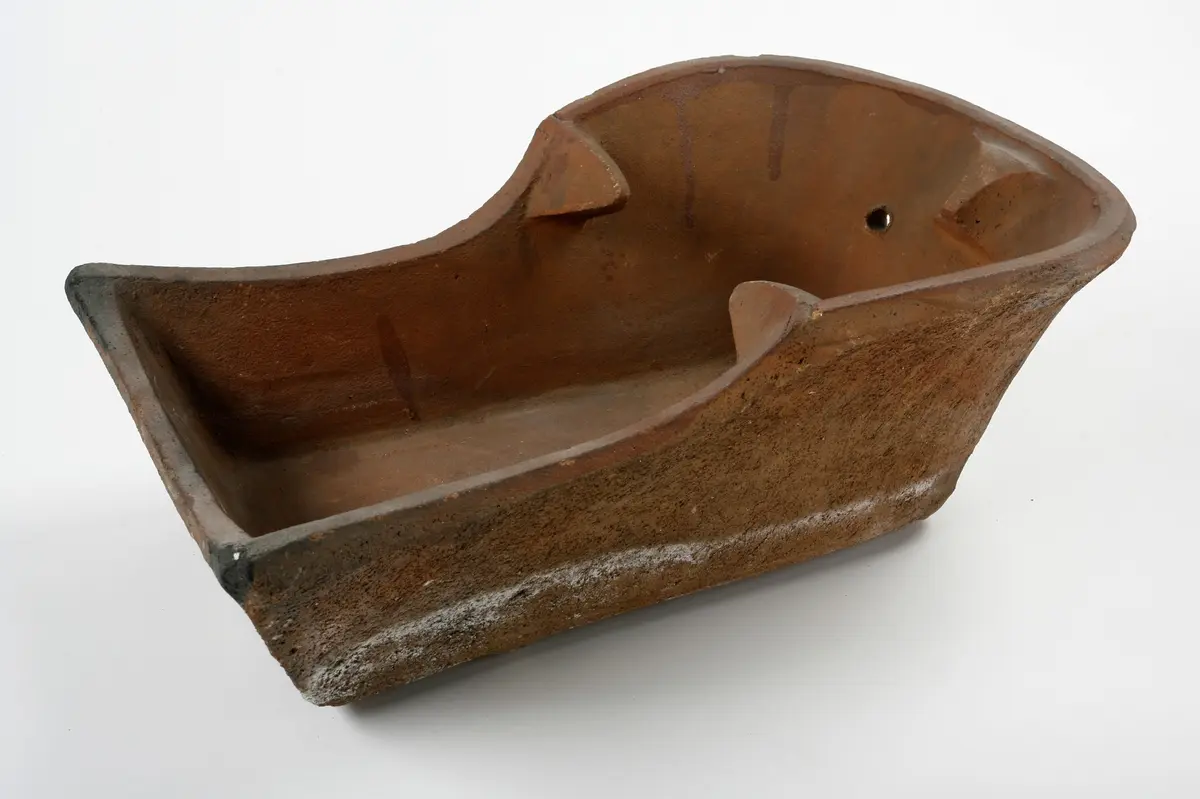
Note: The following text is taken from a 19th-century collection catalog and, in its language and perspective, partially reflects colonial thought patterns. We present the text in its original version to make the collection's history transparent and promote a critical examination of the colonial legacy. Certain terms and formulations may be perceived as problematic today. A 2009 research project concluded that most descriptions are factually correct and still usable; only a few details were found to be inaccurate or incorrect. The results of this project were published in the following collection catalog: khm-wmw-tm-library.on.worldcat.org/oclc/1457155265"162. Cooking stove - "Dapo".A peculiarly shaped stove of fired clay, only to be used with one large pot. A sort of long bowl, on one side round the other squared. The pot is set on the rounded part while the fire, usually wood or charcoal fire, is lit on the square part. In all of these types of stove some little bamboo tubes are used with which air can be blown into the fire from time to time. Only the women cook and this stove, that cannot be found in every house, replaces three equally high stones on which the pot is set and under which the fire is made. In most Buginese houses there is a separate cooking room where, on the flooring made of woven bamboo, there are stones for cooking which are set on a layer of sand or dirt so that the very flammable flooring does not catch fire. In the dry season when it does not rain the cooking is usually done outside, in front of the house."Translation of: Czurda, F. A. J. (1883). Catalog mit Erklärungen der Etnografischen Privatsammlung des Dr. F. A. J. Czurda in Postelberg (Böhmen). (p. 40). Wien, Wilhelm Braumüller
Collector:
František A. J. Czurda (1844 Pisek - 1886 Cirebon) DNB
Entry Date:
1883
Object Name
Stove
Culture
Süd-Sulawesi, Jeneponto
Material/technology:
Clay; fired
Copyright
Weltmuseum Wien
Collection area
Insular Southeast Asia
Invs.
17411