Sword
Sundang
Note: The following text is taken from a 19th-century collection catalog and, in its language and perspective, partially reflects colonial thought patterns. We present the text in its original version to make the collection's history transparent and promote a critical examination of the colonial legacy. Certain terms and formulations may be perceived as problematic today. A 2009 research project concluded that most descriptions are factually correct and still usable; only a few details were found to be inaccurate or incorrect. The results of this project were published in the following collection catalog: khm-wmw-tm-library.on.worldcat.org/oclc/1457155265"33. Sword.A short and wide two-edged, cut and thrust weapon, with a form similar to a Roman sword, whose blade, in contrast to those of the kalewangs, is as wide at the base as it is at the tip. On both surfaces of the wide, flat blade there is a groove running lengthwise into which, when it is in use, a poisonous plant juice is rubbed and then spreads across the whole surface and in this way poisons the wound. This weapon is not typical and was probably introduced by some other Asian folk. These are often found in Java among small robber bands which operate in the kingdom of Solokarta. The present weapon has a pretty, carved hilt of bone onto which a band of gold is wound around like a snake. In addition it also is decorated with a gold ring on the lower end, close to the blade. The blade rests in a simple wooden sheath which is painted black."Translation of: Czurda, F. A. J. (1883). Catalog mit Erklärungen der Etnografischen Privatsammlung des Dr. F. A. J. Czurda in Postelberg (Böhmen). (p. 5-6). Wien, Wilhelm Braumüller
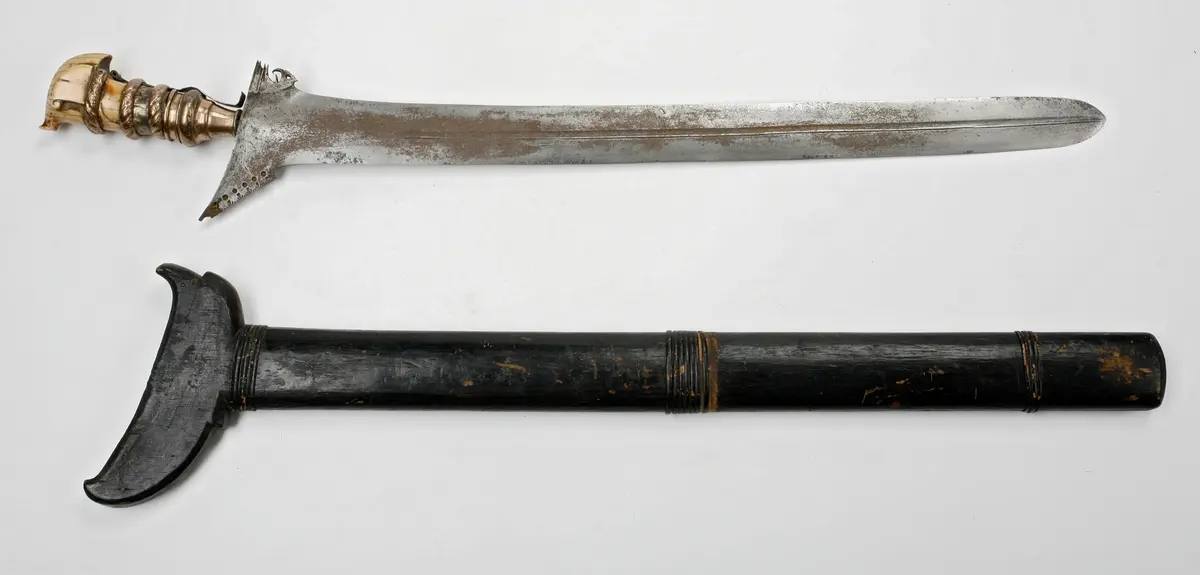
Note: The following text is taken from a 19th-century collection catalog and, in its language and perspective, partially reflects colonial thought patterns. We present the text in its original version to make the collection's history transparent and promote a critical examination of the colonial legacy. Certain terms and formulations may be perceived as problematic today. A 2009 research project concluded that most descriptions are factually correct and still usable; only a few details were found to be inaccurate or incorrect. The results of this project were published in the following collection catalog: khm-wmw-tm-library.on.worldcat.org/oclc/1457155265"33. Sword.A short and wide two-edged, cut and thrust weapon, with a form similar to a Roman sword, whose blade, in contrast to those of the kalewangs, is as wide at the base as it is at the tip. On both surfaces of the wide, flat blade there is a groove running lengthwise into which, when it is in use, a poisonous plant juice is rubbed and then spreads across the whole surface and in this way poisons the wound. This weapon is not typical and was probably introduced by some other Asian folk. These are often found in Java among small robber bands which operate in the kingdom of Solokarta. The present weapon has a pretty, carved hilt of bone onto which a band of gold is wound around like a snake. In addition it also is decorated with a gold ring on the lower end, close to the blade. The blade rests in a simple wooden sheath which is painted black."Translation of: Czurda, F. A. J. (1883). Catalog mit Erklärungen der Etnografischen Privatsammlung des Dr. F. A. J. Czurda in Postelberg (Böhmen). (p. 5-6). Wien, Wilhelm Braumüller
Collector:
František A. J. Czurda (1844 Pisek - 1886 Cirebon) DNB
Entry Date:
1883
Object Name
Sword
Culture
Sulawesi
Material/technology:
Iron; forged, horn, gold or brass, Sheath: wood, rattan, painted
Copyright
Weltmuseum Wien
Collection area
Insular Southeast Asia
Invs.
17349